Hello everyone,
I am working on a question regarding the dimensional stability of horizontal fire barriers made of steel sheet (1 mm) in ventilated curtain wall façades (VHF). I have measured temperature-time curves from a fire test (approximately 700–800 °C in the area of the fire barrier). I want to model this construction in RFEM 6 and investigate it computationally.
My questions:
-
Is it possible in RFEM 6 to perform a thermo-mechanical analysis (fire design) for surface or shell elements? Or is fire design exclusively limited to beam elements?
-
If surface elements are supported: How can a temperature field be applied to a shell element? Can a measured temperature-time curve from a fire test be used as an input?
-
Can the heat transfer coefficient (convection + radiation) be defined as temperature-dependent? Or must the steel temperature be specified directly?
-
Can the temperature-dependent material properties according to DIN EN 1993-1-2 (reduction factors for yield strength, proportional limit, and modulus of elasticity) be implemented as a nonlinear material law?
-
Is it possible to represent deformations under fire load and evaluate the resulting stresses?
-
If this is not possible in RFEM 6 for surface elements: Which program would you recommend? Are there any experiences at Dlubal from research projects with comparable tasks?
Thank you very much in advance!
Hi ÜnalTezcan,
Welcome to the Dlubal Community! 
Thank you very much for your inquiry! I would like to provide you with the most important information about fire design in the Steel Design add-on and help you clarify any open questions.
-
Fire Design for Bars
Currently, fire design in the Steel Design add-on only includes the design of bars. Other components are not considered at this time.
-
Temperature Curve and Fire Protection Configuration
The temperature curve can be selected via the fire protection configuration. By default, the standard temperature curve is set. However, we also offer the external fire and hydrocarbon fire curves. Please note that these options are also only applicable to bars.
-
Convective Heat Transfer Coefficient
The convective heat transfer coefficient can be defined by the user in the fire protection configuration. This value is then constant, i.e., not temperature-dependent.
Furthermore, for example, a galvanizing of the steel surface can be considered, which reduces the emissivity of the surface. Important: The effectiveness of the galvanizing is only considered up to a certain limit temperature.
-
Temperature-Dependent Material Properties
You can define temperature-dependent material properties, e.g., a reduction of the modulus of elasticity (E-modulus) depending on temperature.
The yield strength is automatically reduced as part of the hot design in the Steel Design add-on, taking into account the specifications of the relevant standard.
-
Deformations and Static Analysis
Deformations are not calculated directly in the Steel Design add-on. They are only determined within the static analysis.
To consider the effects of fire exposure, you can define a temperature-dependent material (e.g., reduction of the E-modulus due to temperature) and apply temperature loads to all components.
Under these conditions, realistic deformations due to fire are simulated.
However, please note: The correctness of the stresses depends on the chosen material model. For a plastic material model, the yield strength is not automatically reduced due to temperature. In this case, a manual adjustment for the specific temperature load case is required.
-
Further Information
Unfortunately, I do not have any further information on this.
I hope this explanation helps you! If you have any further questions, I am happy to assist you. 
Best regards
Niklas Wanke
Hello Niklas Wanke,
thank you very much for the detailed and helpful response!
The workaround using temperature-dependent material + temperature load + static analysis sounds exactly like what I need. I will work with that.
A quick follow-up question:
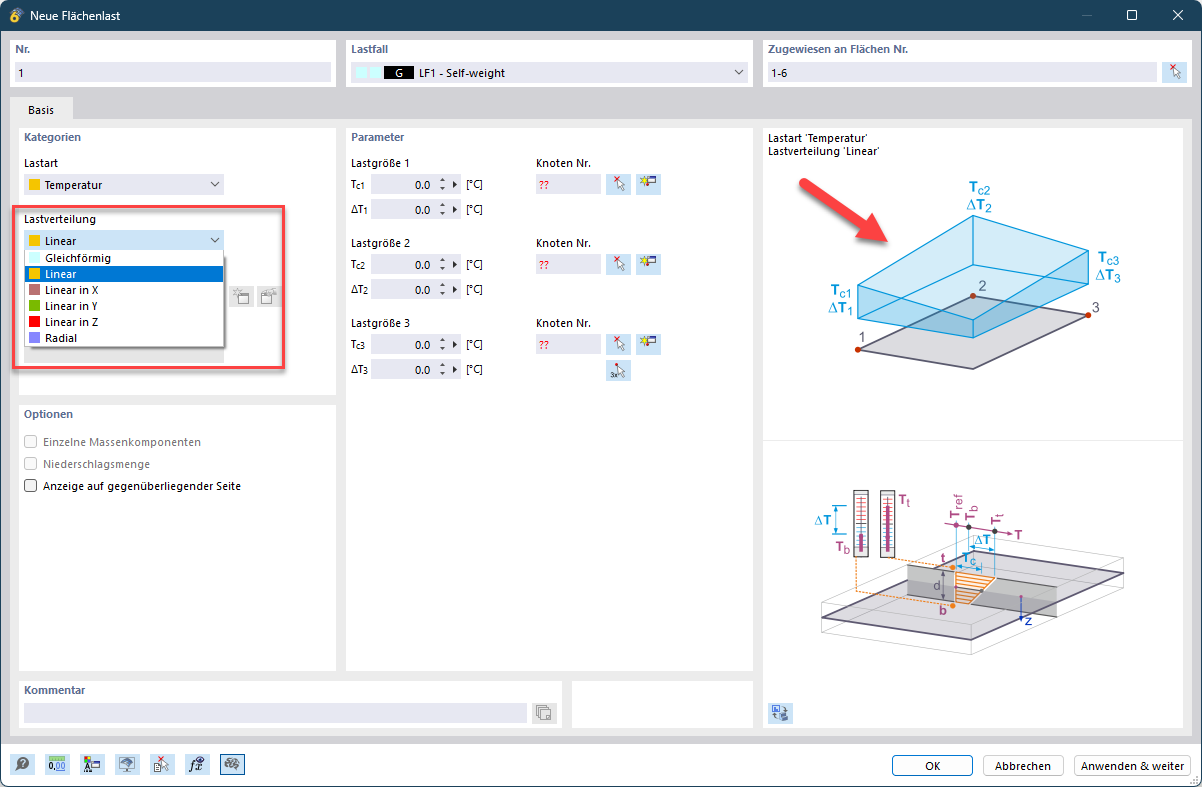
Can I also apply the temperature load differently in zones for surface elements? Specifically: One part of the surface is to be loaded with 700–800 °C (directly flame-exposed), while another part should remain significantly cooler (protected by insulation). Is this possible via different surface loads or load distributions on sub-areas?
Thanks again!
Best regards
Hi ÜnalTezcan,
Yes, that is also possible through the different load distribution types of the distributed temperature load (see the following image).
Best regards
Niklas Wanke
One more note regarding my previous answer.
For the definition of different temperature zones, I would recommend dividing the area into several sub-areas. Then the temperature loads can be defined separately for each sub-area.