Hello,
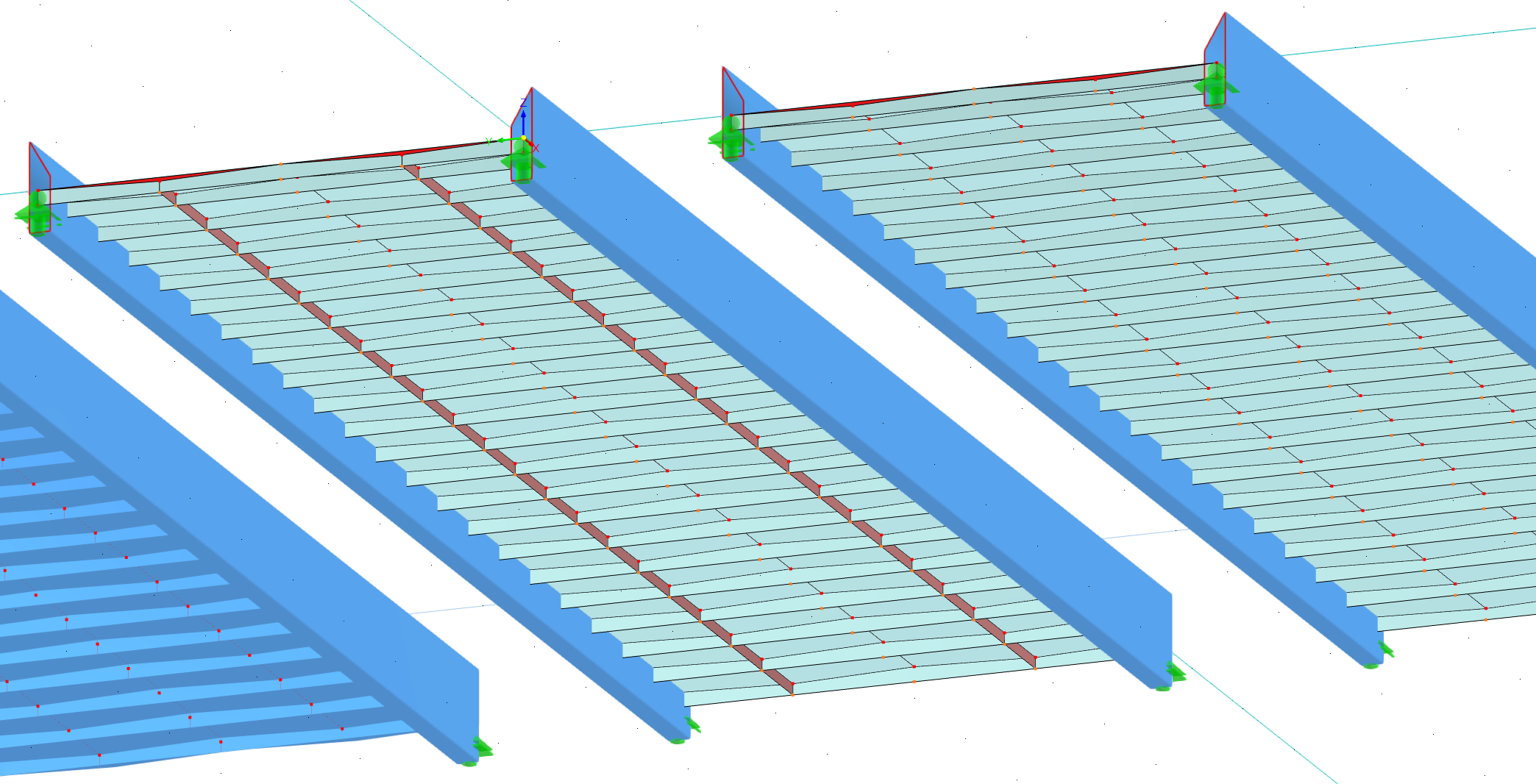
I am currently working on a pedestrian bridge and I need to calculate it using plate finite elements.
This is the first time I am working with plates and I am not sure if the modeling I have done is correct. I performed a test with an equivalent variable inertia T-beam.
Span of the bridge: 12.4m
Sawtooth transverse stiffeners: every 0.6m
Passerelle Z.rf6 (1.6 MB)
Thank you in advance for your help 
Hi Benjamin.Thomas,
could you please provide the screenshots with English labels? I guess that more users will be able to dive into the problem then.
Thanks and regards
Sören
Hi Sören,
Here is the image with the text in English.
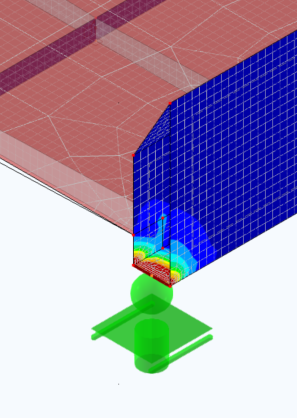
I created the model entirely using surface elements. I have stress concentrations at my supports, which seems logical, but how can I ensure that the stress check is verified at this local location?
Passerelle Z éléments surfaciques.rf6 (1,5 Mo)
Thanks for your help 
Hi @Benjamin.Thomas  ,
,
thank you very much for your request!
 Stress Concentration and Singularities
When nodal supports are used in a model with surfaces, stress concentrations (also known as singularities) are unavoidable.
To reduce this effect, we recommend using line supports or surface supports instead. Both types of supports allow you to define nonlinearities:
At the supported ends of beams, local reinforcement measures are typically required. You can model these using end plates or stiffeners to ensure a realistic stress distribution.
Load Transfer Surface
Please check whether it makes sense to use a load transfer surface on top of your existing surfaces.
If you want to distribute the load only in the X-direction, you can enable this directly on the steel surface by activating:
Activate load transfer
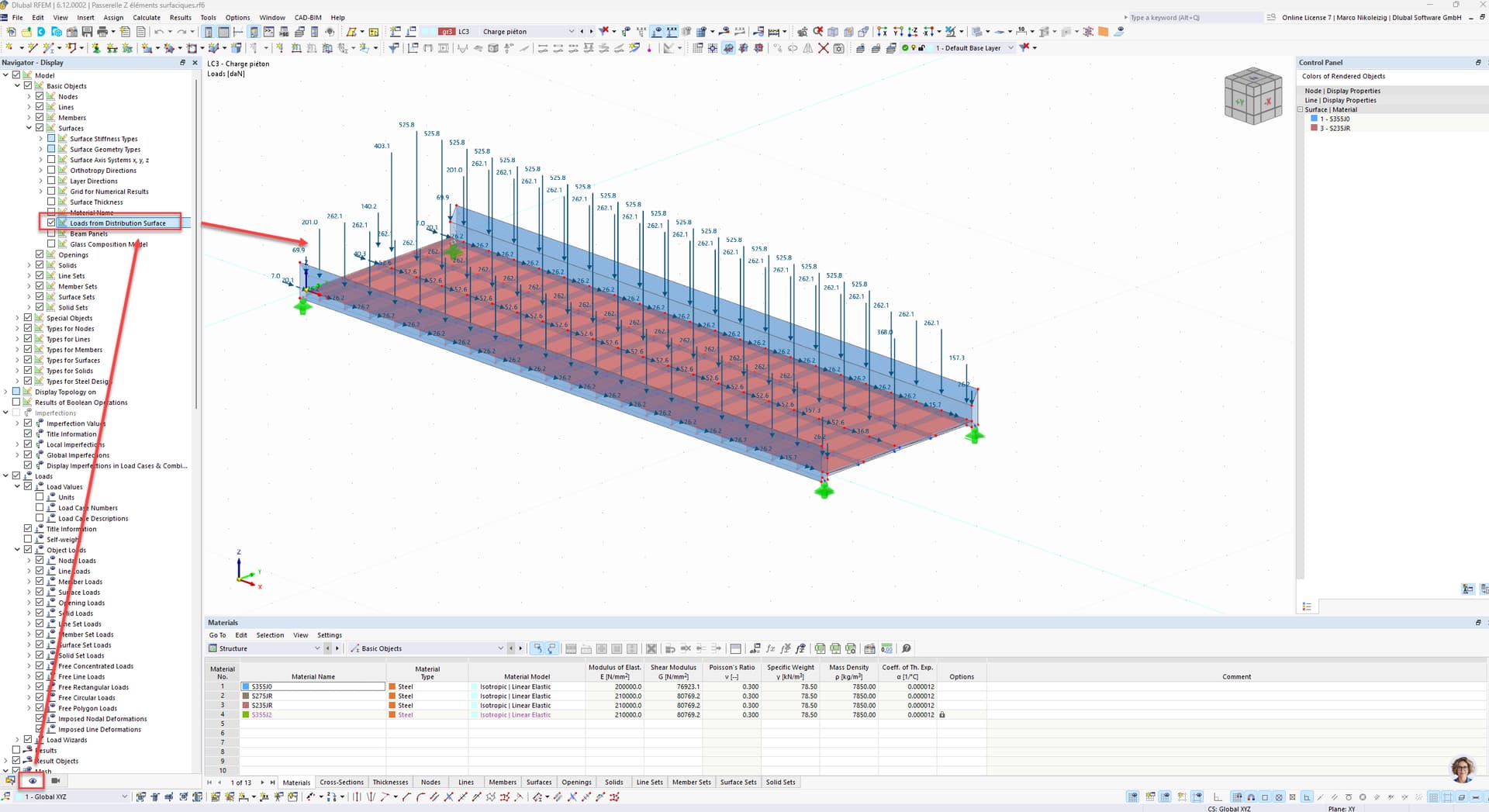
At the moment, your current configuration generates nodal forces only.
To visualize the load distribution from the load transfer surface, please activate the following option in the Display Navigator:
Best regards,
Marco Nikoleizig
Dlubal Software Support Team