Hello,
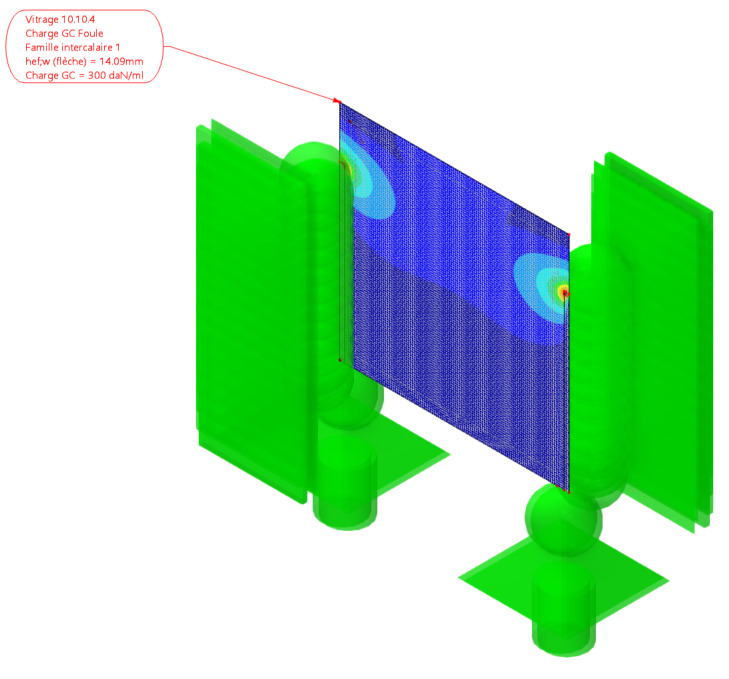
I am working on the sizing of a glass railing with glazing beads on 2 sides with free horizontal edges. I followed the webinar “Design of glass railing in RFEM6”. I followed exactly the same modeling, that is to say modeling the glazing bead areas.
However, when using a surface support blocking out-of-plane forces, I have stress peaks in the corners.
So I tried three different modeling approaches:
- Modeling the glazed surfaces with surface supports
- Linear support on the edges of the glass
- Surface support taking into account a stiffness
- The out-of-plane surface fixity creates a clamping that does not exist in reality given that the width of the glazing bead is 25mm in my case and that the seal is rather flexible.
- When I use linear supports, I also have a peak at the corner and when I refine the mesh the stresses increase…
Do you have any advice or tips on the modeling?
Thank you for your help!
Hi Benjamin.Thomas,
The stress peaks you have observed at the ends of the lateral rigid supports are plausible for this type of modelling approach. They may result from the abrupt transition between the supported and unsupported areas. In particular, idealized rigid supports can lead to local stress increases that do not fully represent the actual behavior of the real structure.
Since the stresses continue to increase when the FE mesh is refined, this indicates that a local singularity effect may be present. Such stress peaks should generally not be considered as governing local stresses without further assessment, but rather evaluated in the context of the modelling assumptions and the actual load transfer mechanism.
Further information regarding singularities in finite element models can be found in the following Knowledge Base article:
https://www.dlubal.com/en/support-and-learning/support/knowledge-base/002051
For the modelling, the actual support behavior can be represented as realistically as possible. Instead of using a rigid support, an elastic support with an appropriate spring stiffness could be defined in order to consider the flexibility of the actual joint or restraint.
In addition, surface result adjustments can be used for the evaluation of the results. This allows local stress peaks, which may occur due to idealized support conditions or load introduction areas, to be taken into account during the result assessment. A description of this function can be found at:
https://www.dlubal.com/en/support-and-learning/support/knowledge-base/001762
Best regards
Sonja von Bloh