Hi,
I was wondering if there is a way to simulate a vehicle crash on a road barrier system in order to check for compliance according to EN1317. Is this possible with RFEM6?
Thank you
Hi,
I was wondering if there is a way to simulate a vehicle crash on a road barrier system in order to check for compliance according to EN1317. Is this possible with RFEM6?
Thank you
Hi _lobo,
It depends on what exactly you want to verify and which requirements need to be proven according to EN 1317.
In general, RFEM 6 is primarily a software for structural analysis and not designed for simulating moving systems like vehicles. Therefore, simulating the actual crash of a car into a barrier system is not feasible within RFEM 6.
However, there are alternative approaches to analyze a road barrier:
You can model the road barrier using surfaces or members in RFEM 6.
The car can be represented by applying specific loads onto the road barrier structure. The key challenge here will be determining the magnitude of these loads.
Additionally, you can perform a dynamic analysis, such as a time-history analysis, if needed.
Please let me know if you need more details on how to proceed with any of these approaches! 
Best regards
Niklas Wanke
Hi Niklas,
In principle, the goal is to check the crash barrier system for compliance to EN 1317. So, to model the crash and define the utilization of the members of the crash barrier system, as well as their deformation.
Yes, exactly. Obviously it is possible to treat the impact as a load. But would you have any recommendations on the magnitude of the load depending on different containment levels?
Hi _lobo,
A possible approach can be found in EN 1991-1-1 Annex B, where a formula for calculating the impact load due to a vertical vehicle collision is provided. Please refer to the attached image for the detailed formula.
The formula is expressed as:
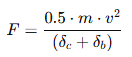
where:
m = Total mass of the vehicle (kg)
v = Impact speed of the vehicle (m/s), perpendicular to the impact protection
δ_c = Deformation of the vehicle (mm)
δ_b = Deformation of the impact protection (mm)
Please make sure to check the standard to ensure that the exact application limits and conditions of this approach are met. 
I hope this helps clarify the approach outlined in the standard. If you have any further questions, feel free to ask!
Best regards
Niklas Wanke
Thank you. I think this is probably the best option. Of course, the deformation of the car is difficult to asses, but I suppose a conservative approach by assuming the car as rigid would be good enough.
Thanks and best regards