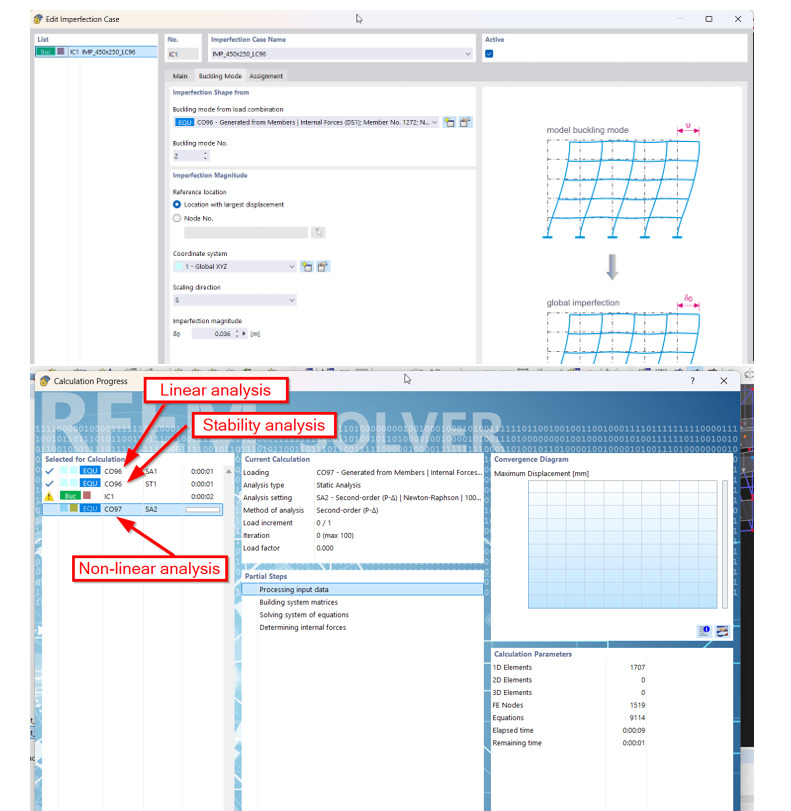
I am doing an analysis of a truss leg for a pipe bridge where I do a stability analysis from a load combination that was calculated using linear analysis. I then use the first global buckling mode as an imperfection and run a non-linear analysis. However, I get the following warning message where I am recommended to increase the number of iterations. But, looking at the calculation progress it seems as the error occurs before the non-linear analysis is even started. I interperate it as though there is something wrong happening in the process of creating the imperfection from the buckling mode, and in that case the numer of iterations shouldn't madder? And it is not helping to increase them, I still get the same error.
I'm I understanding it correctly that it is the creation of the imperfection itself rather than the non-linear analysis that seems to be the issue? Do you know what could be the reason for this?
Error: "The required accuracy of the iteration calculation was not reached | The results may be unusable | Increase the 'Maximum Number of Iterations.' Otherwise, the structure cannot support the applied loads or the iteration does not converge."
Unfortunately I cannot post the file publicly. However when clicking on your user name/profile picture there is no option that says message. I can't find a message option when visiting your profile either.
Is there a setting or something I need to activate to send messages, or could I send the model to an email adress instead?
When I add hinges at the ends of member No. 222 the problem disappears. In reality this connection will be semi-rigid. I just want to understand if the rotational stiffness of the connections of this member is actually affecting the global non-linear behaviour, or if it is something numerical that we can neglect.
Currently, if a project involves eccentricities, imperfections, or nodes on members, users may experience some issues in RFEM. Fortunately, there's a reliable workaround!
By converting all "node-on-member" elements into regular nodes, and then working with member sets, the project should run smoothly without further complications.
Feel free to try this solution, and don’t hesitate to reach out if you have any questions or need further assistance!
 .
. Click on File → Save as and choose the following settings to reduce the file size: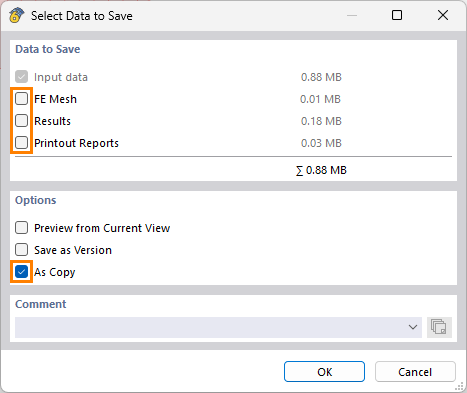
 Prefer not to share the file publicly? No problem – send it to me via direct message: click on my profile picture or user name → Message.


