Hello everyone,
I would like to verify my FE mesh according to DIN 18008-3 Annex B for the calculation of cylindrical and conical boreholes. The standard specifies boundary conditions for the verification.
However, I now have the problem that singularities occur at the edge of a cylindrical borehole in a volume model, which I cannot eliminate by mesh refinement (refinement on the surface with 0.5 mm).
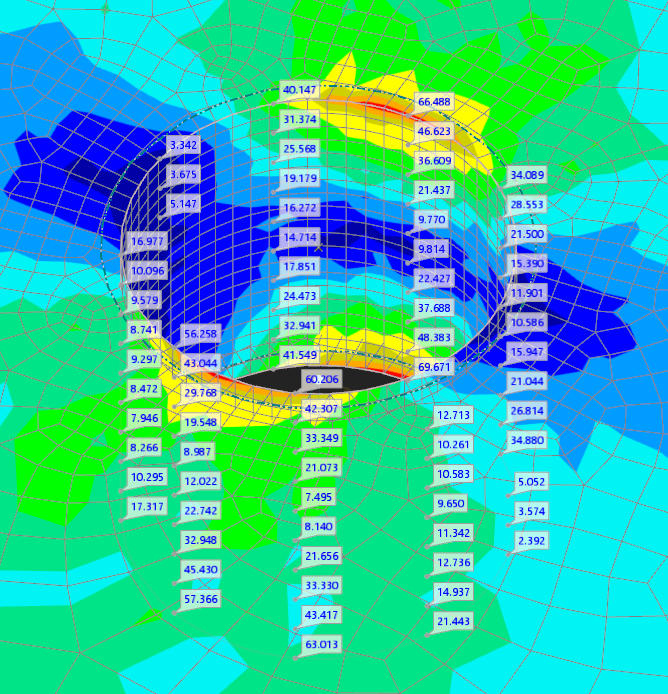
When I model the model as a surface, the stresses at the borehole edge agree with the standard and are within the tolerance range.
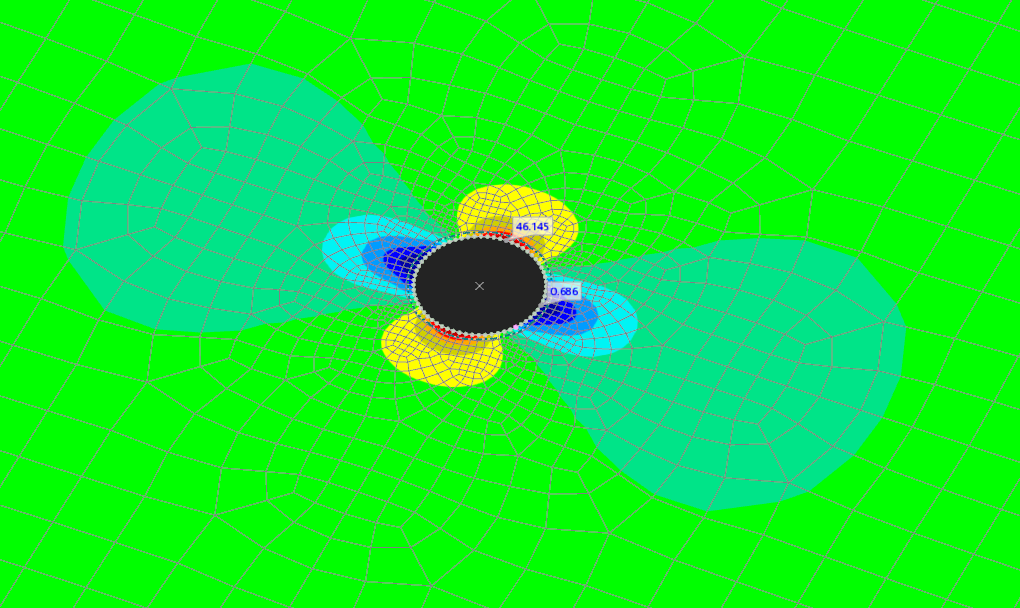
Are there any experiences on how the mesh must be adjusted in order to achieve the required stresses at the borehole edge according to 18008 in a volume model?
The goal is later to represent and verify the countersink. For this reason, a volume model is also required.
Verification 18008-3 B cyl.rf6 (4.6 MB)
Hello Fabian_Allgayer,
Indeed, the mesh settings are crucial for plausible FE results.
In general, a mesh convergence study should always be conducted here. This technical article touches on this topic somewhat.
For your specific problem, the following points are relevant:
- The global responses should converge. This means that you may need to arrange more elements through the plate thickness to correctly represent the bending stiffness.
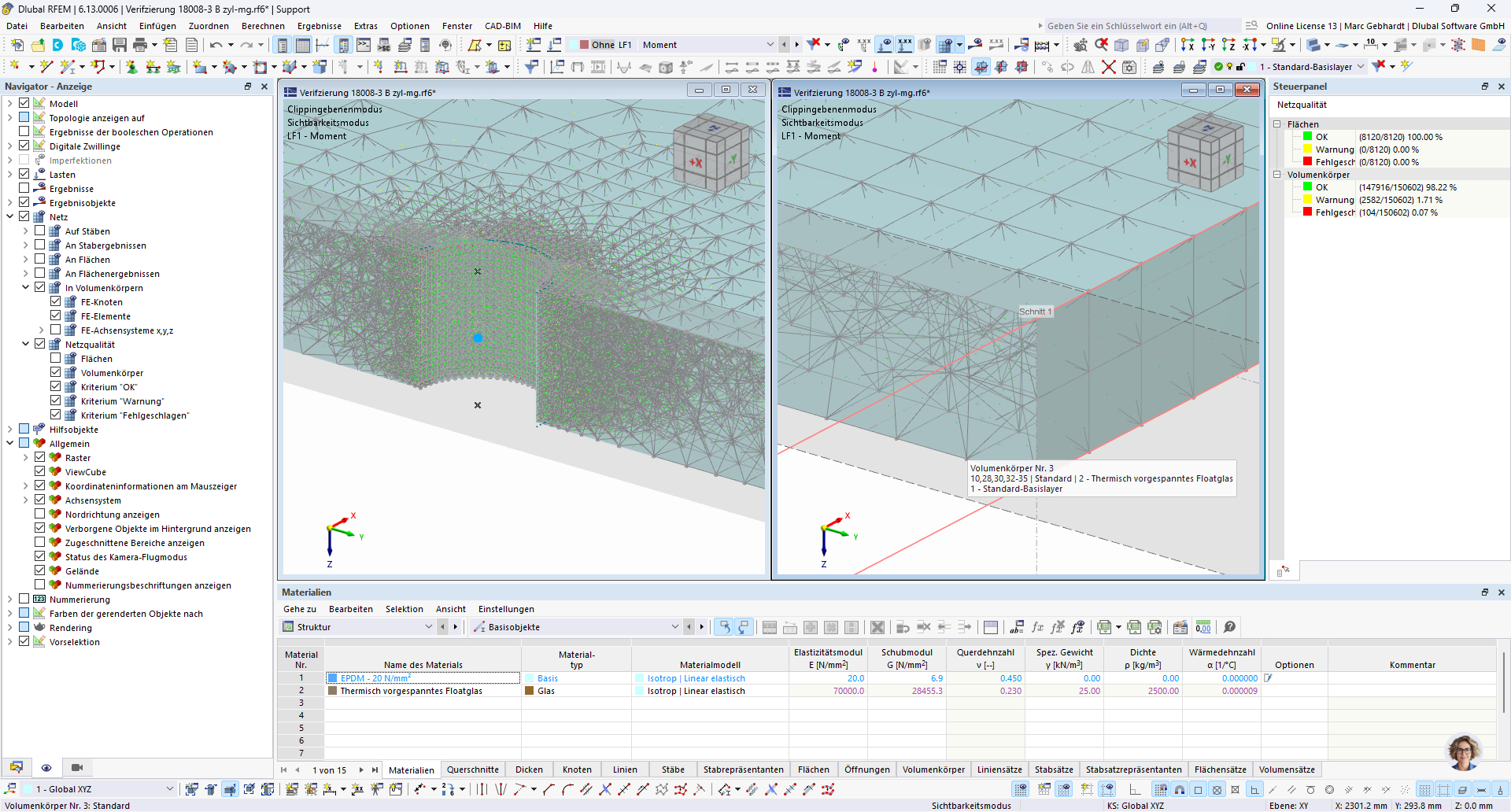
- Since the stress gradient increases towards the hole edge, the mesh should also represent this. Not only on the surface but also in the volume. Therefore, always activate the volume mesh in the Navigator display. The use of clipping boxes and clipping planes facilitates visual control here. Also, the display of mesh quality is a good aid.
For visualization, please see the following image of your model:
My recommendation would generally be to use few mesh refinements in a targeted manner. The generation of hexahedral elements is preferable to tetra-/pentahedrons.
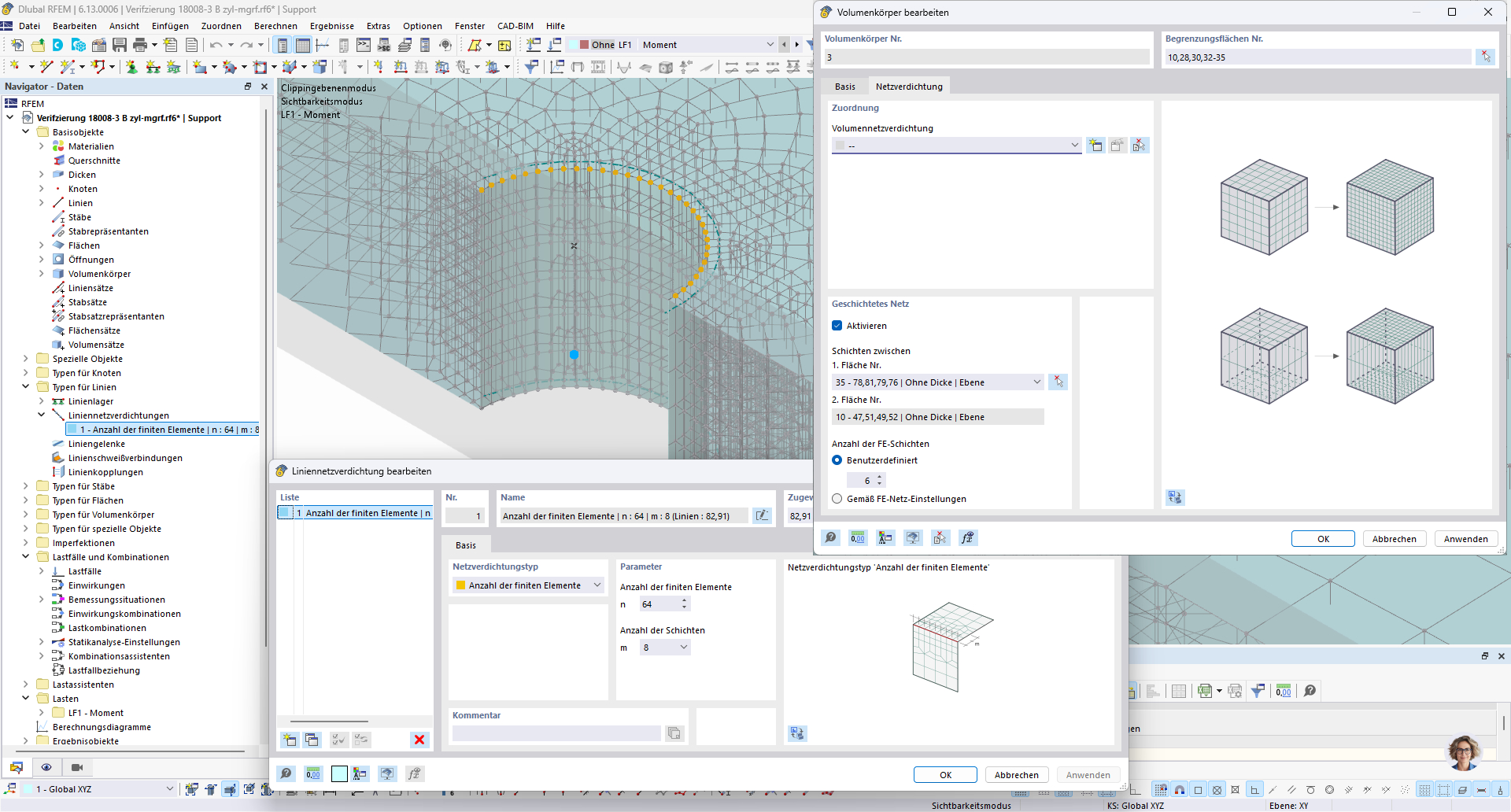
In this case, the layered FE mesh could be helpful. This can also be applied with a line mesh refinement as in your surface model. Please see the following images.
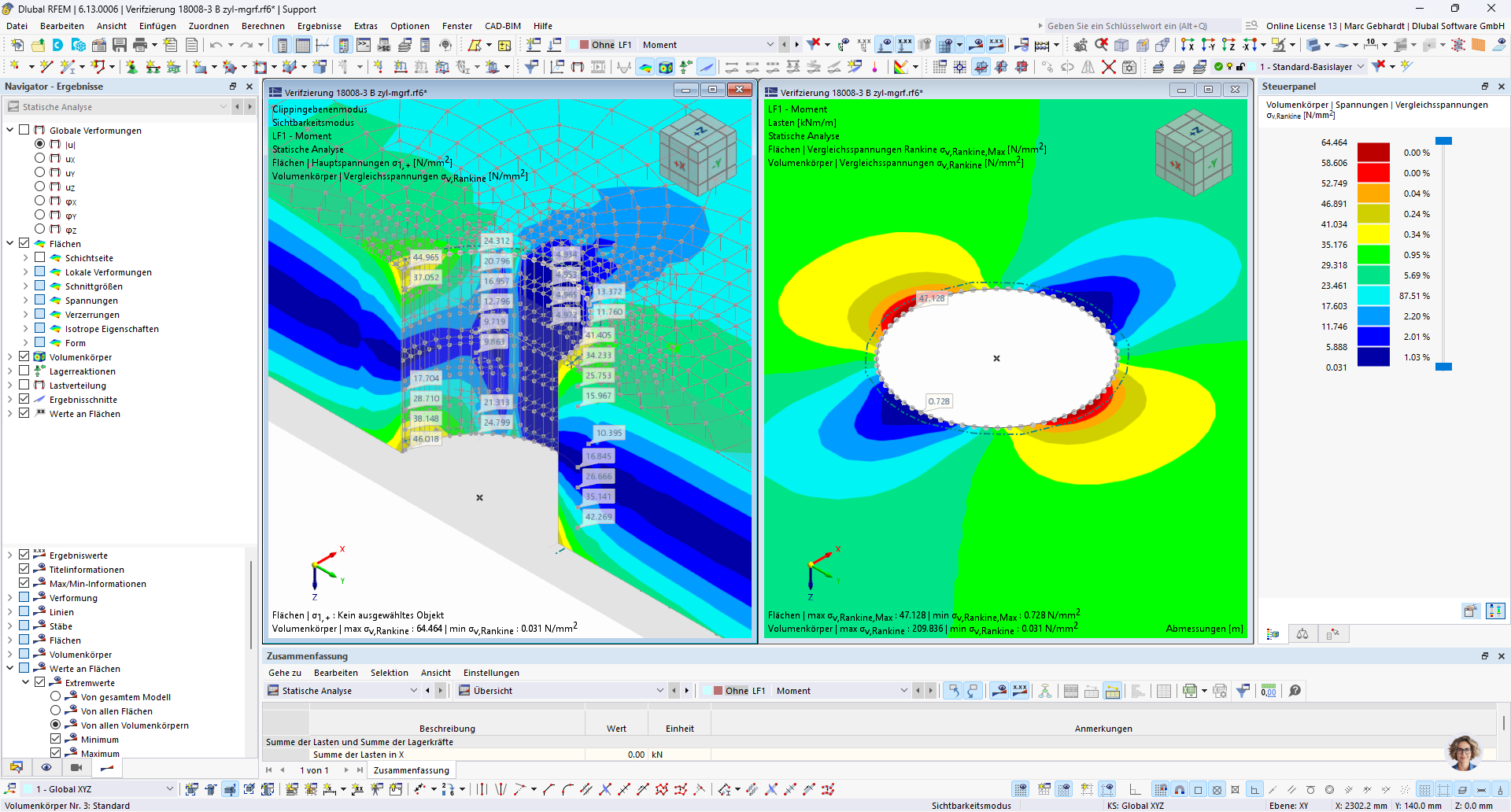
It is also important to observe the result smoothing in RFEM 6. For the evaluation of such stress peaks, the type "discontinuous" (unsmoothed) should possibly be chosen. By the way, this result smoothing can also be used for the rough estimation of mesh quality. 
Best regards,
Marc
Thank you very much for the response @marc.gebhardt.
For a cylindrical bore, the suggestion works.
Is there a possibility to set a layered mesh for a counterbore? Here I get an error message saying that only parallel surfaces are possible. Or what suggestion is there for mesh refinement here? Currently, I have tried line mesh refinement and volume mesh refinement. Unfortunately, the current results for my mesh settings are not satisfactory (stresses about 50% too high).
Furthermore, I would like to know if there is a setting for volume bodies that only hexahedrons are generated?
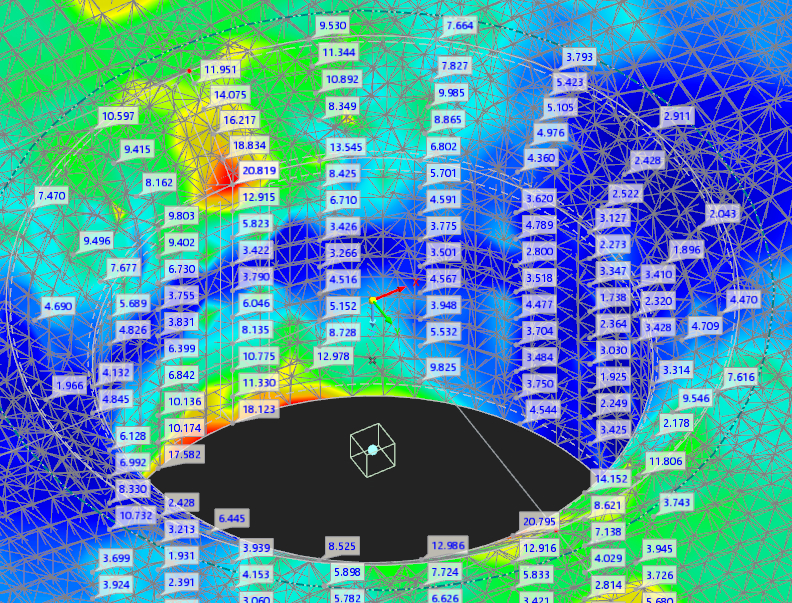
Solution for the verification of a countersunk hole according to DIN 18008-3 B:
Application of a couple of forces, instead of a line moment
Additional volumetric mesh refinement n=1.5 mm in the area of the hole
Great! I'm glad you were able to solve your problem. And thank you very much for sharing your solution here! 