I have created a volume model of a test specimen in RFEM 6. After generating the mesh, I now want to calculate the stresses under a load. Unfortunately, during the static analysis, I receive the error code 10997 with the description "Please inform the software manufacturer and send the data of the respective model." for the load case. I have tried different loads and load cases, but the warning does not change. Since I am a student and therefore working with the student version, the support referred me to the community. Does anyone have an idea where the error could be and can please help me?
Hi Baustudi,
welcome to the Dlubal Community  Glad to have you here
To analyze the problem more precisely, the model file would be very helpful:
 Click on File → Save As and choose the following settings to reduce the file size:
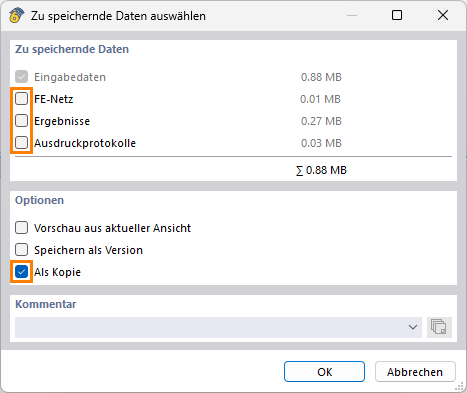
Then upload the file here (e.g. *.rf6, *.rs9) – this way the community can also contribute to the solution.
 Don't want to share the file publicly? No problem – send it to me via direct message: click on my profile picture or my username → Message.
Best regards
Clemens Gutmann
Thank you very much for the hint!
Modell_PK_Kopie.rf6 (1.0 MB)
Here is the model file. I now believe I have found out that the problem lies with the surface contacts. However, I still do not know what is wrong there.
Best regards from Baustudi
@clemens.gutmann I have the same issue. The model was running perfectly fine and at some point, I got this error..
@clemens.gutmann I just wanted to ask, without any pressure, only for my planning, whether you are working on a solution or if I can wait for an answer.
Best regards
Hi Baustudi,
my colleague @matthias.meyer is currently looking into the matter and will get back to you as soon as he has an answer.
Best regards
Clemens Gutmann
Hello Baustudi,
The problem lies with the surface contacts. Due to the small distance between the surfaces, they are merged into one surface during mesh generation. As a result, they can no longer interact properly with each other. 


One way to prevent this would be to reduce the tolerance in the basic settings. However, this could cause a volume body to "hang in the air" and make the system unstable.

I would recommend using a contact volume for the gaps here. You can find more information about this in our online manual:
Contact Volume in RFEM 6 
Please note, however, that you still need to adjust the tolerances in the basic settings as described above.
Best regards
Matthias
Hello Matthias,
thank you very much for your response, unfortunately I had already feared that. I will try it further with a contact volume. Does this handle the small distance better? Otherwise, I was wondering if there is a function similar to the surface clearance where you don't have to create a second surface if two components are very close to each other, but which, unlike the surface clearance, can also take friction into account depending on the occurring forces.
Best regards
A construction student
Hello Baustudi,
the contact volume is generally better suited for modeling clearance fits or similar. When the distance between the components is very small, contact volumes represent the best solution.
With contact volumes, both friction (contact parallel to the surface) and contact failures (contact perpendicular to the surface) can be taken into account.
Surface releases, on the other hand, are used when two volumes share a surface.
Best regards,
Matthias
Hello Matthias,
I have now modeled the contact with contact volume, but there is a problem with the FE mesh generation. The error appears that one of the boundary surfaces of a contact volume does not have a 2D FE element.

"Surface no. 21 has no 2D FE element | This can occur if a node support of the type 'fictitious support' covers the entire surface."
However, I do not know how to solve this problem. Could you please help me with this again?
Kontaktvolumen_Holz_Kopie.rf6 (1.3 MB)
Many thanks and best regards
Baustudi
As a supplement: This problem seems to occur only with 3 of the boundary surfaces (see image). Even with the smallest possible mesh density of 0.01 cm, nothing changes.

Continuation of the topic: