I am investigating the influence of damaged concrete reinforcement steel (chloride-induced corrosion) on the stress and deformation behavior of reinforced concrete components. The goal is to represent the difference between undamaged and corroded reinforcement in a nonlinear FE calculation.
I am performing a nonlinear stability analysis of a reinforced concrete slab in RFEM 6 (version 6.14.0003) and want the surface reinforcement to be considered in the calculation of deflections and stresses.
Model description:
- Reinforced concrete slab 7×5 m, thickness 24 cm
- Concrete C20/25 with material model 'Anisotropic | Damage'
- Surface reinforcement with material model 'Isotropic | Plastic (bars)'
- Nonlinear stability analysis (ST1 - incremental method without eigenvalue analysis) in load case 4 (load phases 1 and 2)
- Structural modification with activated surface reinforcement and materials
Problem:
I am comparing two models:
- Undamaged model: Reinforcement d=12mm
- Damaged model: Reinforcement d=7mm (reduced cross-sectional area) + reduced modulus of elasticity
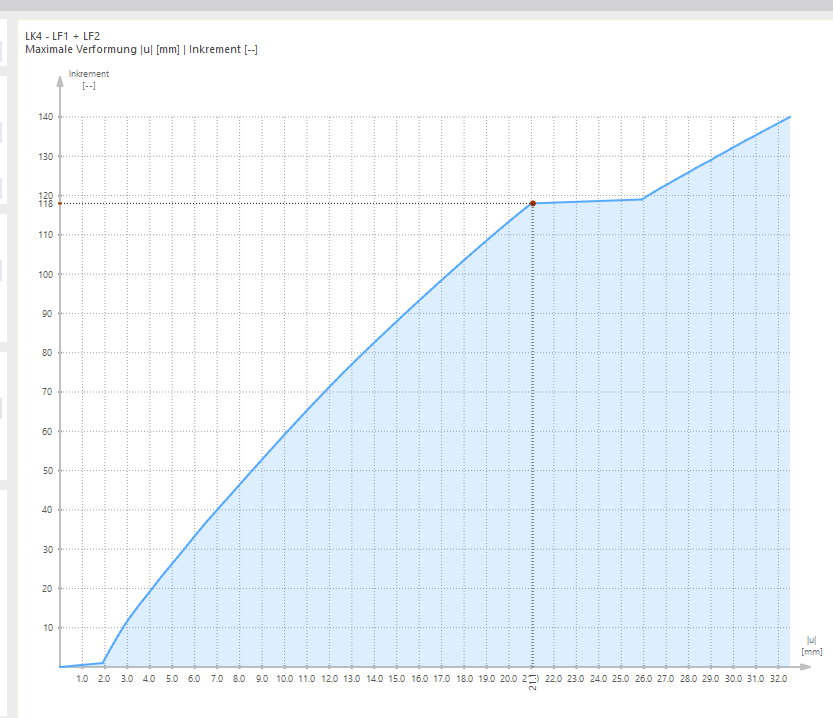
Despite these significant differences in the reinforcement, both models show identical deflections up to reaching the yield point (load factor ~8.51, increment 118). No influence from the reduced reinforcement amount is apparent.
My questions:
- Is the surface reinforcement actually considered in the FE calculation when structural modification is activated?
- Is an additional setting required so that the reinforcement influences stiffness and deformation behavior?
- Could the plastic deformation of the reinforcement also be made visible if the concrete exhibited linear elastic material behavior?
Attached is my file with both models
Reinforced concrete slab damaged and undamaged.rf6 (1.1 MB)
I would be very grateful for any feedback.
Hello @Marie_V and welcome to our Dlubal Community 
Thank you for the detailed description. That is an interesting research topic.
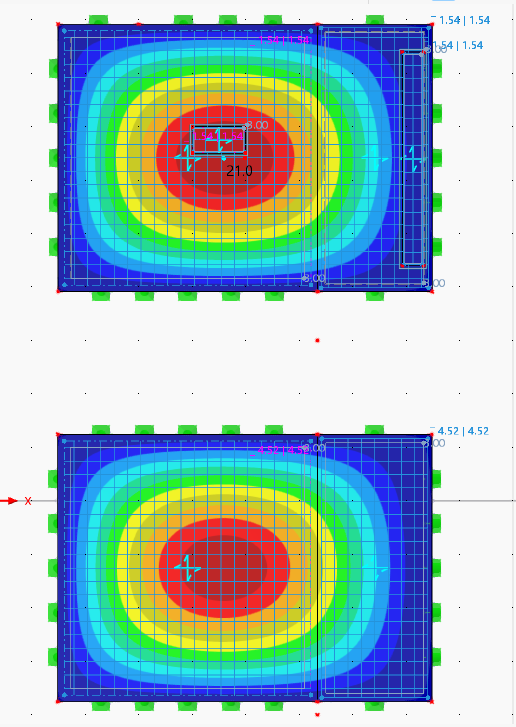
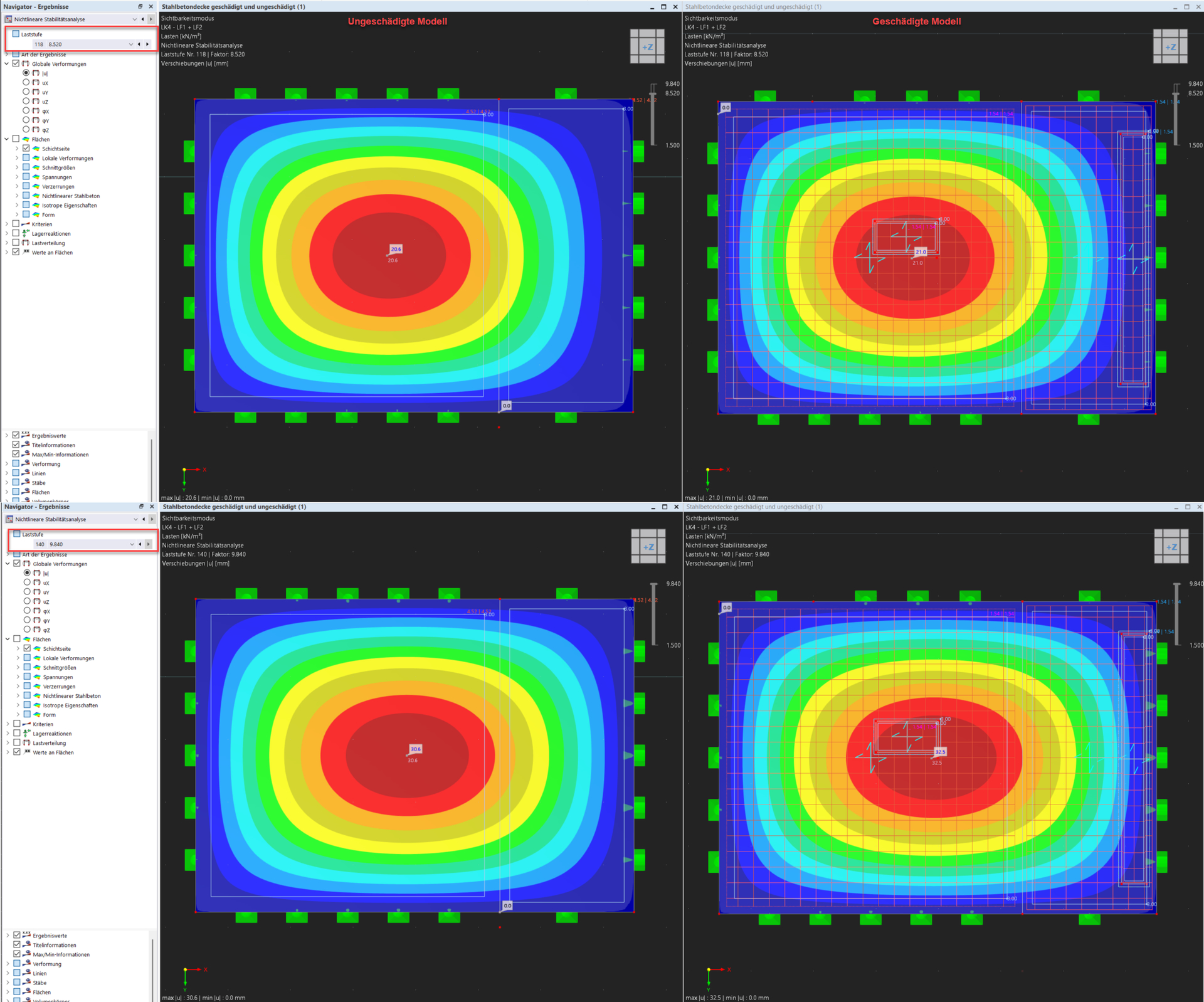
Yes, the surface reinforcement is indeed included in the FE calculation when structural modification is activated. The results of the two models are not identical; the difference is only superficially small. At increment 118, the undamaged model shows a maximum deformation of 20.6 mm, the damaged one 21.0 mm. At increment 140, the difference becomes clearer: 30.6 mm vs. 32.5 mm, i.e., about 6% more deflection in the damaged model.
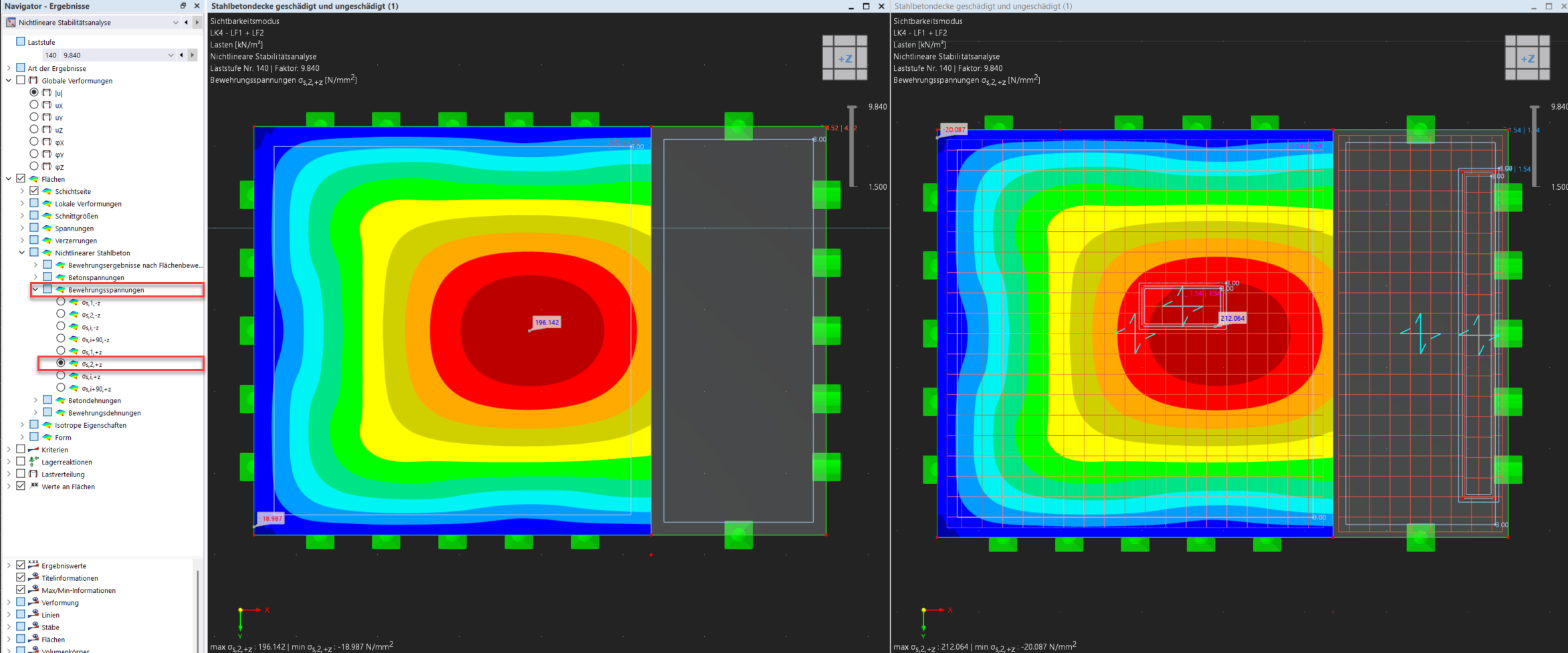
Also in the steel stresses: At increment 118, the maximum stress in the undamaged model is 196 N/mm², and in the damaged model 212 N/mm². Since the yield strength (420 N/mm²) is not yet reached in either model at increment 118, the differences in this area are still moderate (the closer to yielding, the more the models diverge.)
Best regards
Hedi Boukraa
Good day,
Thank you very much for the response, I have been able to solve that in the meantime, however, it still seems unrealistic to me that the first change only appears at such a high increase in load. The deformation is already at 20mm. Shouldn't the concrete crack much earlier and the yield limit be reached faster? I have now also completely turned off the 'Tension Stiffening', which did not lead to a faster failure.
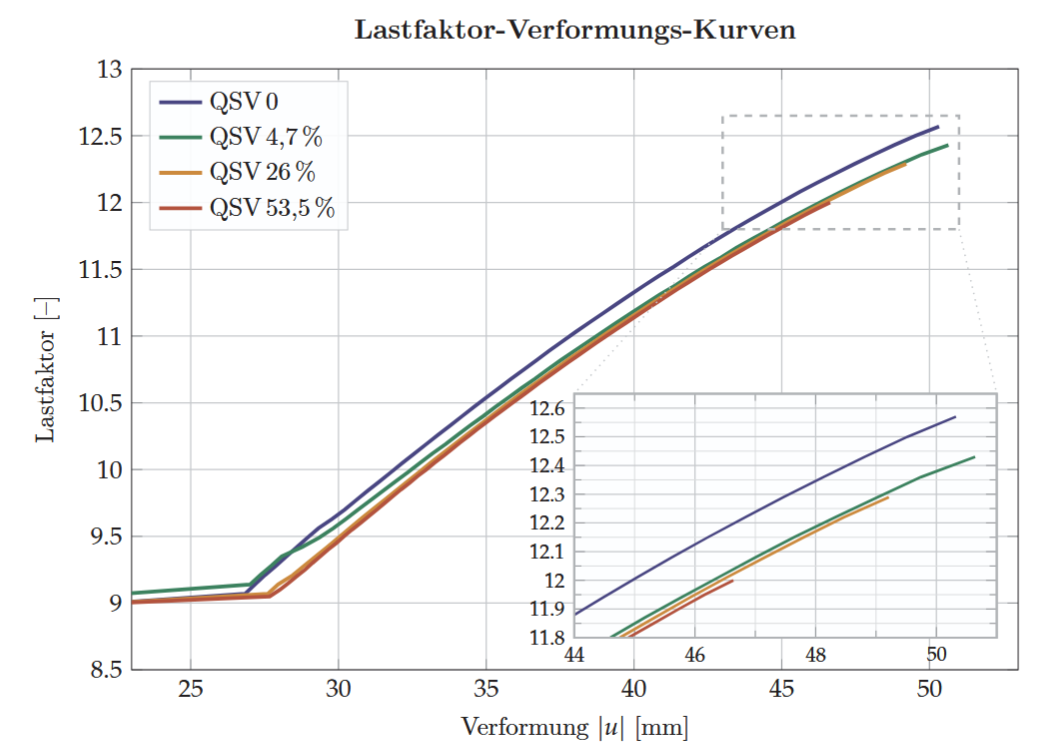
In the meantime, I have also stored different stress-strain curves for different cross-section weakenings, but the differences remain overall small, so my conclusion must be that storing a different material model hardly makes any noticeable difference in the calculation. Attached again are my results for different stress-strain curves.
If you also look at the damage parameter D, it is already unrealistically high from the beginning (load level 1.3: D= 0.72), and yet the plate only fails at a very high load level, which I cannot really explain.
I would be very happy to receive an answer.
Marie
The problem has meanwhile been resolved; I had misinterpreted the results.
It would still be interesting to know why the damage parameter is so high, since already at my first load level a large part of the concrete exceeds fct = 2.2 N/mm².