Hello everyone,
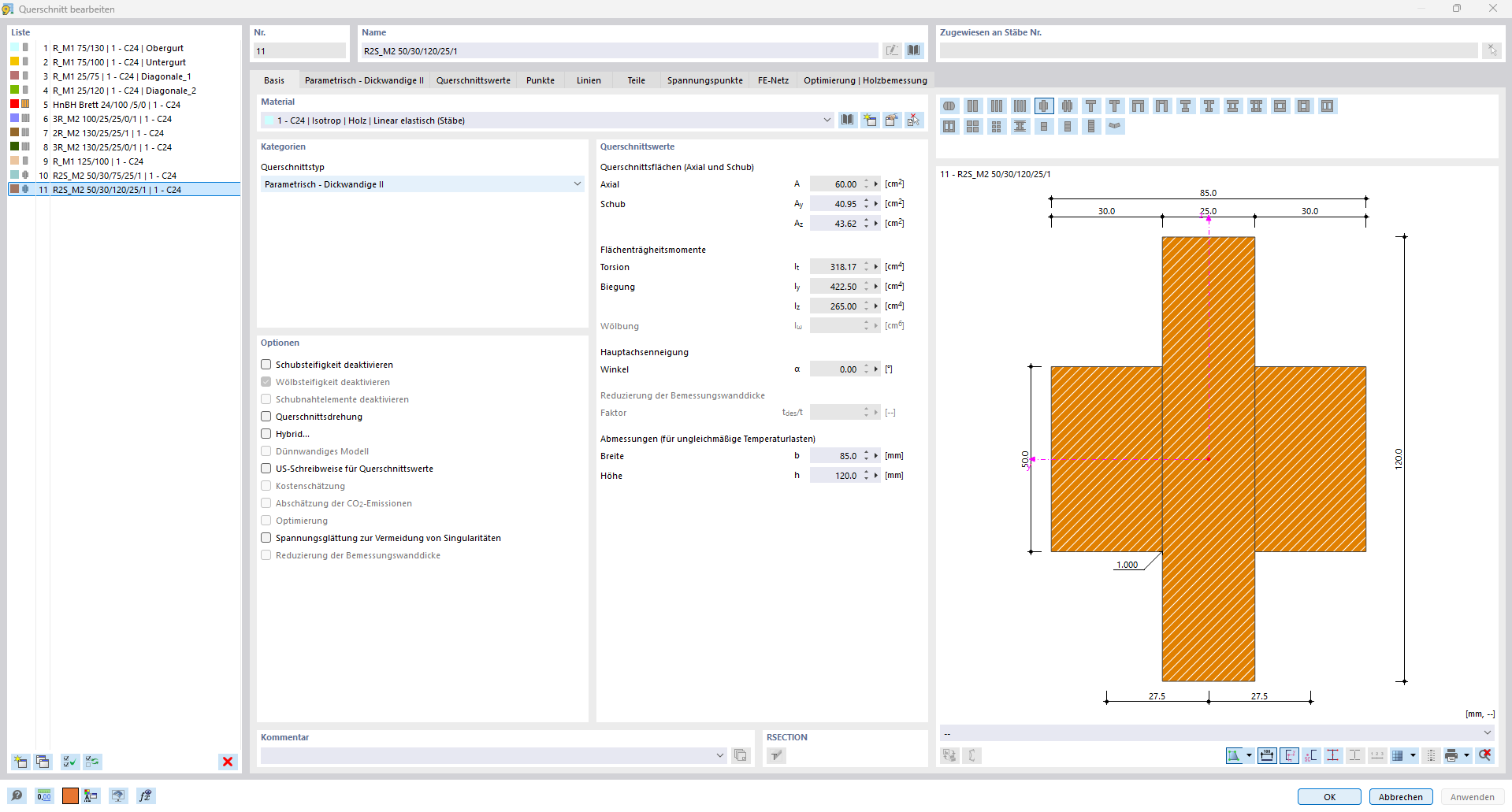
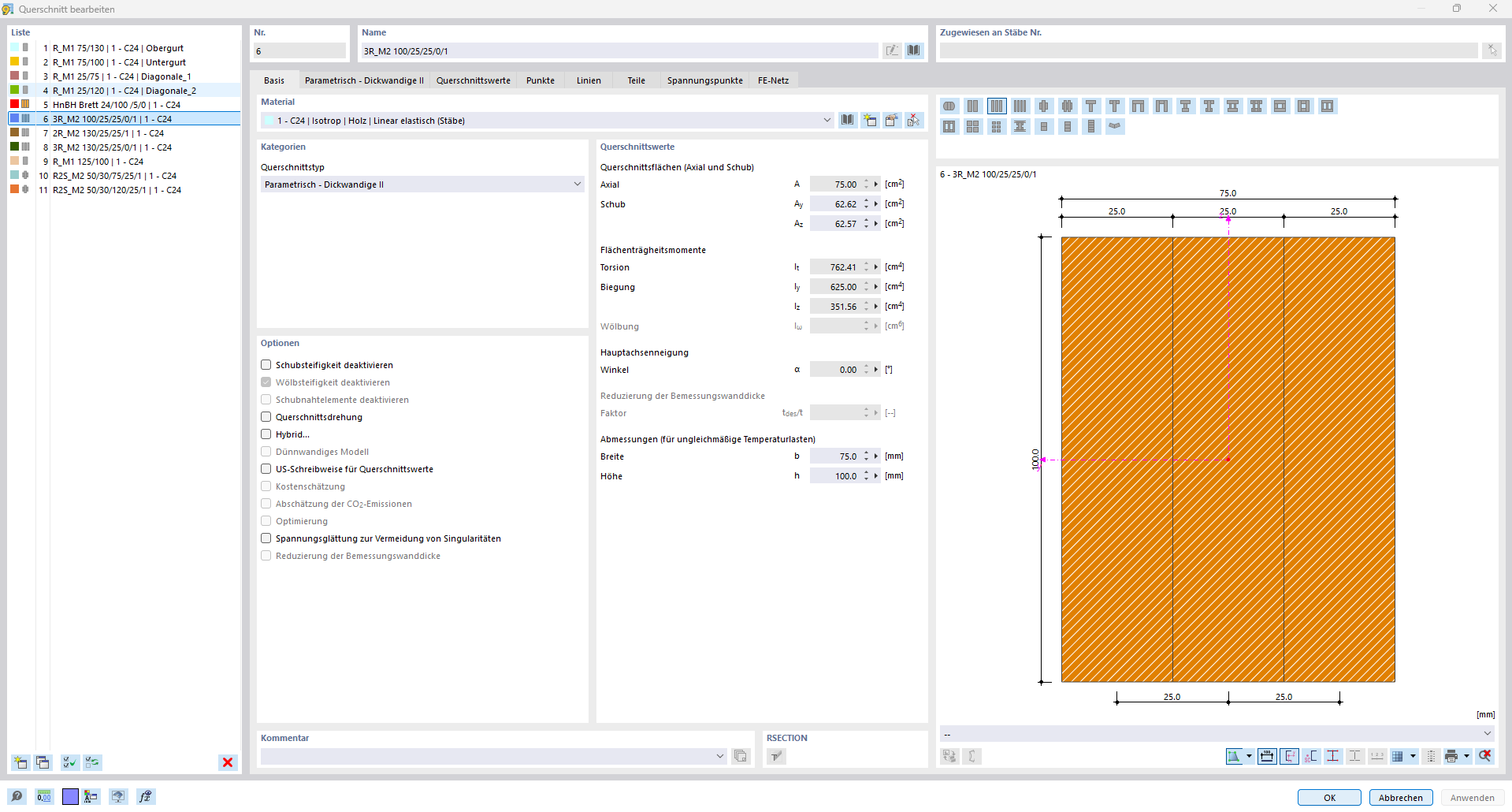
I want to design a nail plate truss in RSTAB 9. For this, I have created cross-sections (parametric - thick-walled ||) made of C24.
However, in the design, RSTAB says that these are not permissible. Is there a solution to still be able to use them?
I have uploaded the cross-sections for the bottom chord as well as for a diagonal as a photo.
Hello Leon,
currently, it is not possible to design these cross-sections with the Wood Design Add-On in RSTAB 9.
A possible solution in RFEM 6 would be to model the cross-section as several members and connect them with a rigid coupling. You can find more information here:
Rigid Couplings in RFEM 6
In RSTAB 9, you can also solve this problem by connecting the two members at regular intervals with rigid bars.
I hope this helps you! 
Best regards,
Matthias
Hello Matthias,
that means I create, for example, 3 bars for the diagonals and assign different cross-sections to each? Then you can couple these bars?
I have to admit, this is the first time I've heard of that 
But it's good to know that it is possible.
Best regards
Leon
Hello everyone,
I'm just jumping in here...
For nail ties, I go along with that, but it requires many more bars and possibly makes the model less clear.
A classic clamp then over two bars without connection?
Depending on the scope of the project/model, it's nicer if you could group such bars together...
And why is there even the option "Thick-walled II" if a calculation is not possible? Or better: why hasn't this finally been programmed?
Best regards, Andi
Hello AndreasBirnbaum,
with the switch to RFEM 6, we now calculate the stresses in the cross-section using unit stresses via FEM. The great advantage of this is that we can calculate stresses at any cross-sections – RSECTION cross-sections are also possible.
In RFEM 5, we still calculated the stresses analytically, which often led to inaccuracies and assumptions that did not always correspond to reality (e.g., the assumption that shear stresses are distributed constantly over the web width in profiled cross-sections). In RFEM 6, we can now determine these stresses much more precisely and realistically. 
An important point is that by applying FEM, the stresses can no longer be combined with the Gamma method – this approach is no longer "compatible" with the Gamma method. We wanted to move away from the Gamma method anyway, as it has too many limitations and no longer meets the requirements of a modern 3D program.
To further optimize the composite beam, we have decided to introduce a new member type – the "composite member". This will, analogous to the member type "surface model", include all required partial cross-sections that are coupled with each other. The goal is to model the composite cross-section with a single member, while the "submodel" is automatically created and calculated in the background. 
We are currently working intensively on this new feature.