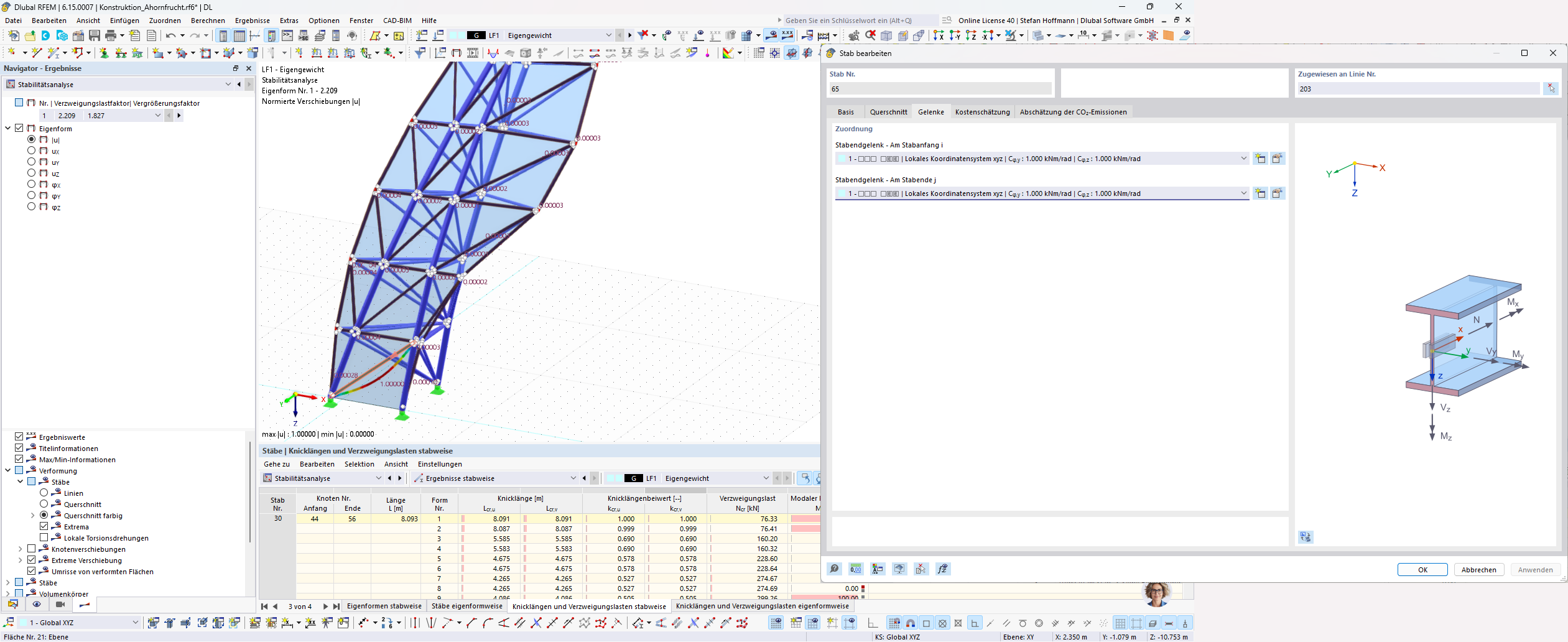
Hi everyone, I’m currently working on a project for a course assignment. My classmates and I are having trouble interpreting the following information about the “Stability Analysis” add-on: The effective length factor kcr is generally 1.0 for a member pinned at both ends and at most 0.5 for a member fixed at both ends. The system I created is pin-supported and carries only axial forces. However, the factor for member number 97 is 0.487. I can’t explain this value, as I intended to model a pinned support condition.
Could someone please help me with this? I’ve attached a link to the relevant file. Thank you in advance for your help and time!
For a system with multiple members, it’s important to generate a local mode shape and then determine the buckling length for that member.
Please reconsider your model using only truss members — N only. These are numerically stable here, even though a chain of hinges forms at all the connections. A better approach is to use a combination of beam and truss members.
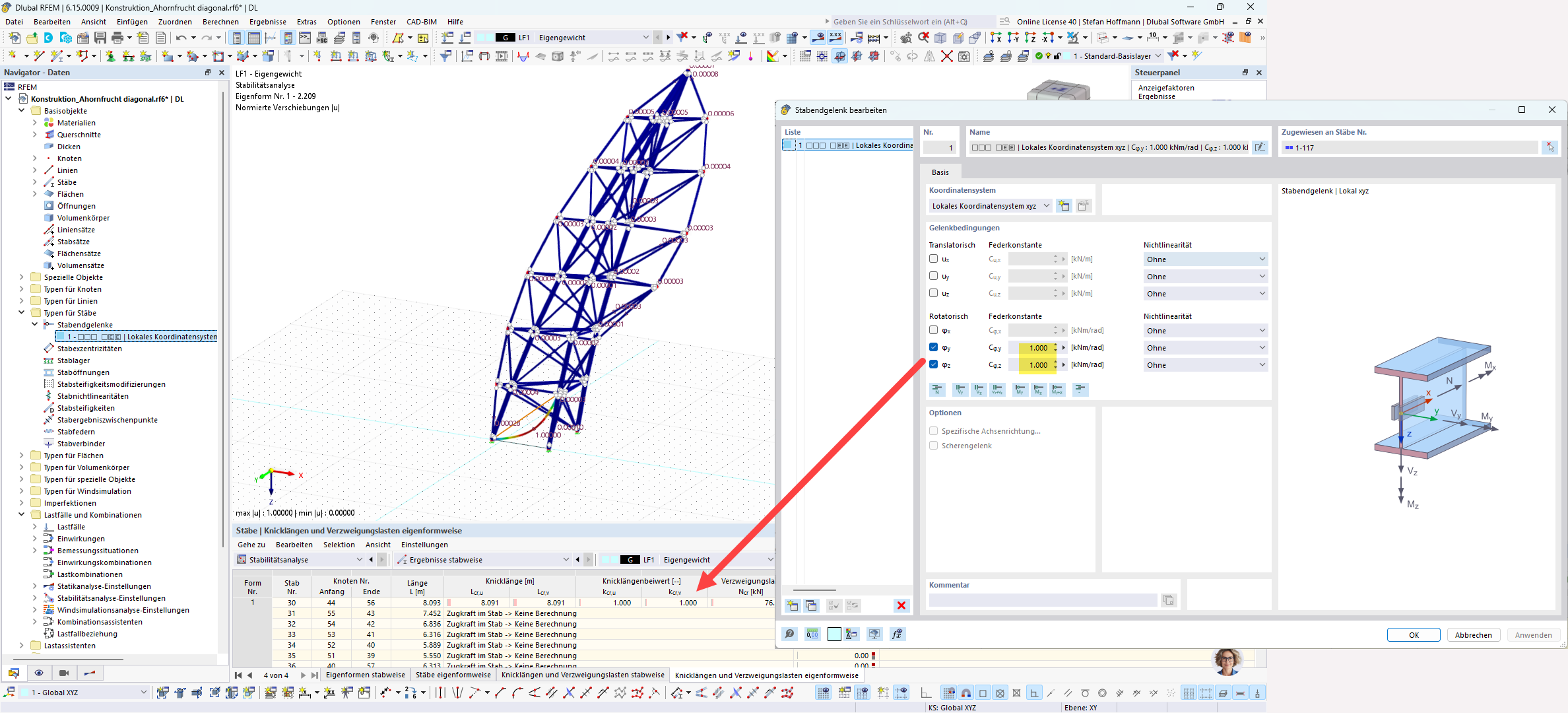
When I test your model using beam members with a small member end hinge, I get a local mode shape. The governing buckling length for the member here is 1.0:
Thanks for your reply. Unfortunately, I haven't been able to solve my problem, and I still have a few questions:
Why are you using the self-weight load case (LF Eigengewicht) here instead of the governing ULS combination?
I modeled all the members as beam members, assigned end hinges at both ends, set the spring stiffnesses as shown in your screenshot, and ran the analysis (also using the self-weight load case). However, for member 30, I get a kcr value of 0.591 for the first eigenmode, while the values for the other members range from 0,... to 32. So I don't get the same result as you—why is that?
Did you change the material or the cross-sections of the members?
Thanks for your feedback. To avoid distorting the system too much, the value at the joint needs to be very small. You set it to 1000, which already has a significant clamping effect.
The higher the value, the less pinned the joint becomes and the more it tends toward a fixed connection. So the effective length factor is already very close to 0.5 here, rather than 1.0.
 !