Hello,
I am currently a student and conducting an analysis of a column base.
I have modeled the column and the base plate (including thickened areas around the anchors) using surfaces. The foundation was modeled as a solid body.
A contact joint is to be modeled between the base plate and the foundation, which fails under tension and has a friction coefficient of 0.3.
I modeled the contact joint using surface contacts.
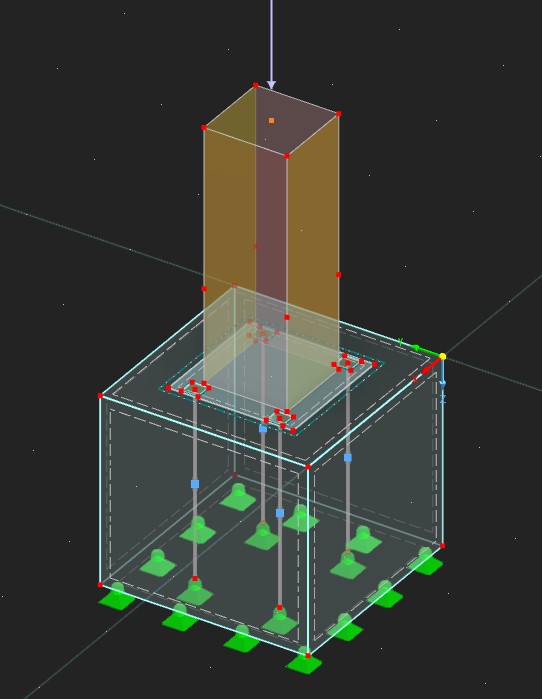
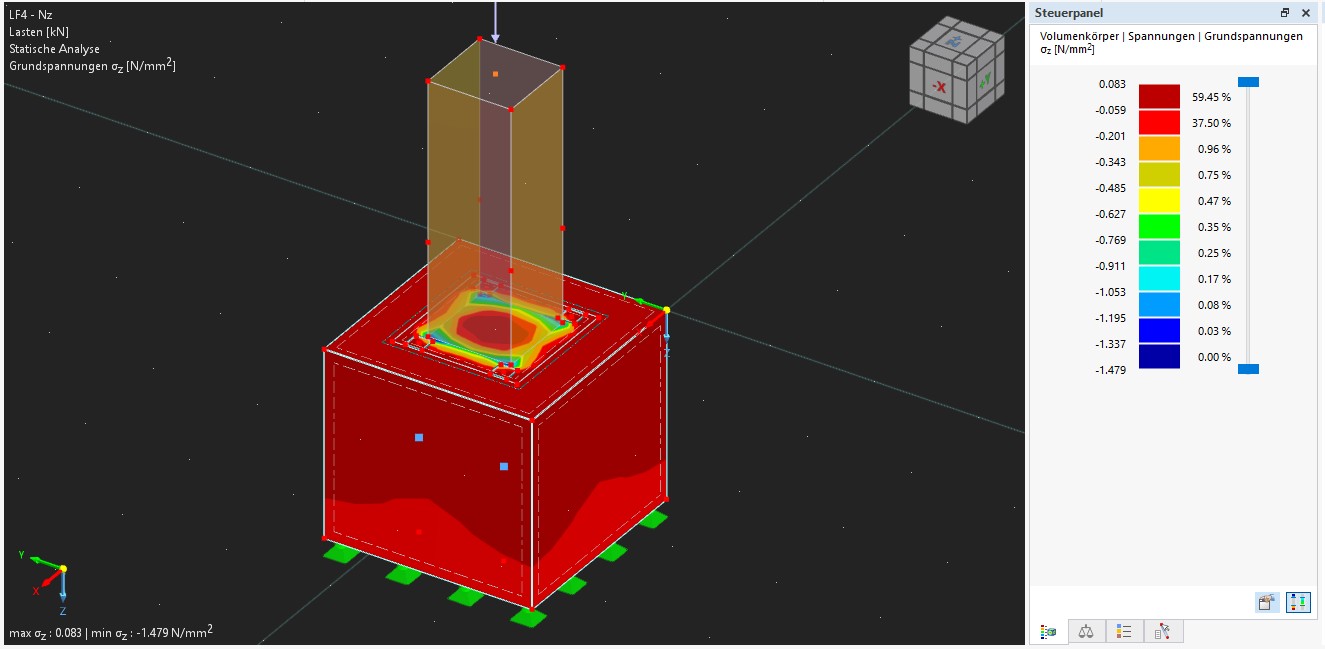
To verify the modeling, I tried to calculate the model with the load case Nz (compression on top of the column, without self-weight).
When looking at the principal stress in the Z-direction (foundation), it is noticeable that tensile stresses occur in the center under the column.
To check the effectiveness of the surface contacts, or the failure under tensile forces, I would like to output the contact stresses between the base plate and the foundation. How can I do this, or is there another method to verify this?
I would appreciate your help.
Hello and welcome to the Dlubal Community.
The tensile stresses probably occur because the load is mainly applied further outwards. In the center of the column, an upward bulge forms.
Unfortunately, it is currently not possible to output a contact stress for surface contacts.
But don't worry! You can instead model the contact using contact volume. This way, you will obtain the corresponding stresses:
https://www.dlubal.com/de/downloads-und-infos/dokumente/online-handbuecher/rfem-6/000066
I hope this helps you! If you have any further questions, I am happy to assist. 
Thank you very much for the response.
While modeling with contact volumes, I encountered another problem (error messages).
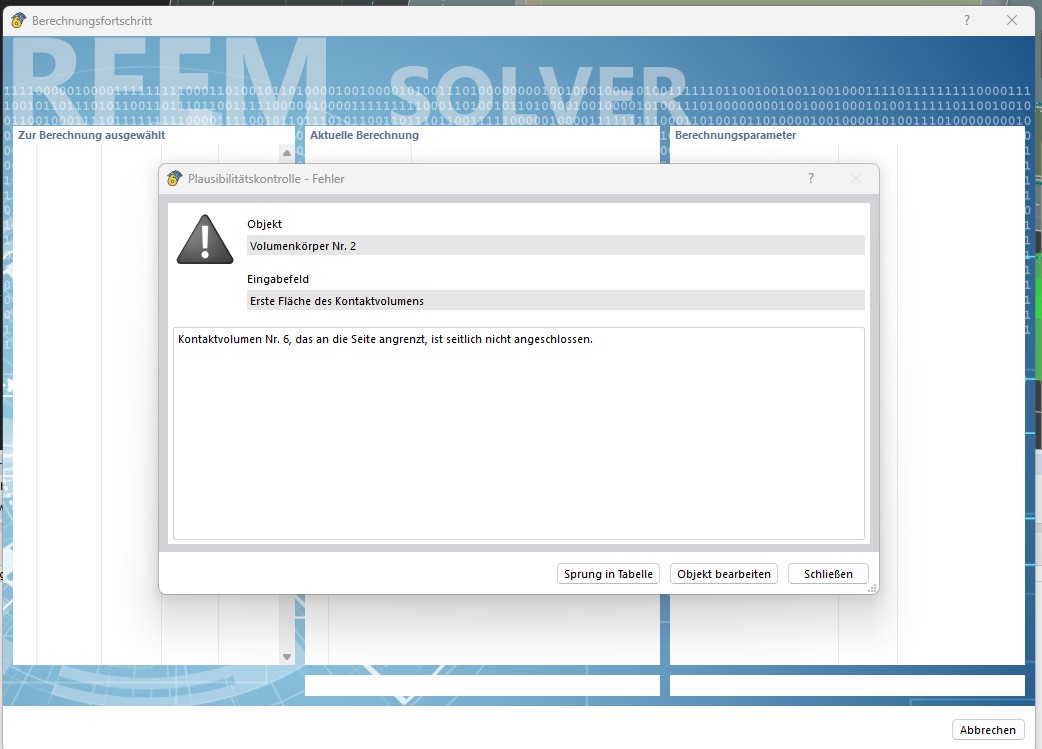
I modeled a total of 5 contact volumes (4 for thickening in the base plate and 1 for the base plate). The error message appears for all thickenings in the area of the anchors.
However, the two volume bodies have the same side surfaces.
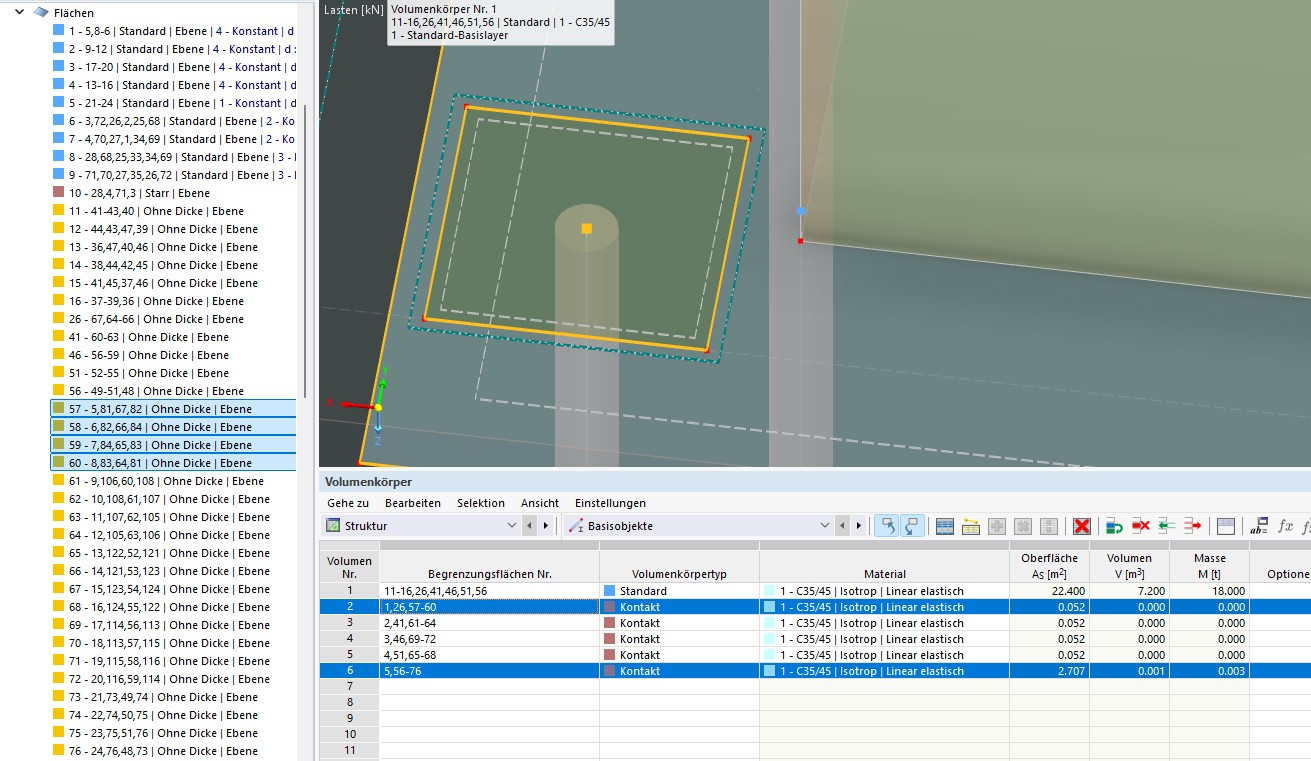
The contact volume must be created between the two surfaces. Unfortunately, screenshots do not help to find the cause.
To analyze the problem more precisely, the model file would be very helpful:
 Click on File → Save As and select the following settings to reduce the file size:
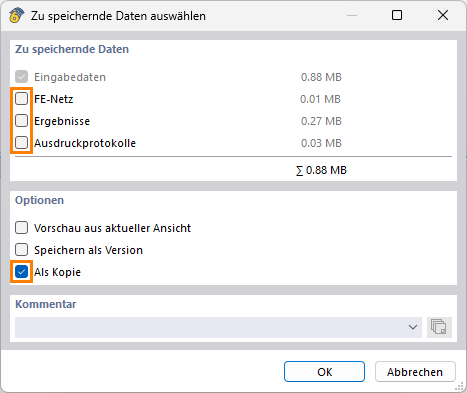
Then upload the file here (e.g., *.rf6, *.rs9) – this way the community can also contribute to the solution.
 Don't want to share the file publicly? No problem – send it to me via direct message: click on my profile picture or my username → Message.
Best regards
Gerhard Rehm
If I insert only 1 contact volume between the base plate and the foundation (neglecting the thickening of the base plate in the area of the anchors), I get tensile stresses in the z-direction despite the definition "failure under tension". What could be the reason for this?
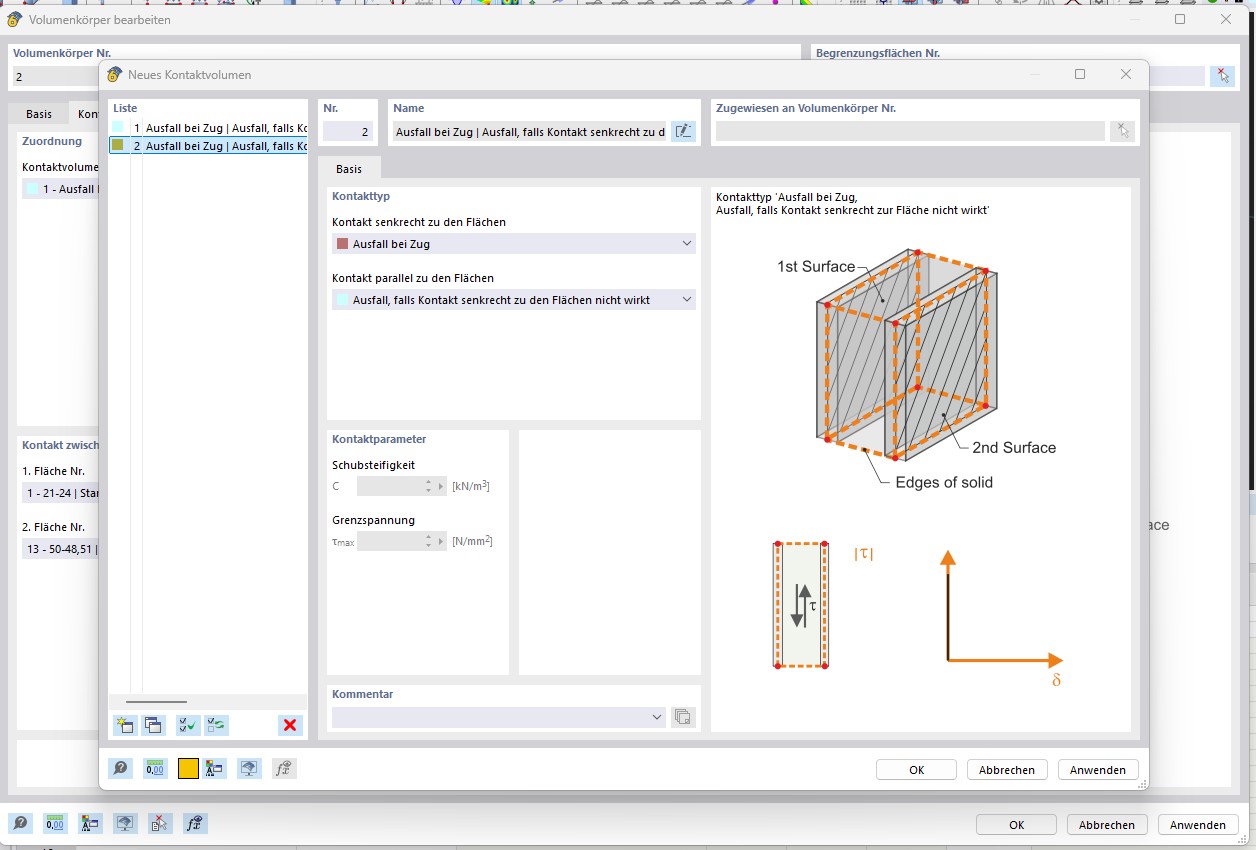
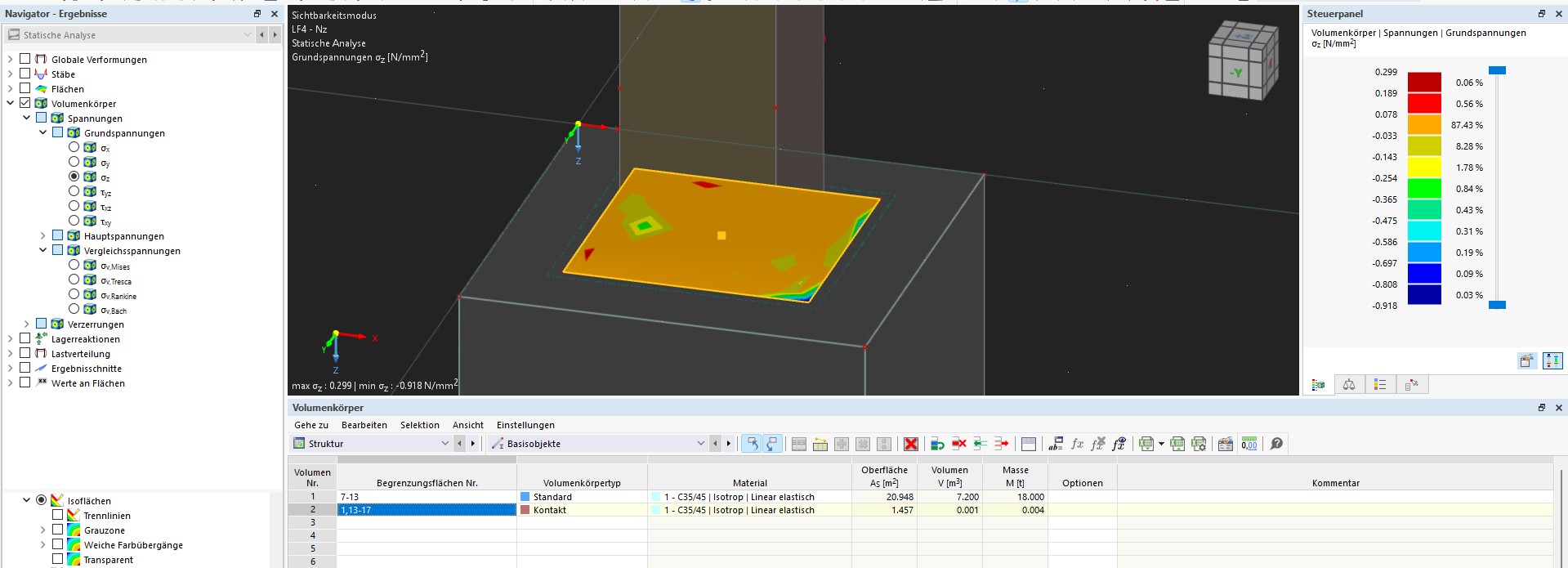
Regarding the model with the thickenings:
Unfortunately, it is currently not possible in RFEM 6 to create contact volumes in openings. One possible solution would be to define additional surfaces for each section so that the openings are eliminated.
Regarding the model without thickenings:
It took me a bit longer to locate the problem here. In the basic data, you have activated the add-on "Warping Torsion". Since the contact volume internally works with bars, I suspect this is the cause of the problem. If you deactivate the add-on, the results become symmetrical and the stresses are also correct. I will have the problem optimized.
One more note:
In the basic data, you have activated a variety of add-ons. I recommend only activating the add-ons you actually need, as otherwise unnecessary performance losses may occur.
I hope these notes help you!  If you have any further questions, I am happy to assist.
The definition of contact volume in openings is now possible.
2 Likes