How to idealize a lightweight slab constructed with prestressed beam elements spaced every 60 cm between beam axes, EPS as a lightening complement, and a 5 cm concrete topping, in which a 6 mm iron grid is installed as shrinkage reinforcement.
Can someone refer me to a tutorial video to perform the idealization in RFEM 6 for students?
Thank you very much in advance for your attention and help.
Hello Rolecon,
Welcome to our community. Glad to have you with us. 
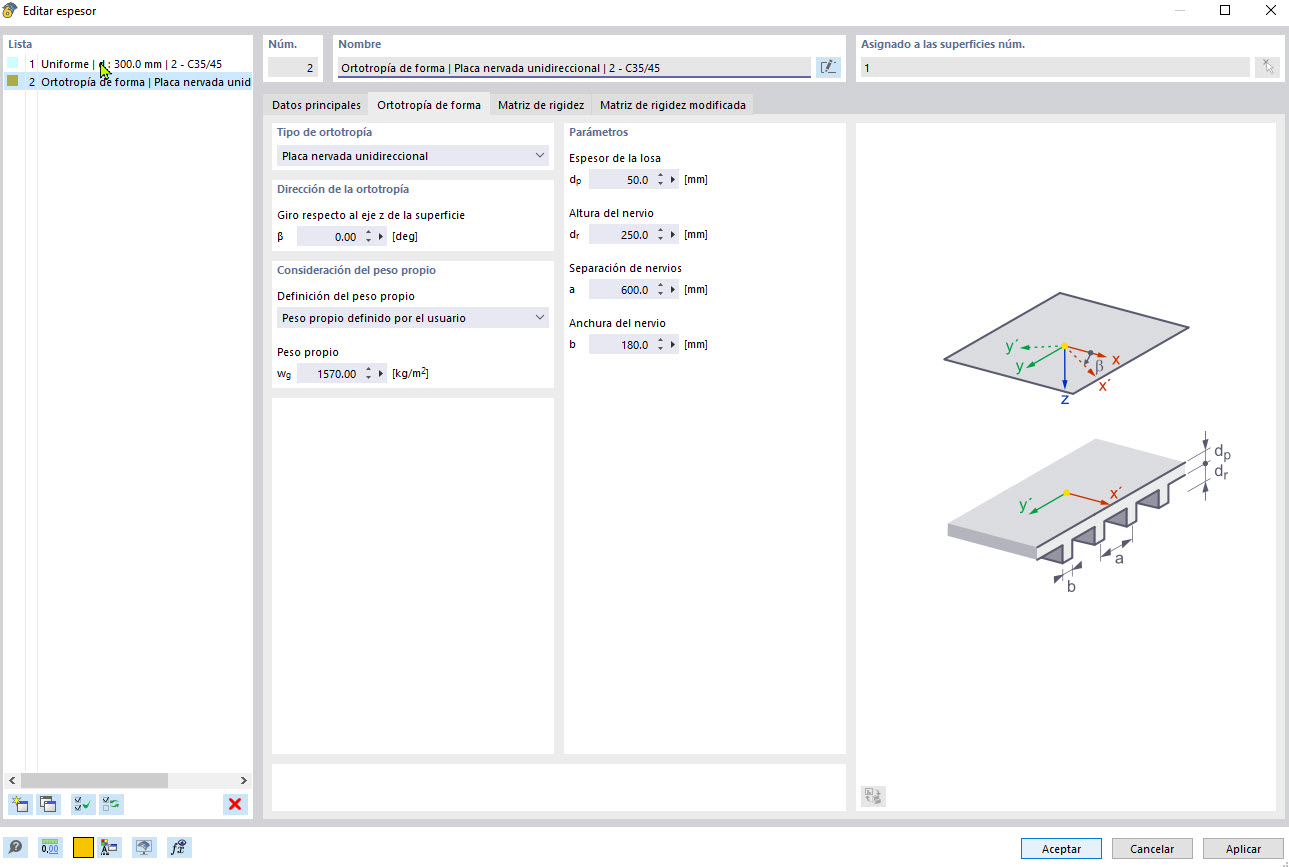
In RFEM6, it is possible to use orthotropic-type surfaces for which you can choose a unidirectional type, defining the geometric characteristics of this type of slab. Ensure the orientation of the joists by means of the surface orientation.
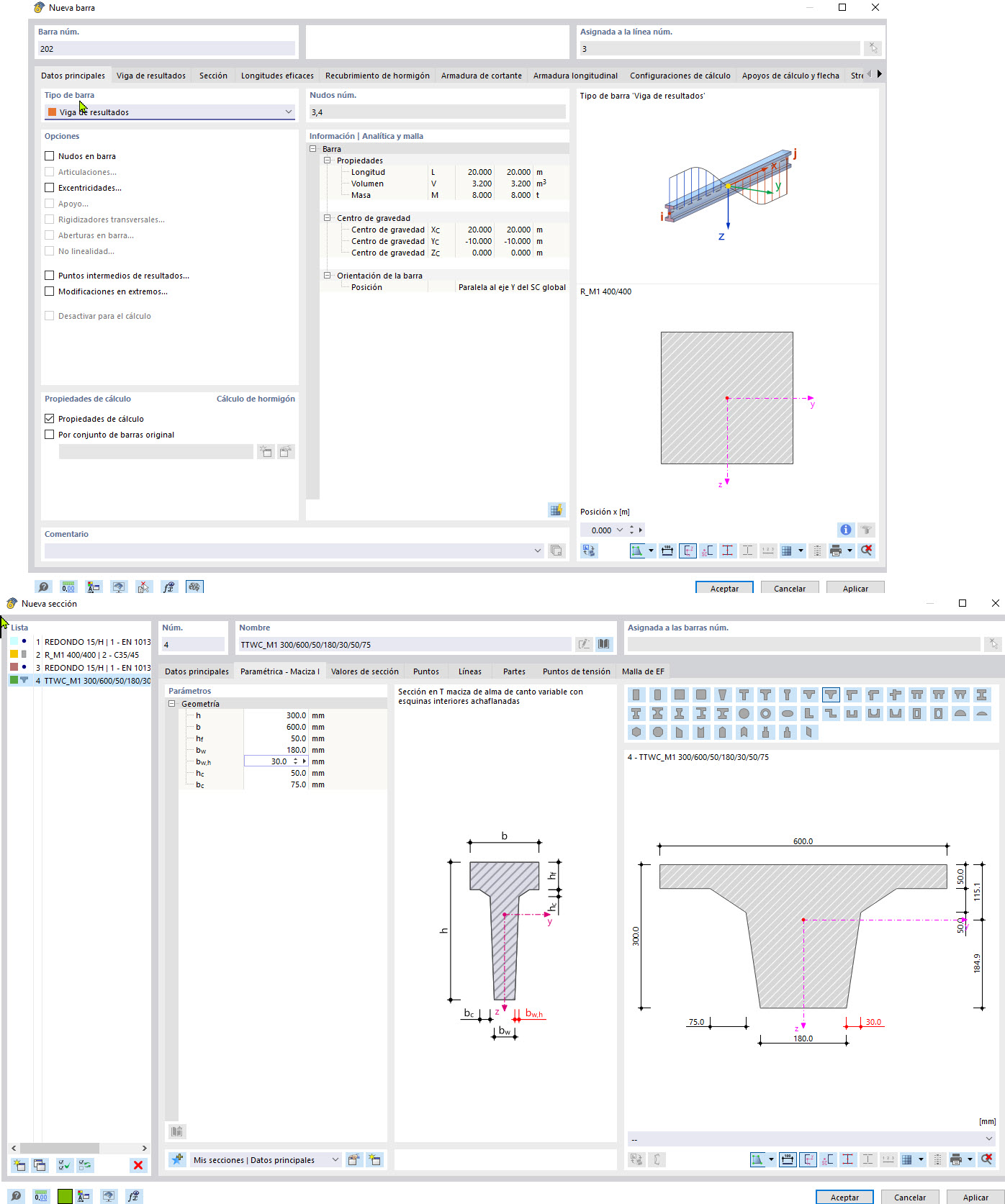
For the design of these slabs, you can later use result beams with a T-section equivalent to that of the ribs of the slabs positioned in critical alignments, for example near supports and mid-span. This section integrates forces in the width of the joist to represent them as beam forces and can then be designed with the concrete design module.
I hope I have been able to help you.
2 Likes
The modeling of the lightweight slab with prestressed joist is very interesting. I believe the main issue arises from the difficulty in obtaining the mechanical properties of the prestressed joist itself, as it does not behave like a reinforced concrete beam. Is there any example that involves incorporating a prestressed joist into the model as those available according to the catalogs? Each manufacturer has its own geometry, materials, and behavior derived from tests; clearly, this is the case, and that makes it a difficult task to incorporate into the model we want to achieve. In such a case, what would be the approach to represent the behavior as close as possible to reality?
2 Likes
Thank you very much @cerciora for participating and contributing your experience to the community, we welcome you. 
Indeed, as you rightly mention, the diverse catalog of available joists usually depends on the project's location, and the various industrial suppliers guarantee a shear capacity, positive and negative moments. In such a case, the design method I would recommend would be exactly the same as indicated; I would simply not design with the concrete modulus but would read the envelopes of moments and shears to check against the industrial catalog.
Alternatively, you can always create a model of bars spaced at the joist center-to-center distance, using as the section for them the one that is actually needed. Then you can generate a load case called "Prestressing" for which the joists would be simply supported; in this case, deactivate the entire structure except the joists and their supports and introduce the prestressing load. Subsequently, in the rest of the load cases, deactivate the joist supports and leave the entire structure active. Finally, proceed to work with result combinations. Lastly, you can design with the concrete modulus assuming that the active reinforcement acts as passive at a percentage that depends on the neutralization force of the prestressing.
If you wish, I can prepare an example model. I hope I have been able to help you.
1 Like
Thank you very much for responding, Manuel. The example model would be of great interest to me, especially to understand and how to model the prestressing in the beams. As far as I know, prestressing is not yet implemented in Rfem6, hence my inquiry. I understand that the model, although it may seem very simple, is not, precisely for that reason: the beams are prestressed elements that, because they are prestressed, have mechanical characteristics different from those of a reinforced concrete section. I hope this can be understood.
1 Like
It would be very helpful to understand through a video how to model this type of lightweight slab with pretensioned joist.
Thank you very much.
1 Like
@cerciora @Rolecon , as requested, I have prepared a sample model with the first solution I mentioned in my initial intervention.
It is a model with an orthotropic surface for unidirectional work, and for the design of the joists, result beams with equivalent sections have been used, which can later be designed with the concrete design module.
Losa Alivianada 1D.rf6 (1.1 MB)
2 Likes