Hello everyone,
I am currently writing my master's thesis, in which I examine the negative moment region of timber-concrete composite (TCC) structures. For this purpose, I am modeling a TCC slab using a frame model based on the "Rautenstrauch" theory. To realistically include the structural behavior in the calculation, the effect of tensile stiffening must be considered and the entire calculation must be performed nonlinearly. I have adjusted the material laws accordingly. I have set the load steps for the nonlinear calculation to 10.
As expected, the concrete cross-section experiences a large tensile force above the internal support. Here a major problem arises for me:
The deflection is significantly greater than in reality (a test series from TU Braunschweig). This can be traced back to the fact that the concrete cross-section in the support area in my model does not transfer internal forces and generally no longer provides any load-bearing effect in the overall cross-section. However, this makes no sense to me, since the reinforcement should at least transfer the normal force which brought it to the tensile limit (plasticity theory). The only conclusion for me is that in the model the reinforcement and the concrete fail, and then the moment is carried only by the remaining timber cross-section.
The question now is: how would it be possible in the modeling for the concrete cross-section at least to transfer the tensile force of the reinforcement (50.0 kN/cm² * 2.26 cm² = 113 kN)? A strain in the reinforcement of 25 per mille should not actually occur, since the timber cross-section counteracts the strain/curvature. In the test series, the beams failed due to tension failure of the timber cross-section in the span area.
What I have already tried:
- Points in stress-strain diagrams at a strain of 50 per mille with a stress of 0.022 N/mm² for concrete and 500 N/mm² for reinforcement
- Inserted a plastic hinge above the internal support (did not work because the material is nonlinear)
 Und danke für deine Nachricht!
 Klicke auf Datei → Speichern unter und wähle folgende Einstellungen, um die Dateigröße zu reduzieren: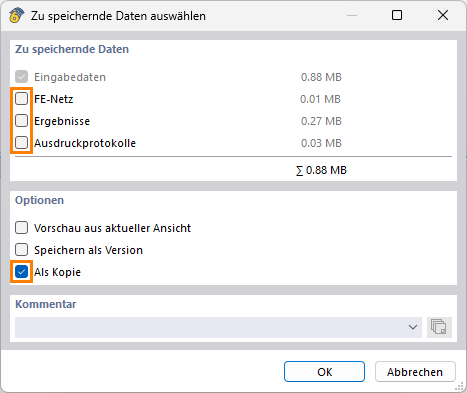
 Möchtest Du die Datei nicht öffentlich teilen? Kein Problem – schicke sie mir per Direktnachricht: klicke auf mein Profilbild oder meinen Benutzernamen → Nachricht.