Good day,
Is there anyone here with practical experience / verified statics of wall-like beams based on RFEM6 or concrete design?
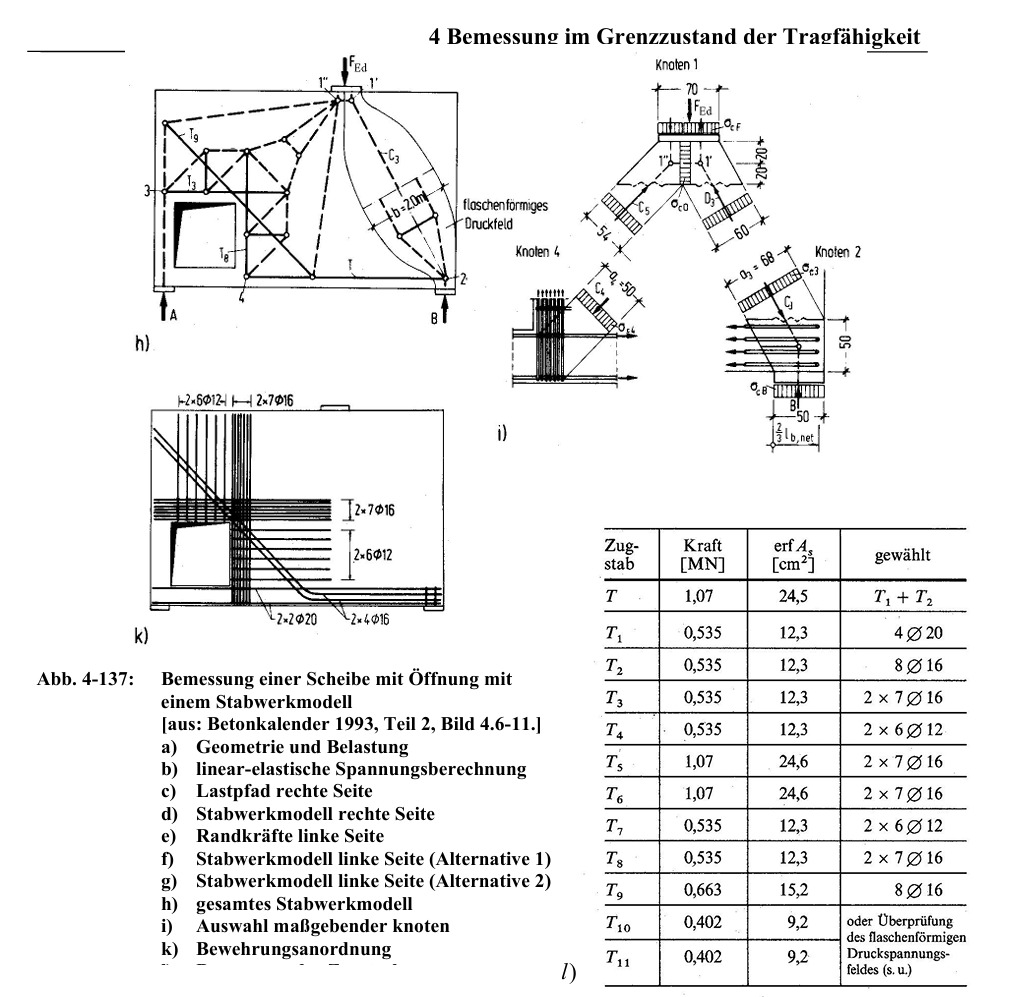
VS
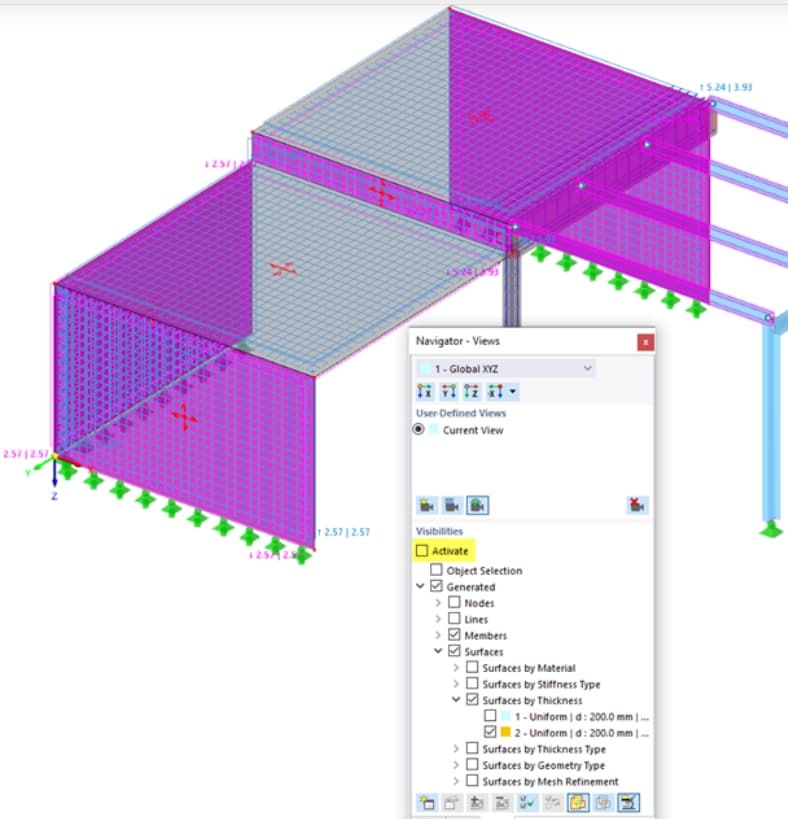
During my student career, as probably for most, the design based on truss beam models was taught, and even more FE-skeptical colleagues always use conservative programs that automatically create editable truss models with the justification that certain verifications must be performed and that wall-like beams must be verified according to certain reinforcement rules following the concrete design codes, etc. Now I wonder why actually? Since in RFEM6, at every single FE node, the surface internal forces and stresses are determined, these main internal forces and design internal forces are combined, and stress trajectories are determined, and also the verification of minimum reinforcement, as well as longitudinal reinforcement in every direction on every side, is carried out... even the crack width verification is performed at every point according to the specified limit value. Finally, one might think of the concrete strut verification at the support or load introduction => this is also automatically carried out at every FE node in RFEM6. Ductility? As far as I can see, this is also automatically verified in RFEM via strain and stress verification at every FE node of the surface.
For me, as a still young and inexperienced structural engineer, it is not clear why a component failure could occur, provided sufficient discretization was done and the load-bearing configurations are adapted to the design of walls.
What risks exist when designing wall-like beams based on concrete design in RFEM6 and design internal forces instead of truss models + concrete design codes? What effects/verifications could be inadvertently neglected?
I would be very grateful to share your experiences and opinions.
Feel free to contact me via direct message if public publishing is not desired.