Hello everyone,
We are currently investigating a diamond truss model in RSTAB 8 as part of a master's thesis and compare the results with a hand calculation using the Gamma method.
Despite verified input, we are getting a discrepancy in the deformation:
Since we could not find a clear input error so far, we would like to ask for your help to briefly check the matter or give us hints on possible causes.
The investigated model has the following boundary conditions:
-
System length: 1.00 m
-
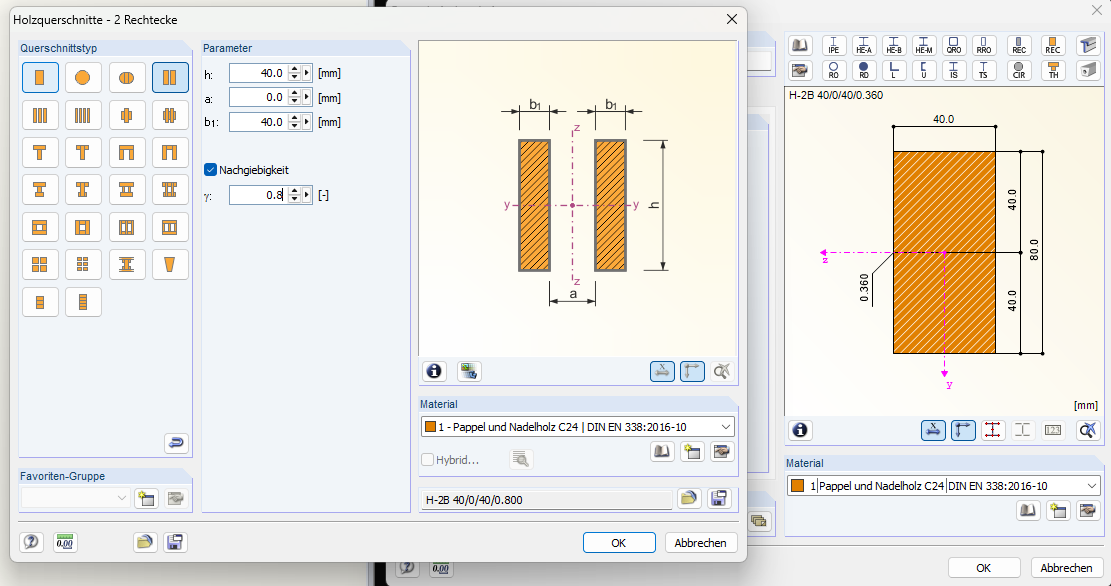
two wooden cross-sections made of C24/softwood
-
Cross-section upper chord: 4 x 4 cm
-
Cross-section lower chord: 4 x 4 cm
-
Load: Concentrated load 1 kN in the middle of the span
-
Connection of the cross-sections via coupling rods "hinge-hinge"
-
rigid rods with a horizontal spring in the middle of the rod were additionally placed at intervals of 10 cm
-
The spring was defined in the local axis (u_Z) (horizontal direction).
-
The spring stiffness in this comparative model was set very stiff to represent an almost rigid composite
-
The shear stiffness of the rods was deactivated because the Gamma method in our hand calculation does not consider shear deformation.
Our goal is to be able to compare the deformation from the RSTAB model with the hand calculation as comprehensibly as possible.
Our questions regarding this would be:
-
What causes the deviation in RSTAB 8? It should produce the same deformation as the applied Gamma method since shear deformation was not considered.
-
Are there any further influencing factors in RSTAB 8 that should be considered or deactivated in such a comparison?
-
Can the modeling via coupling rods "hinge-hinge" and rigid rods with springs lead to a slightly different system stiffness than the idealized hand calculation?
-
Is there a recommended procedure to map a diamond truss model in RSTAB 8 as equivalently as possible to the Gamma method?
I am attaching the corresponding RSTAB file.
We would be very grateful for a brief assessment or hints on the possible cause.
Best regards
Abdulraman
260512 Holzquerschnitte.rs8 (1.2 MB)
Hi Abdulraman,
thank you very much for your inquiry.
I have copied the rod once in the model and entered another rod with the Gamma method.
Furthermore, I have changed the material from DIN1052 to EC5.
The deformations look quite good with this. For the Gamma method, I did not know the flexibility, so I calibrated it.
I no longer have RSTAB8 installed. Therefore, I modified it with RFEM5. RFEM files can also be opened with RSTAB and vice versa.
In general, we of course recommend using the current program RFEM6.
Further information on the Rautenstrauch and Gamma methods can be found at the following link.
Rautenstrauch
Best regards
Bastian Kuhn
Hello Mr. Kuhn,
Thank you very much for your response.
We have improved our model and followed your advice as well as the instructions from the link. However, unfortunately, we still have a deviation in the deformation (0.06 mm with rigid composite) and 0.20 mm with flexible composite with a Kser = 595 N/mm. Additionally, it is important to mention that we calculated with an E-modulus of 10000 N/mm² for the material (C24 softwood) because we already have a comparative calculation for this case.
Furthermore, we have a general question whether deviations from the Gamma method and the associated composite model are common and how this can be justified?
I am attaching the improved model.
Would it also be possible to receive your model?
Thank you in advance for your effort.
Kind regards
Abdulraman
260513 Holzquerschnitte 2D Rautenstrauch.rs8 (484 KB)
Hello Mr. Kuhn,
I noticed that I forgot to mention the value for the flexibility. It is 0.0363.
In addition, we also entered our structure or model into RFEM5 (an older version, because I only have the license for that), and I get the same deviations there: rigid composite RFEM5 / RStab8 1.28mm and in reality it is 1.22mm. At first glance, the deviation does not seem large, but it increases with a larger beam.
Best regards,
Abdulraman
Hi Abdulraman,
Thank you very much for your response.
I have attached the model again in the first post and also here. I hope it works now.
If you look at the model, I have once defined your cross-section with the Rautenstrauch method and another beam with the Gamma method. Both are possible in RFEM/RSTAB.
In principle, the Gamma method is only correct for a "smeared" composite and only for a constant load introduction. For point shear force transfers, such as shear curves, a discrete modeling or definition via Rautenstrauch is better.
Both are of course possible. In the case of applying the Gamma method for shear curves, consideration should be given to also "pulling" the Steiner terms downward. This was also addressed in the following work. Chapter 5.
https://www.dlubal.com/files/32a7f01b-fddd-44aa-b2a9-df905f32a9d8/Thesis.pdf
260512 Holzquerschnitte.rf5 (544 KB)
Best regards
Bastian Kuhn
Hello Mr. Kuhn,
Thank you very much for your response, you really helped me.
Best regards
Abdulraman