thank you very much for your feedback. I will read up on it further.
In this context, I have a similar question that you might be able to answer:
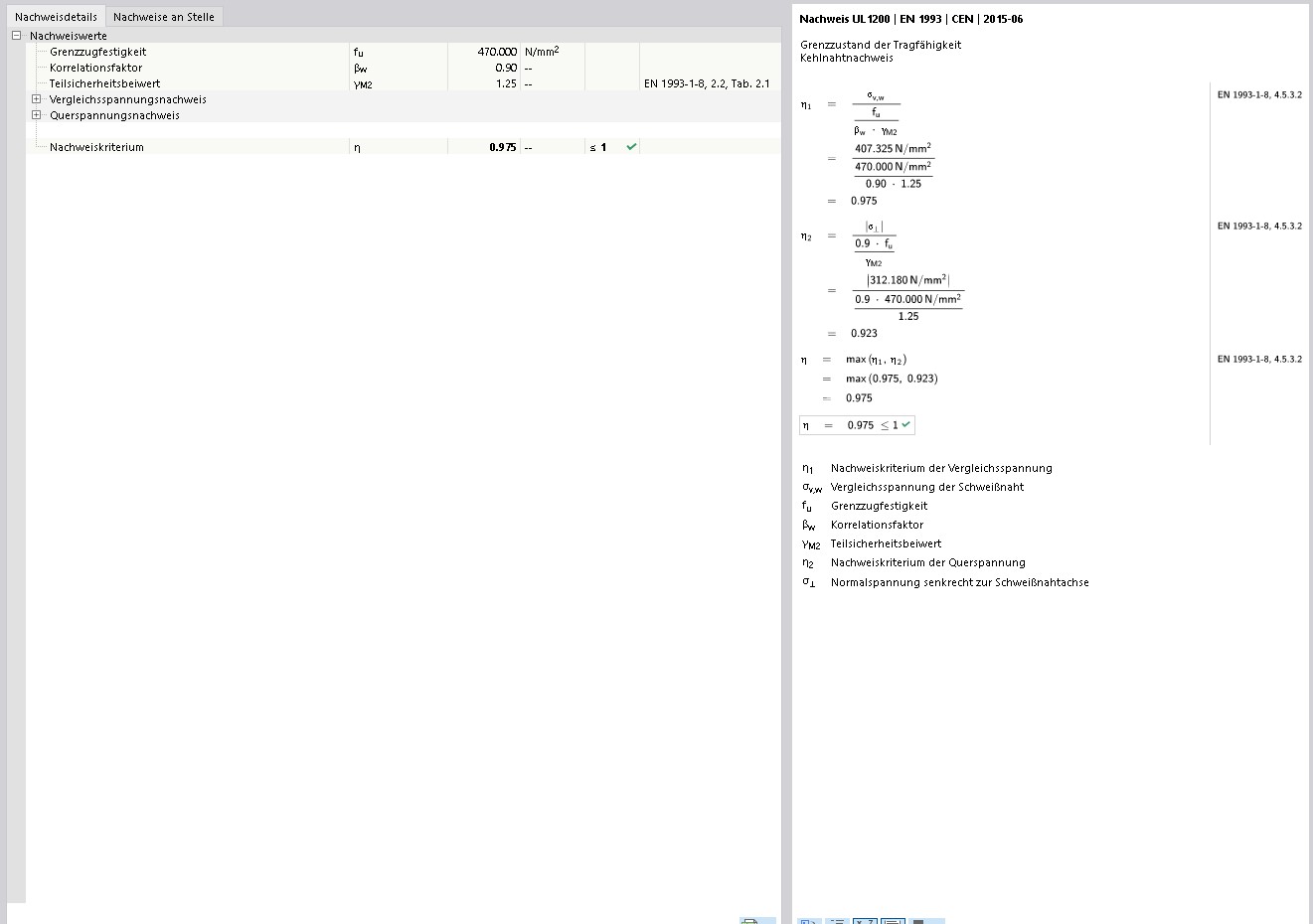
When I verify welds or fillet welds, I often notice that the utilization is around 96–98%. As in the photo below, for example.
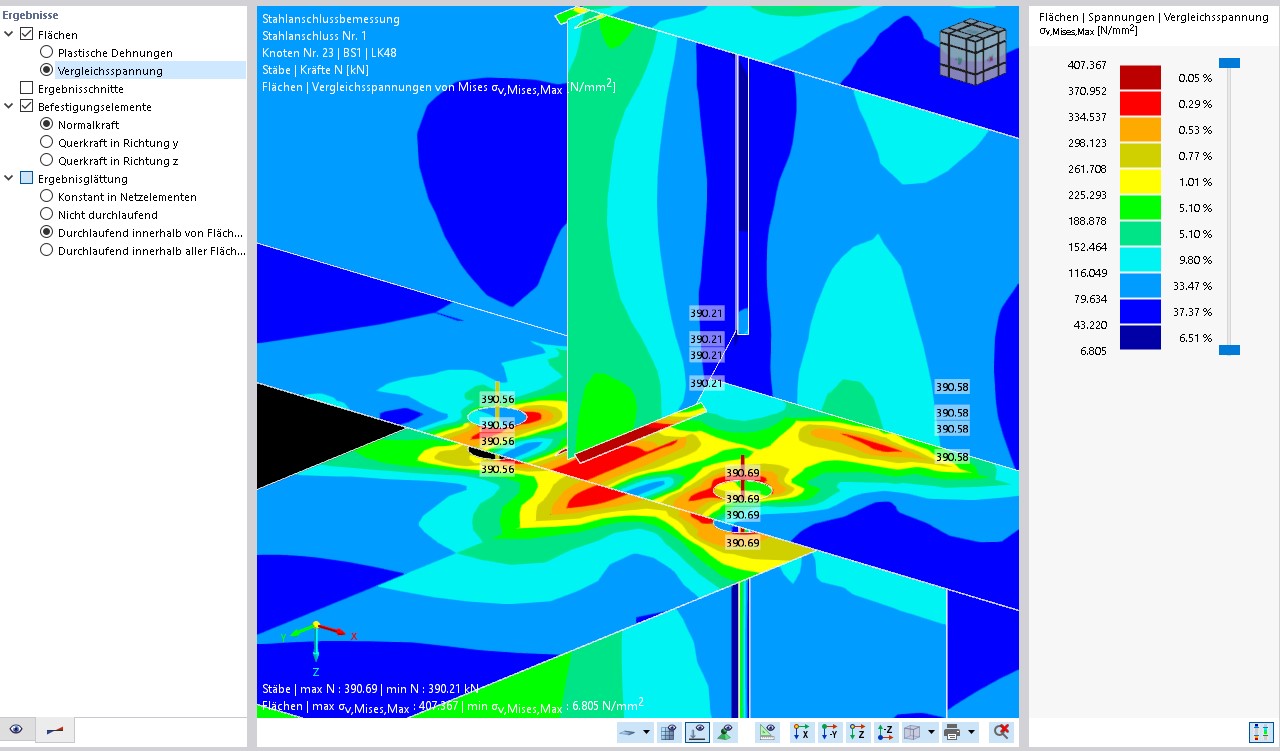
The evaluation then shows a very high equivalent stress. However, I do not know exactly how RFEM internally calculates the fillet welds.
Can I assume that the fillet welds are actually utilized at about 98%? Or is it rather a stress singularity, so that the equivalent stress – e.g., for the nominal stress concept – would have to be evaluated a few millimeters away from the weld, as specified in DIN EN 1993-1-14?
The background is that I would like to verify the connections for fatigue. Across projects, I notice that the utilization of the fillet welds is often unusually high, which in my opinion can no longer be a coincidence and rather indicates singularities.
Or questions would come from clients whether the utilization is really 98%, to which I cannot give a clear answer.
This is due to the plastic material model of the welds. This model is set so that the weld material begins to flow just before the limit load capacity according to EN 1993-1-8 is reached. This is necessary because singularities actually occur in the weld, which are smoothed out by plasticization.
The plastic limit strain can be defined in the load-bearing capacity configuration.
More information about the material model "Plastic | Weld (Surfaces)" can be found here: Online Manual – RFEM 6
Since we are operating in the nonlinear range here, the utilization of 98% should not be overinterpreted. Even if the utilization at one point is 98%, it will not increase to the same extent with a load increase or thickness reduction.
Verification according to the nominal stress concept is of course also possible, even though EN 1993-1-14 is still in draft status.
If you have any further questions or anything is unclear, I am happy to help!
 ,
,