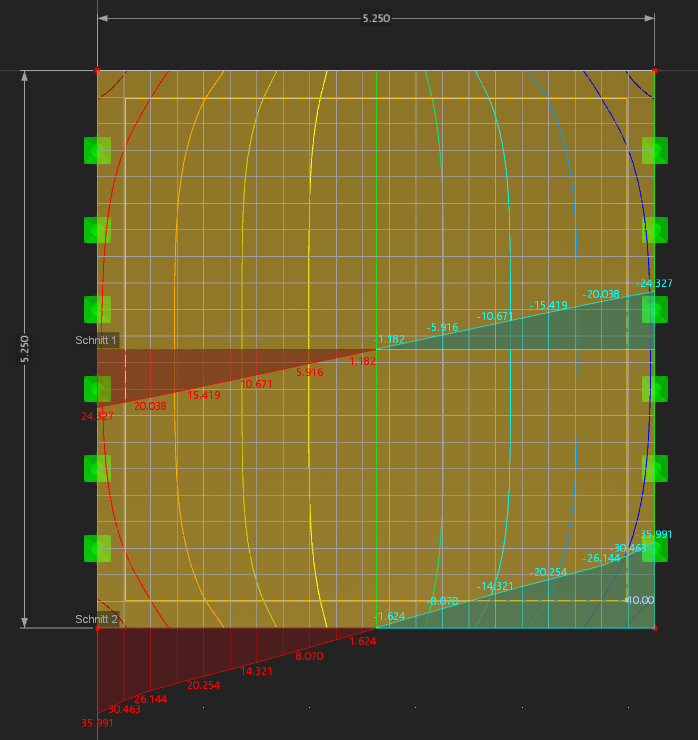
We have been using RStab and RFEM for ages, but mainly only as a frame system. Recently, we upgraded to RFEM6 and now wanted to use the concrete surfaces productively to gradually move away from our previous FEM program.
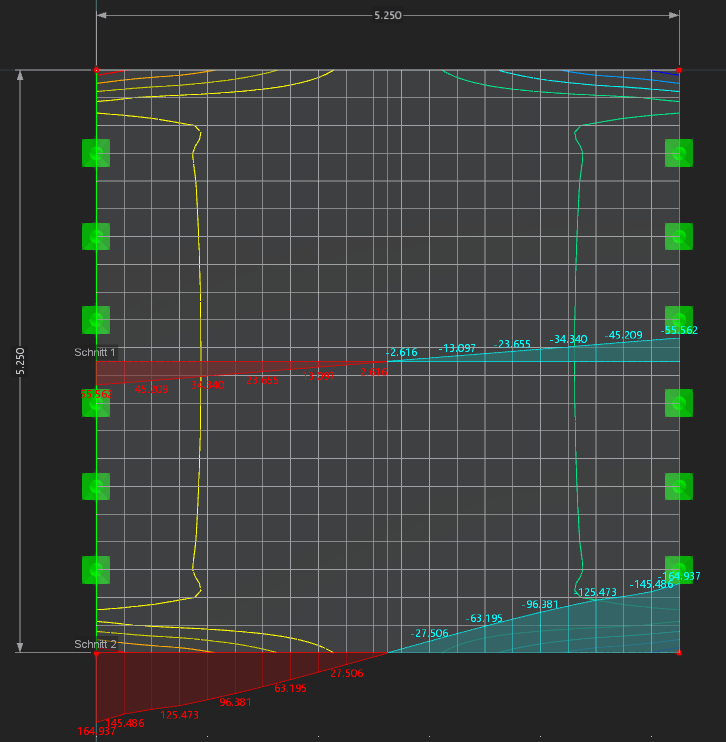
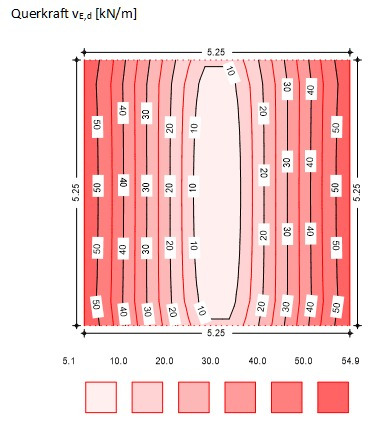
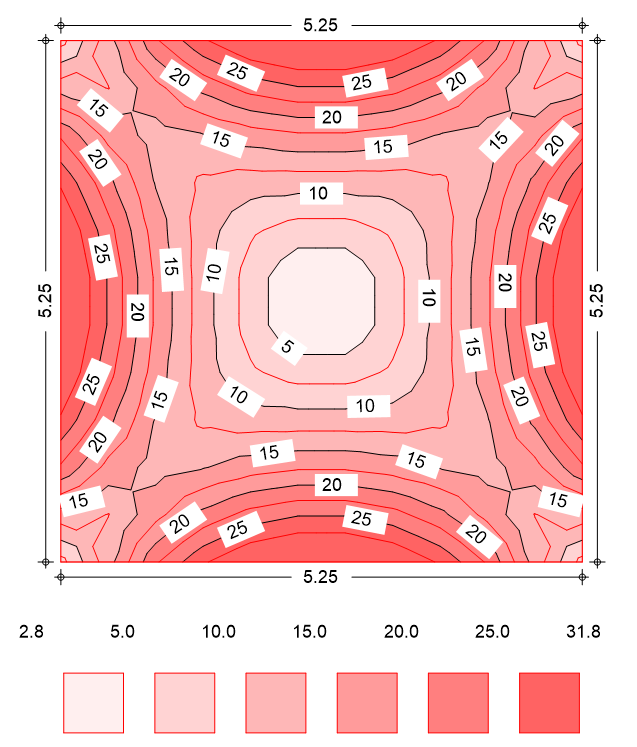
As the first "project," we tested a simple two-way spanning slab. Here, we already noticed the unusually high shear forces that occurred partially. Comparison calculations with our previous program and another one showed much lower values.
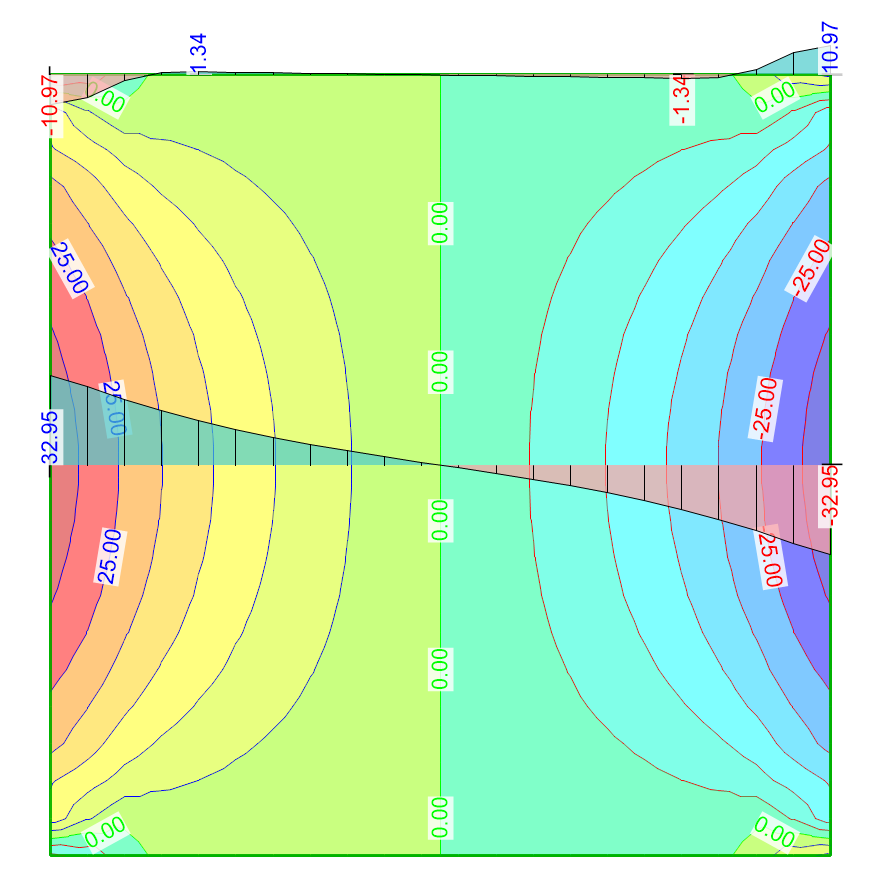
To break it down in the simplest form, we then modeled the slab as one-way, and the effect remained the same. Unusually high shear forces at the free edge, which actually should not be there.
Are we making a modeling error?
With such simple systems, you can still recognize that something is wrong, but with more complex systems, it would be fatal if suddenly "everywhere" spots with shear force problems appeared.
REFM5 delivers similar results, although not quite as extreme.
The system:
2D slab system
Reinforced concrete floor slab, C25/30, h=22cm, 5.25x5.25m, FE mesh 0.25m
Self-weight only from the slab + 10 kN/m² live load.
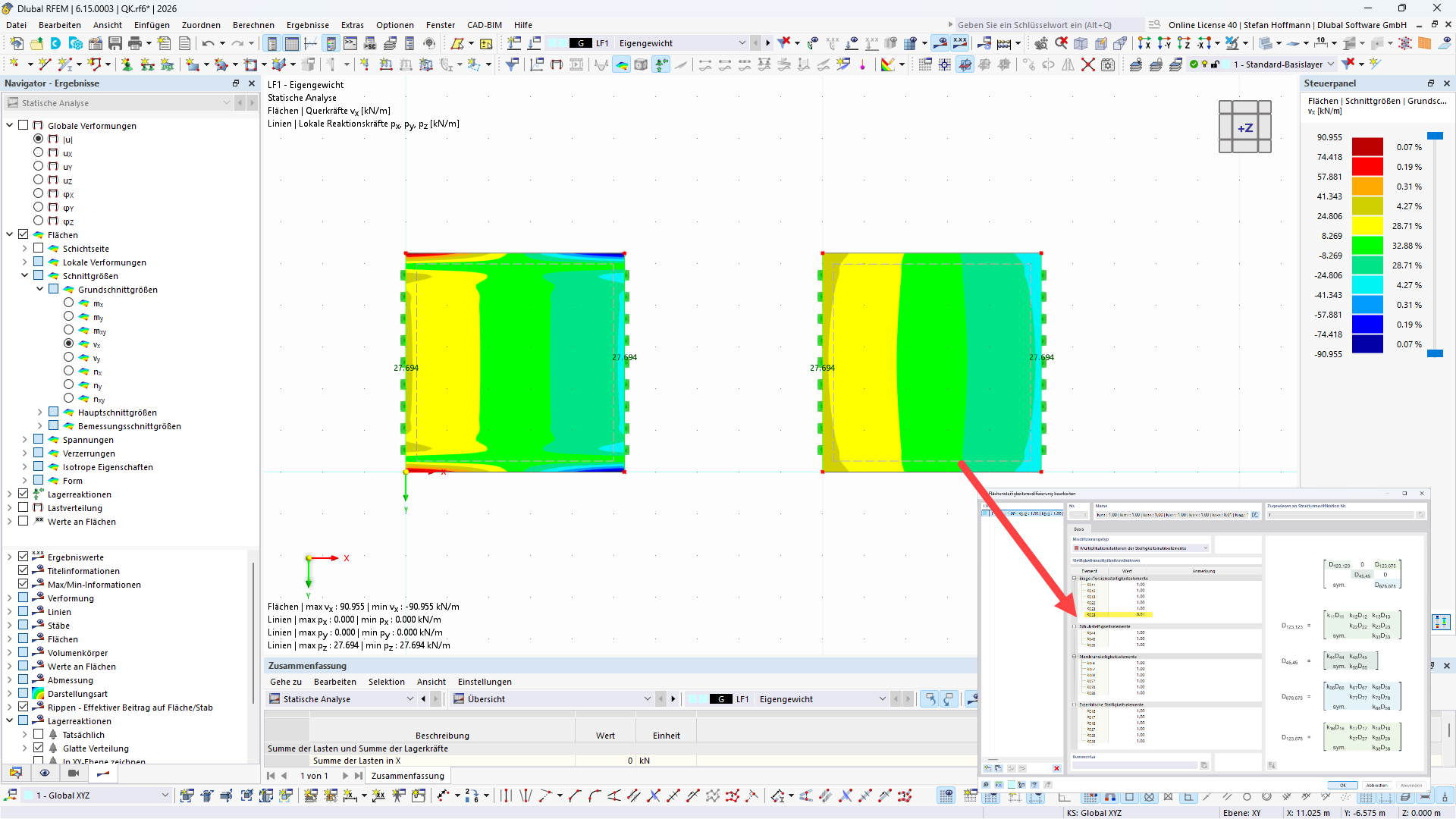
In general, with a ceiling tensioned in one direction – as in your given example – it is due to the torsional stiffness. If you want to ignore this, you would need to modify the stiffness here, analogous to RFEM 5:
Whether your slab is torsionally stiff or torsionally soft depends on your boundary conditions (reinforcement, type of surface) and is difficult for me to assess.
The reduction to a one-way plate was only an attempt to reduce the possible causes. With the two-way plate, we already thought it might have to do with the torsional stiffness, but the effect was extremely pronounced. For example, we also worked with elastic bearings to mitigate the support effects in the corners.
Basically, we believe that for a definitely one-way supported slab, it should hardly make a difference whether it is torsionally flexible or stiff, since no torsional effect can occur!?
Does this mean that I generally have to reduce the torsional stiffness? None of the shown tutorials address this, and the results there also look plausible. Therefore, I am surprised that with such a simple and regular system we already have problems and have to reduce values where other programs directly provide plausible results.
Honestly, this worries me regarding the interpretability of the plate internal forces in RFEM.
Or are we doing something fundamentally wrong in the choice of the surface, etc.?
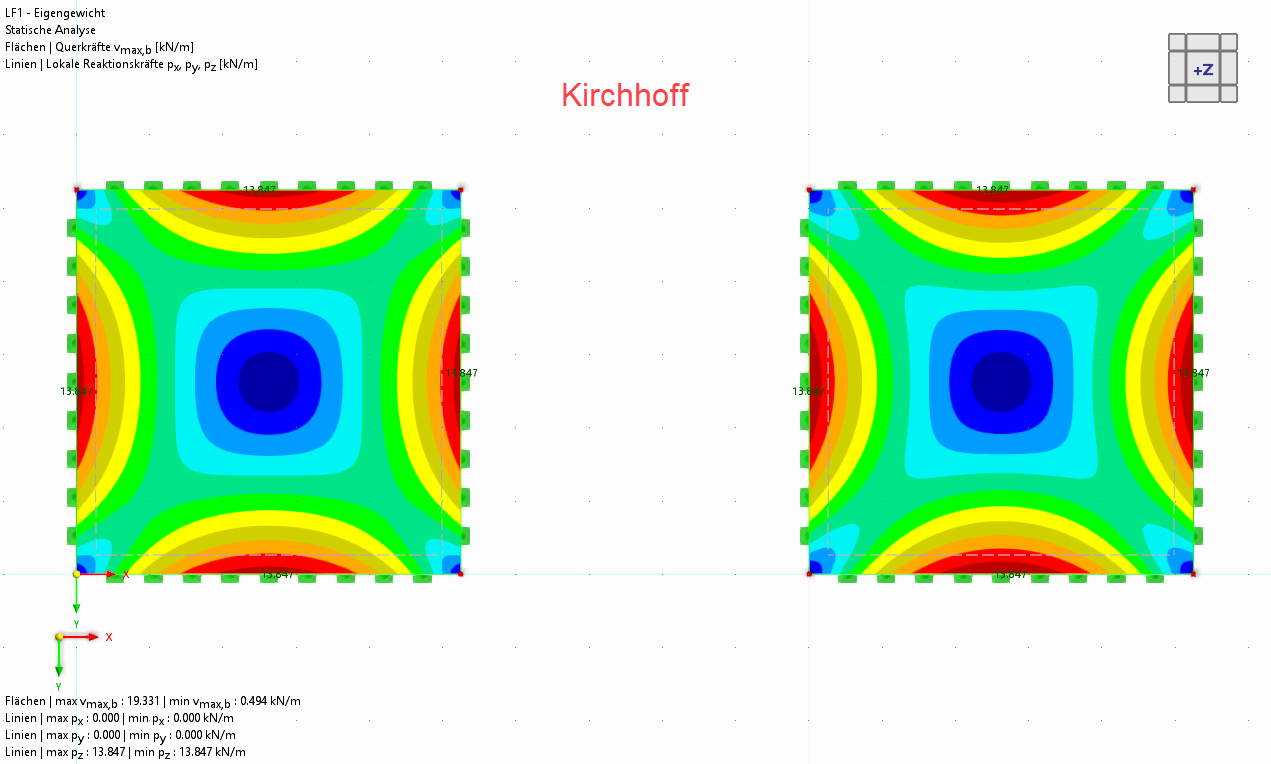
The comparison images suggest that the other programs calculate according to Kirchhoff instead of Mindlin. This can also be changed directly on our side, if desired:
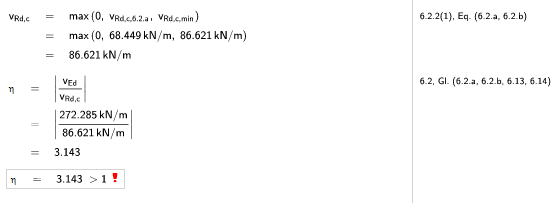
If you reinforce a regular concrete surface biaxially, then according to my understanding it is torsionally stiff and should be assessed according to Mindlin. The shear force verifications are carried out at a distance of 1d from the slab edge. RFEM initially verifies every value here. So, either the singularities can be counteracted by adjusting the surface result, or a different note can be attached here.
Thank you very much.
This is the solution or rather the reason for the deviation.
Now we have to decide for ourselves which calculation method we want to apply.
According to my understanding, this depends less on the type of reinforcement and the resulting torsional stiffness, and more on the estimation of "thin" vs. "thick" plate.
A reinforced concrete slab usually behaves somewhere in between, tending rather towards "thin."
I would also be very interested in the opinions of other users here.
Do all of you basically calculate according to Mindlin?
How are the shear forces handled?
Perhaps Dlubal could also make a short video about the advantages, disadvantages, and applicability. Something around 20 minutes, not a full webinar.
Regards.
EDIT:
I found the switch in my other program to also calculate according to Mindlin there, and comparable results to RFEM came out.
Subsequently, I made the slab really "thick" both there and in RFEM, and the thicker the slab gets, the more Mindlin behaves like Kirchhoff.
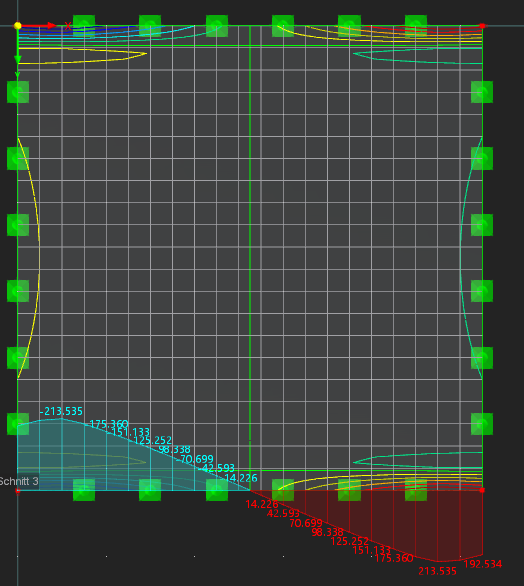
Shear force distribution for live load only in RFEM6 with a 200cm thick slab according to Mindlin:
This reinforces my assumption that the h/L ratio plays a decisive role in the result. For "normal" slabs, I would therefore tend more towards Kirchhoff and spare myself the result smoothing at certain points.