Hello,
I have another question regarding the topic of aluminum design in RFEM 5.
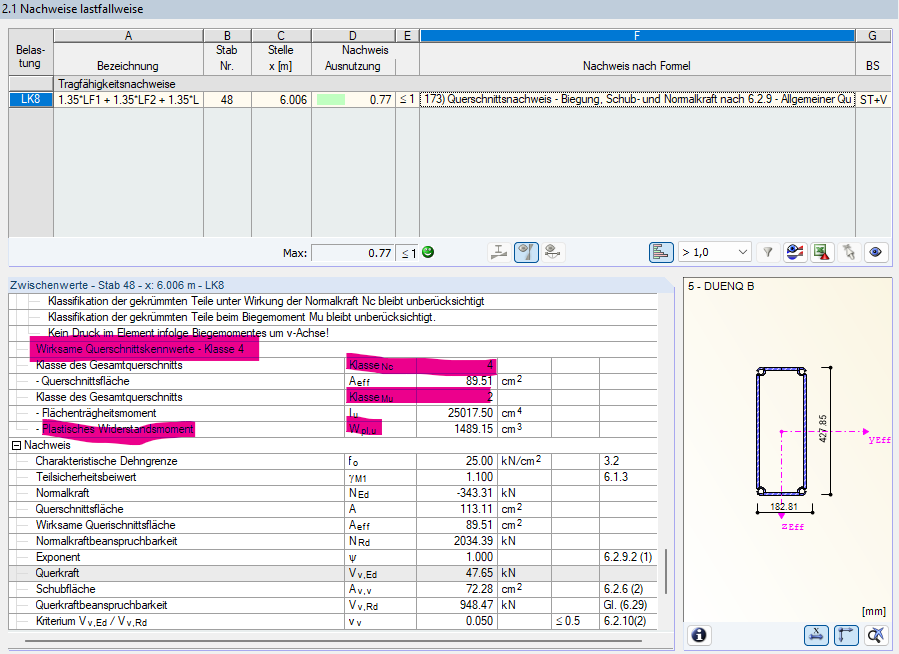
I noticed that the cross-section is being checked plastically, even though it was classified as Class 4.
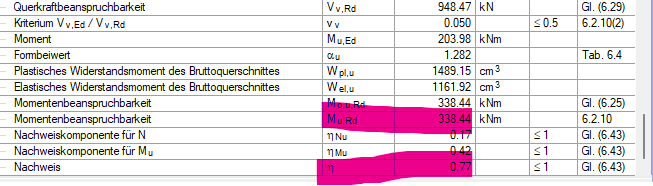
I am also puzzled by the check: despite the cross-section being Class 4, the compression check is performed as a Class 4 check, while the moment check is performed as a Class 2 check.
A plastic section modulus was used for this check.
P.S.: The results for the internal forces were obtained from a load combination.
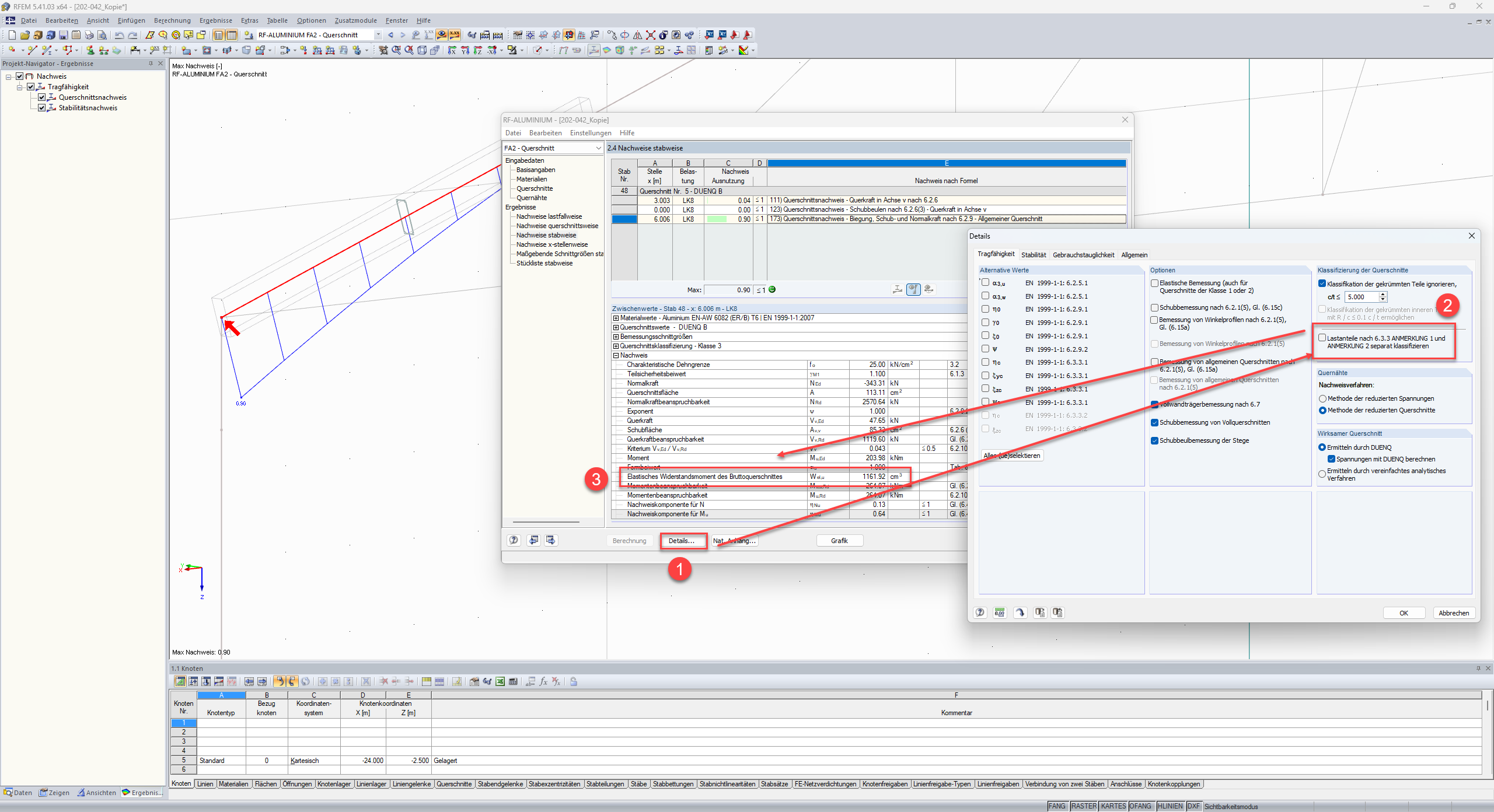
Auszug: "Die Einstufung der Querschnitte für Bauteile mit Biege- und Längskräften wird in RF-/ALUMINIUM nach EN 1999-1-1, 6.3.3 Anmerkung 1 für jede Belastungskomponente getrennt durchgeführt."
Wenn Du die getrennte Klassifizierung deaktivieren willst, kannst Du das unter den Detaileinstellungen ändern, indem diese Option deaktiviert wird. Der Querschnitt von Stab Nr. 48 wird dann in Querschnittsklasse 3 eingeordnet, die Bemessung erfolgt mit elastischem Widerstandsmoment.
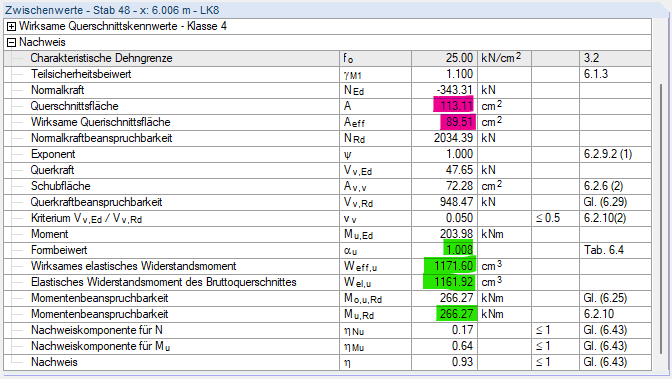
wie kann es sein, dass das effektive Widerstandsmoment größer als das elastische Brutto-Widerstandsmoment ist, obwohl die effektive Fläche durch die Klassifizierung in Klasse 4 kleiner wird?
Aus der Berechnung ergibt sich ein Formbeiwert von 1,008, also größer als 1. Wie kann das sein? somit ergibt sich größeres Moment als el. Moment
 Click File → Save As and select the following settings to reduce the file size: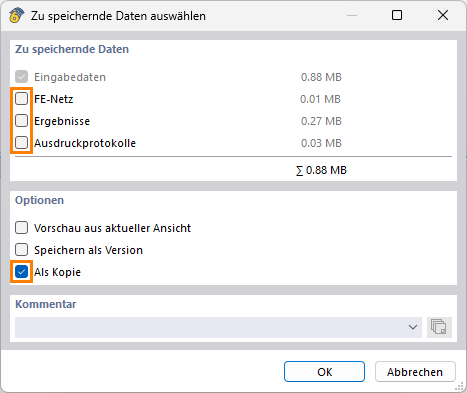
 Would you rather not share the file publicly? No problem — send it to me via direct message: click on my profile picture or username → Message.