RFEM and other Programs on Linux (ubuntu, debian,...)

Dear Dlubal Team,

I would like to suggest a feature that I believe could strongly benefit many of your users: making RFEM 6 and your other software available natively on Linux (particularly Ubuntu/Debian distributions).

Currently, RFEM is the only reason we, as a structural engineering company, still maintain a Windows dual-boot setup. For many of our engineers, we increasingly rely on open-source software such as Code_Aster and other tools available on Linux, which better fit our workflows. Having RFEM available on Linux would allow us to fully migrate, simplify IT administration, and reduce costs.

Here are some key reasons why Linux support would be highly valuable:

  1. Cost-efficiency for small and mid-sized companies

    • Linux is free and open-source, reducing the overall cost of ownership compared to Windows licenses, which can be significant for teams like ours (we are 15 engineers).

    • This makes RFEM more accessible to smaller firms and startups.

  2. Performance and robustness

    • Linux systems generally offer better resource management, stability, and scalability.
  3. Remote work and flexibility

    • Linux enables simple, secure, and free remote access (via SSH, X11 forwarding, or lightweight remote desktop tools) from any device, including tablets and thin clients.

    • This is much more cost-effective than remote access solutions on Windows.

  4. Alignment with engineering and research communities

    • Many universities, research institutes, and engineering firms already rely on Linux for HPC and simulation tasks.

    • Providing RFEM for Linux would integrate Dlubal software more deeply into academic and professional ecosystems, strengthening long-term adoption.

  5. Competitiveness with open-source tools

    • Open-source structural analysis software (such as Code_Aster) is steadily improving, and engineers increasingly adopt it because of its availability on Linux.

    • Offering RFEM on Linux would position Dlubal as the premium alternative that combines professional support and reliability with the openness engineers seek.

In short, Linux support would:

  • Reduce IT costs for small companies.

  • Provide more robust, scalable, and flexible workflows.

  • Make RFEM accessible on powerful remote servers without additional licensing barriers.

  • Strengthen Dlubal’s position in research and academia.

We sincerely hope you will consider this feature request. RFEM is an excellent software, and Linux support would make it even more indispensable for the structural engineering community worldwide.

4 Likes

Hello mga_structurame, and welcome to the Dlubal Community! :waving_hand:

Thank you for your detailed summary of the potential benefits of a Linux port. Porting RFEM (and other programs) to Linux would indeed require a considerable effort on our side. That said, it’s not technically impossible.

For us, the decisive factor is the level of customer demand. That’s why your initiative to create this vote is very valuable — it helps us better evaluate how much interest there really is in this feature. :+1:

Just as an additional note:

  • This feature request has already been documented in our system under RUS ID 3959.

  • You can refer to this ID when submitting further requests or when discussing the topic with us.

Thanks again for your contribution, and let’s see how the community votes! :rocket:

1 Like

One thing is important for speeches. This could be a difference between Dubal software and the competition. To be the first company supporting Linux.

4 Likes

Hello @Marllon_Rangel,

Welcome to our community. I am delighted that you are interested in RFEM.

I would like to go into a little more detail about the issue of porting RFEM to other operating system platforms. This applies not only to Linux but also to macOS.

First of all, I am a committed Linux user myself. I mainly use Ubuntu. Personally, I would really like it if RFEM were also available for Linux.

Porting complex software such as RFEM to another operating system is more complicated than one might imagine.

RFEM is based on the Qt library. This is a good starting point, as Qt is also available for Linux and macOS. However, it is not as simple as telling the compiler to create a Linux or macOS version. RFEM uses a large number of small libraries internally. These would all have to be checked, and a whole series of adjustments would have to be made in RFEM. This would require a considerable amount of effort, but it would only be the first step.

When a new RFEM version is released, a large number of automated processes are carried out (keyword CI/CD). A large number of tests are performed automatically beforehand. This entire process chain would have to be set up in parallel for Linux and macOS.

Finally, the prerequisites would have to be created so that we can provide good support for the Linux and macOS versions.

These are all solvable tasks. However, in our opinion, the effort involved is disproportionate to the benefits in the current situation. The proportion of Linux and macOS users is currently too small.

For Linux, I recommend running RFEM with Wine.

On macOS, RFEM works very well in Parallels Desktop, even on ARM Macs.

Of course, we are always keeping an eye on whether the situation changes and will respond accordingly.

Best regards,
Frank

2 Likes

Thank you very much for your reply. I know that adding support for another operating system is a very difficult task.
Regarding running it using Wine, is there any default setting that allows it to run? I tried and couldn't get it to work.

Is Wine displaying an error message?

The problem could be OpenGL support. RFEM 6 requires 4.2.

Best regards,
Frank

Sorry, I'm a beginner user of Linux operating systems. This distribution is Ubuntu 25.10.

I can run some .exe software programs, such as Ftoll, Trame, Flexo, and others.

Obs.: My wine version is 10.0.

The EXE file you downloaded is a self-extracting archive. Try to extract the archive, e.g., with unzip . This will create cab files and an MSI file.

Then try to install the MSI file with msiexec .

wine msiexec /i Dlubal_RFEM_64bit.msi.msi

Does that work?

Best regards,
Frank

I can't find the msi file

Dear Frank,

Thank you very much for your detailed and transparent answer. We truly appreciate the time you took to explain the technical and organisational challenges behind porting RFEM to Linux and macOS. It is of course a pity given how much value native Linux support would bring to many engineering teams like ours :slight_smile:

That being said, your explanation makes sense and we fully respect the fact that prioritisation must follow actual market demand.

In this context, one potential intermediate solution could be very helpful (as already partially mentionned here) : “official support” or documentation for running RFEM under Wine (or tools like Bottles).

Since Wine compatibility is already possible to some extent, providing guidance, tested configurations, or even partial support would make a significant difference for many Linux users. This would allow teams like ours to stay on Linux while still relying on RFEM without requiring a full native port. It may also be a relatively low‑effort way to address a growing Linux user base…

Again, thank you for your openness and your engagement with the community.

We hope that Wine “support” could be considered as a first step — and we are grateful that you continue monitoring the evolution of Linux usage among your customers.

Best regards

4 Likes

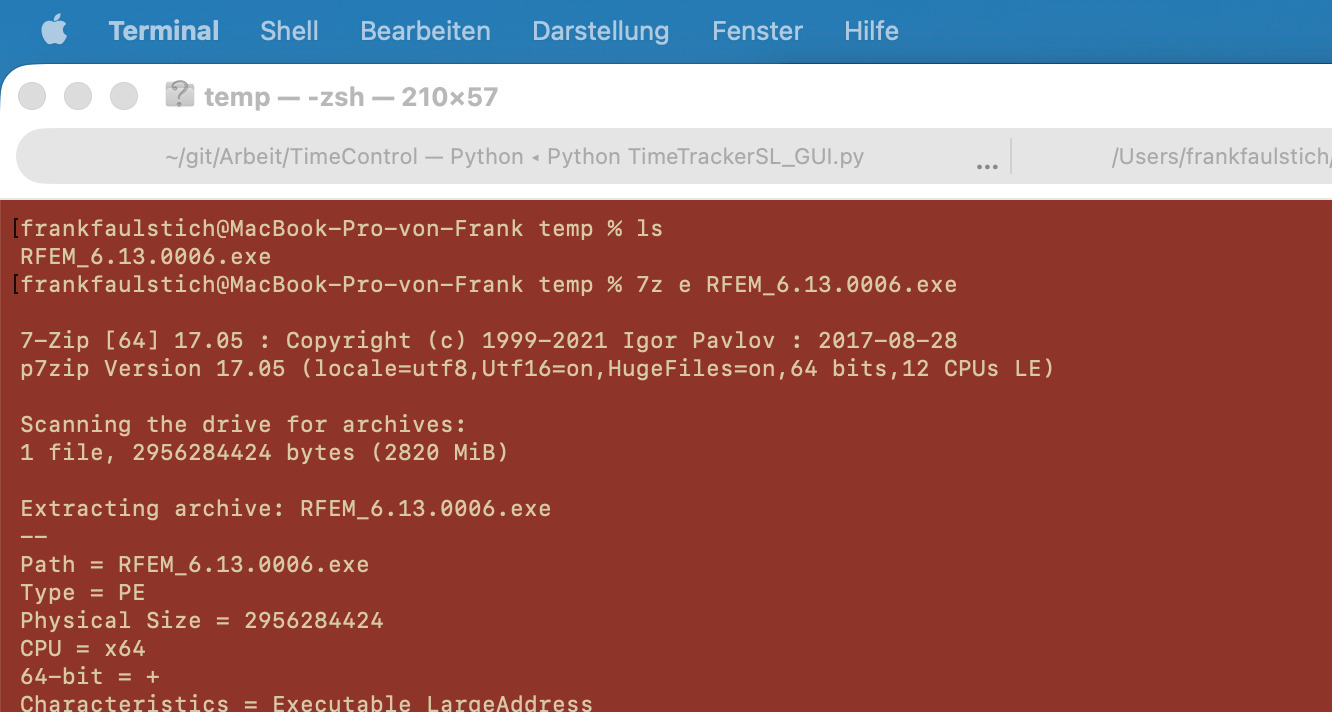
Unpacking should also work under Linux:


7z e RFEM_6.13.0006.exe

I tested it under macOS, which is very similar to Linux.

If necessary, you can also unzip the file in Windows PowerShell.

https://www.dlubal.com/en/support-and-learning/support/faq/005242

Best regards,

Frank

I experimented with Wine and RFEM some time ago, but on macOS rather than Linux. I failed because Macs present completely different challenges (keyword: processor architecture). It turned out that Parallels Desktop is the best solution, which is also suitable for the average Mac user.

In any case, I have decided to look for a solution to get RFEM running on Linux. I will first try to do this with Wine, and if I fail, I will also try with a virtual machine.

Best regards,
Frank

1 Like

Hello Frank,

have you already had experience with installation under Wine (POP! OS)?
I tried to install the current RFEM 6, but the installation hangs at the .NET Framework 4.7.2.

Regards Frank

Hello fox_bw,

no, unfortunately I have no experience with this topic yet. I have planned to look into it, but I haven't gotten around to it yet.

Best regards
Frank

I appreciate the thoughtful discussion on this topic. My engineering software is basically the last thing keeping me on Windows. Windows just seems to get worse and worse and I would love to ditch it entirely for Ubuntu. The problem seems to be a chicken-and-egg issue: not enough market demand to justify the work of porting RFEM over to Linux vs no ability for users to fully switch to alternative OS's because their particular needed software isn't an option on that system yet. We can't ditch Windows and still do our jobs, but until we do, there's little reason for software providers to develop non-Windows versions! And of course there would be a significant time lag between start of developing a Linux version and it actually being ready for us to use.

But I would suggest a paradigm shift: don't think of it as expensive development for a low market share OS, but rather as an investment in future-proofing Dlubal against the eventual suicide of Windows.

In the meantime, guidance on Wine would be helpful. I tried it a few years ago to try to get a certain popular finance software I used at the time to run in Ubuntu. I never could get it to work with Wine, and finally nervously imported years of financial records to an open-souce accounting software that took some getting used to, but I'm happy with now. But if something like RFEM could be implemented with Wine, I'd be willing to give that a try again. Either way, thanks for a high-quality program!

3 Likes

Hello @mccoolj,

I completely understand your point of view. For us, porting to Linux and/or macOS is, for now, a cost factor.

But perhaps we could start with a small step toward Linux. Maybe we could begin by porting the server version to Linux. That would offer significant benefits to users who use the RFEM Server as a backend for their own applications. With technologies like Docker, the infrastructure could be used more efficiently, thereby saving money. We are currently discussing this topic internally and investigating its feasibility.

The wine guide is on my to-do list. I hope I’ll find some time for it soon.

Frank

1 Like

I also vote for a Linux version of RFEM as soon as possible! :+1: :penguin:

It is especially the industry-specific software available only on Windows that forces us to stay on Windows (it's the chicken :chicken: and the egg :egg: story).

Aren't there any European Union grants that allow European publishers like Dlubal to cover part of the development costs?

1 Like

Yes, that’s definitely a chicken-and-egg problem.

What’s the situation like at your company regarding the use of Linux on desktops? There are, after all, a number of ways to make Windows applications available to users with Linux clients.

The Windows applications could run on a Windows server and be made available to Linux users via Remote Desktop.

The Windows applications could be isolated on the Linux client in a virtual machine running Windows. Linux offers several options for this with KVM or VirtualBox.

Windows applications could be run using Wine.

Is something like this done at your company?

Frank Faulstich