Does anyone have experience with the static assessment of cracks in BSH beams?
The ÖNorm 2215 states that cracks up to 1/6 of the depth of the beams are permissible on both sides. However, no information is given about the number of cracks. If I push this to the extreme, I would only have 2/3 of the beam width left as a load-bearing solid cross-section.
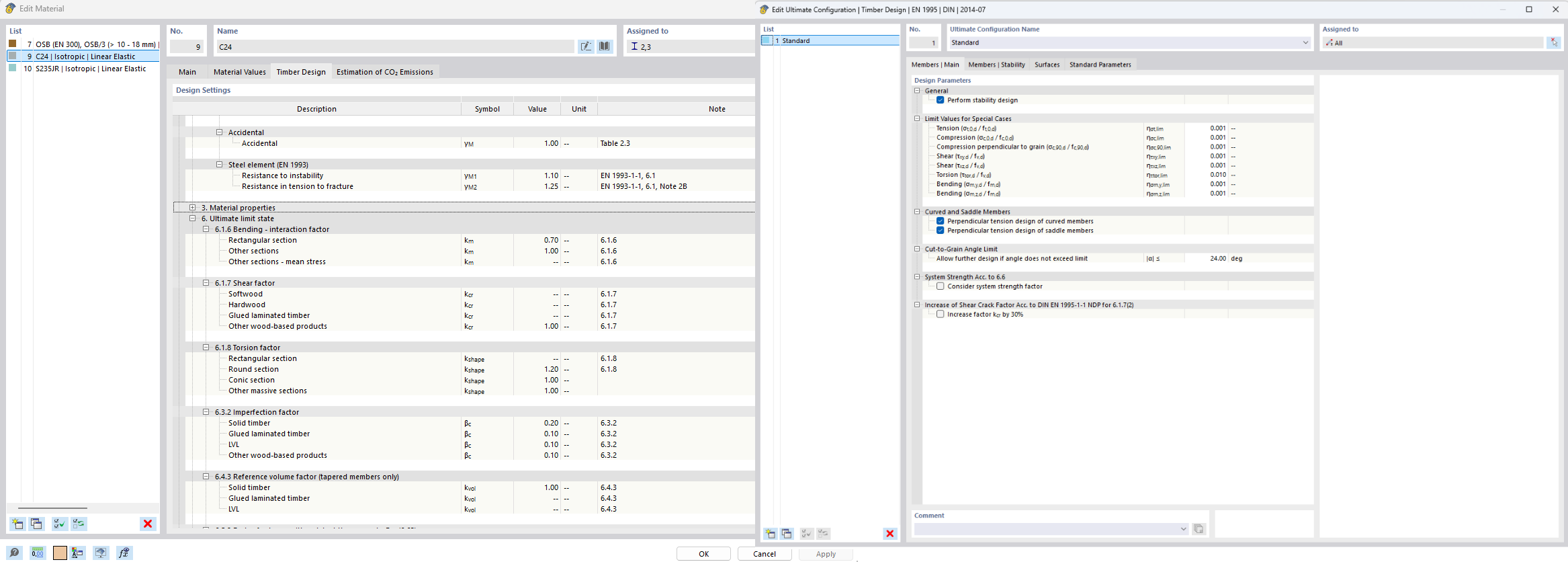
Hello Boris, thank you for your question. For the verification you have the k_cr (k Crack) Factor in the Eurocode. This factor reduces the width in the verification of the shear. In the software you can find this factor in the parameters of the material and in the ULS configurations of the Timber Design. Please see the attached picture and link.
If the cracks are over this limits you`ll have to reduce the stiffness of the section. A possible solution to model this would be via surfaces and line hinges or via rigid couplings for beams.
Hello Bastian,
thank you very much for the response. I am still not sure if the solution works this way. It concerns a beam in the existing structure where two cracks in the glue joints go deeper than 1/6 b. The question now is how much the load-bearing capacity is reduced. In my opinion, the reduction of the beam width should generally be uneconomical (replacement with an overlying roof is correspondingly complex…).
if the support is reduced by more than this 1/6, I would reduce it by this amount. Above all, this should already be relevant for the stiffness and thus for the deformation. In case of doubt, the structure definitely needs to be reinforced.