I am investigating the influence of damaged concrete reinforcing steel (chloride-induced corrosion) on the stress and deformation behavior of reinforced concrete components. The goal is to represent the difference between undamaged and corroded reinforcement in a nonlinear FE analysis.
I am performing a nonlinear stability analysis of a reinforced concrete slab in RFEM 6 (version 6.14.0003).
Model description:
- Reinforced concrete slab 7×5 m, thickness 24 cm
- Concrete C20/25 with material model 'Anisotropic | Damage'
- Surface reinforcement B500S with material model 'Isotropic | Plastic (bars)'
- Areas in the field and support region with lower reinforcement and their own stress-strain curves (damage areas)
- Nonlinear stability analysis (ST1 - incremental method without eigenvalue analysis)
- Structural modification with activated surface reinforcement and materials
- Applied load: 5 kN/m² + self-weight (active)
Problem 1 — Damage parameter already very high at the first load step:
At the first load step (load factor ~1.0), the damage parameter D already shows values of approx. 0.89 — which corresponds to 89% damage of the concrete under service load. This does not appear physically reasonable, as at service load at most slight cracking would be expected.
Problem 2
The first significant crack in the load-deformation curve occurs only at a load factor of 8.35 (= 41.75 kN/m²), at which a deformation of 22.31 mm is already present. Failure occurs at a load factor of 11.8 (= 59 kN/m²) with a deformation of 48.42 mm. For a reinforced concrete slab of these dimensions, this seems unrealistically high.
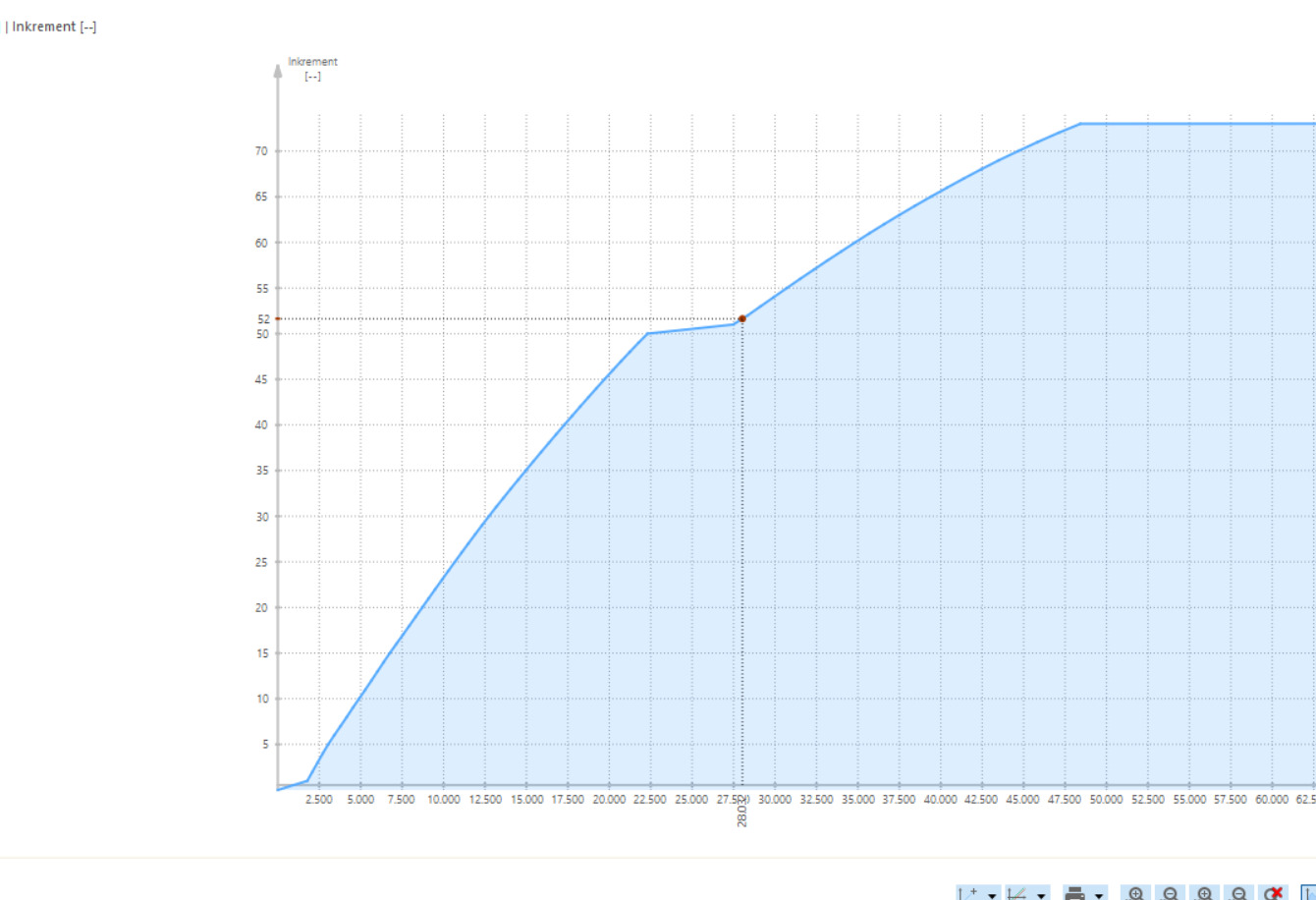
My questions:
- Why is the damage parameter D already so high at the first load step?
- Why does the first visible crack only appear at load factor 8.35 instead of around 0.5–1.0, although D is already about 0.89?
- Why does changing the tension stiffening parameters have no effect?
Stahlbetondecke geschädigt und ungeschädigt.rf6 (1.0 MB)
I would be very grateful for any feedback.