Good evening,
I am currently writing my thesis on connectors for timber-concrete composite bridges. I have created a truss model for discontinuous connectors, which represents a timber beam as well as a part of the deck slab. I now have a question regarding the concrete stresses output by the design tool for bars. Under "Results," the concrete stresses can be read. In my example, only a compressive stress is output, but no tensile stress. From this, I would conclude that the results were determined assuming a cracked state. Is it also possible to output the concrete stresses in an uncracked state?
I have attached the RSTAB model. Thank you very much in advance.
Best regards
Markus
HBV-Brücke-Kerven GZG=GZT_hn=20mm.rs8 (3.8 MB)
Hello Markus,
we still need a bit more time to answer this correctly and thoroughly.
You can expect a response tomorrow.
Best regards,
Matthias
Hello Markus,
A distinction must be made here between structural analysis and design.
The design internal forces are determined by purely linear-elastic structural analysis (uncracked state).
For the ULS verifications, the tensile strength of the concrete is then disregarded in accordance with the code (DIN EN 1992-1-1, 6.1 (2)), and a redistribution of compressive forces takes place, with a shifted internal lever arm, etc. The ULS design therefore assumes a cracked state.
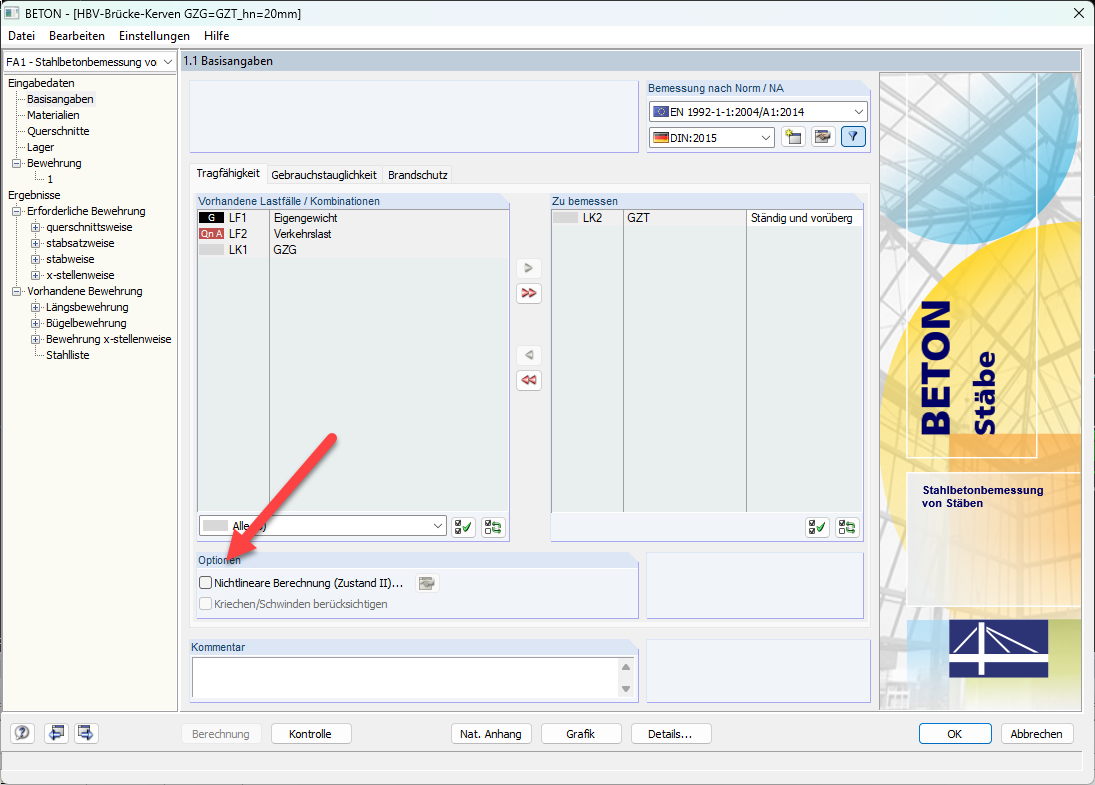
It is possible to use the stiffnesses for the cracked state. To do this, this box must be checked. In your model, it wasn’t checked.
Best regards,
Matthias
Hello Matthias,
Thanks for your quick help. That clears things up for me. I had assumed that nonlinear calculations generally display only values for the cracked state.
Best,
Markus