Hello,
I am working with RFEM 6.12 and I have two related questions regarding beam panels and line hinges.
- Automatic generation of line hinges
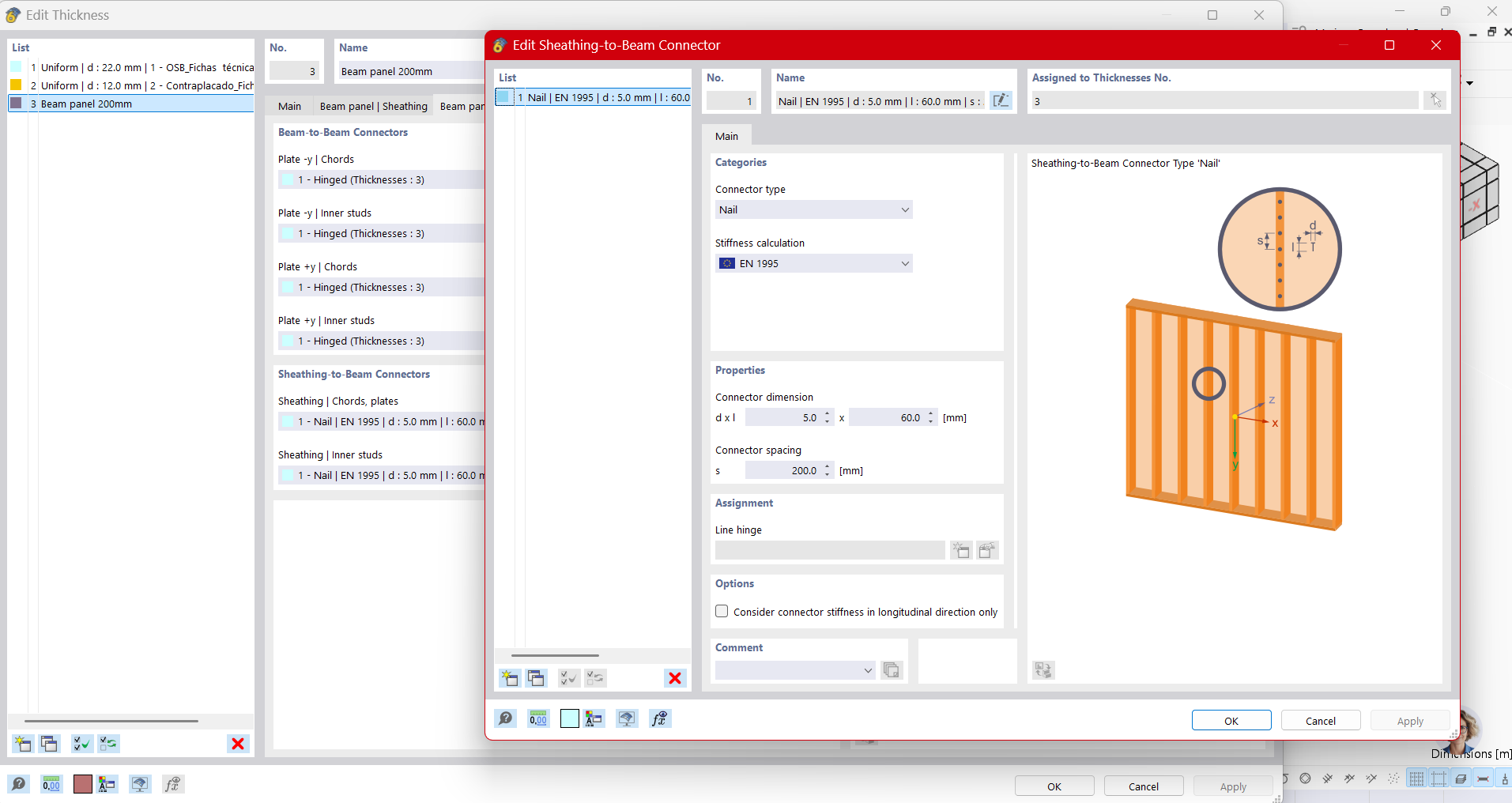
When I create a beam panel and assign connector definitions (see Image 1), RFEM automatically generates rigid links associated with line hinges.
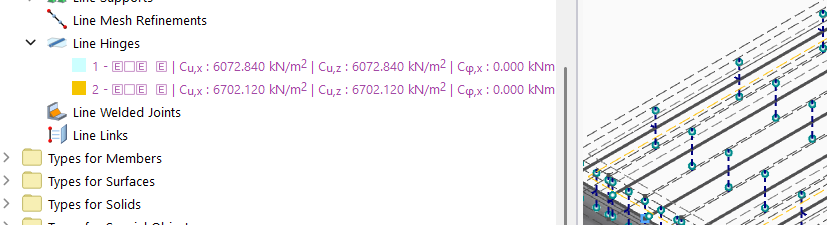
Is it possible to know which calculations RFEM performs to determine the stiffness values of those line hinges (see Image 3)?
In particular:
- Are these stiffness values derived from analytical formulas?
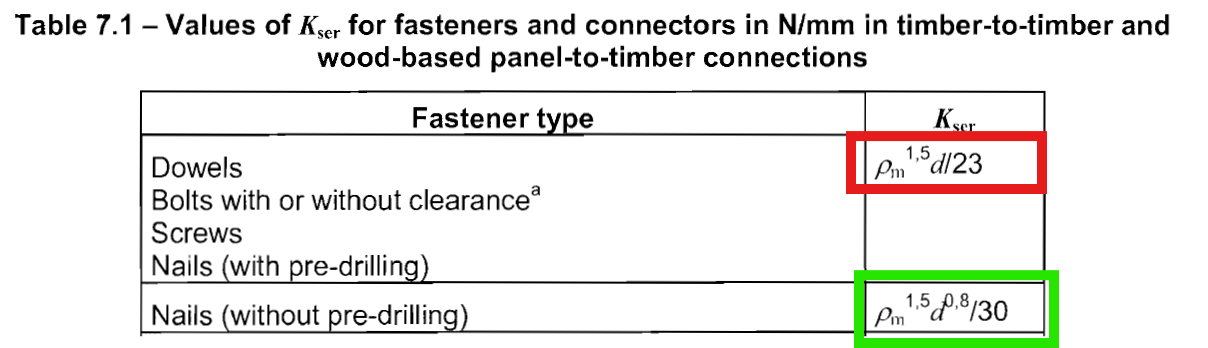
- Are any formulas from Eurocode 5, Table 7.1, used internally to calculate the translational and/or rotational stiffness of the line hinges?
- Manual definition and calibration of line hinge stiffness (EC5-based)
I am trying to calibrate the numerical model to reproduce as accurately as possible the results of a laboratory test.
The following aspects are already correctly defined:
- Material properties
- Geometry of the panel
- Cross-sections of the members
The remaining uncertainty lies in the connections, which is where I still have some freedom to adjust the model.
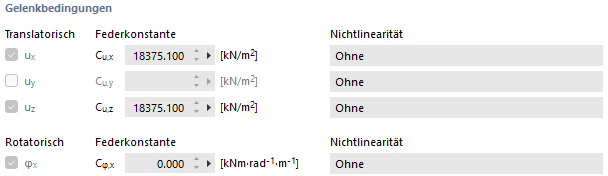
For that reason, I cancel the generated state. However, I would like to better understand how a line hinge is defined mechanically in RFEM.
At this stage, I am not sure whether it is appropriate to use the formulas from Eurocode 5, Table 7.1, for this purpose. Therefore, I would appreciate your opinion on the following points:
- Which approach is recommended to define the stiffness of a line hinge representing a bolt or a group of bolts?
- Whether EC5 Table 7.1 can be used to derive equivalent spring stiffness values, or if another methodology is more suitable.
- How such stiffness values should be implemented in RFEM (e.g., springs, line hinges, etc.).
Thank you for your support.