Uplift due to groundwater in buried open-top water tank

Hi everyone,

I am currently modelling an open-top water tank buried in the ground using the modulus of subgrade reaction method in RFEM.

I am trying to check the uplift condition due to groundwater. For this, I have applied the groundwater uplift pressure as a separate load case and then combined it with the self-weight of the structure in a load combination to evaluate the uplift stability.

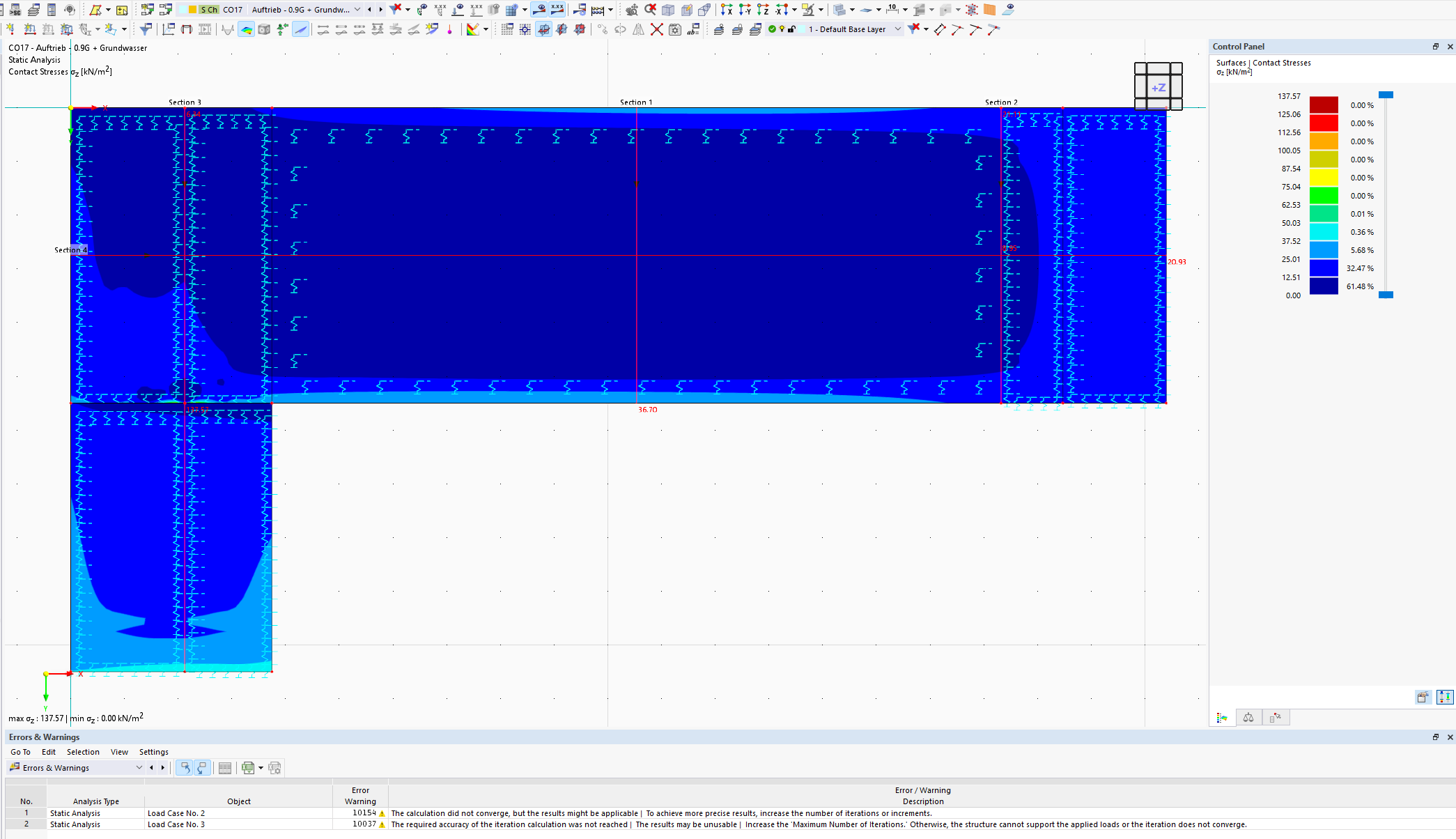
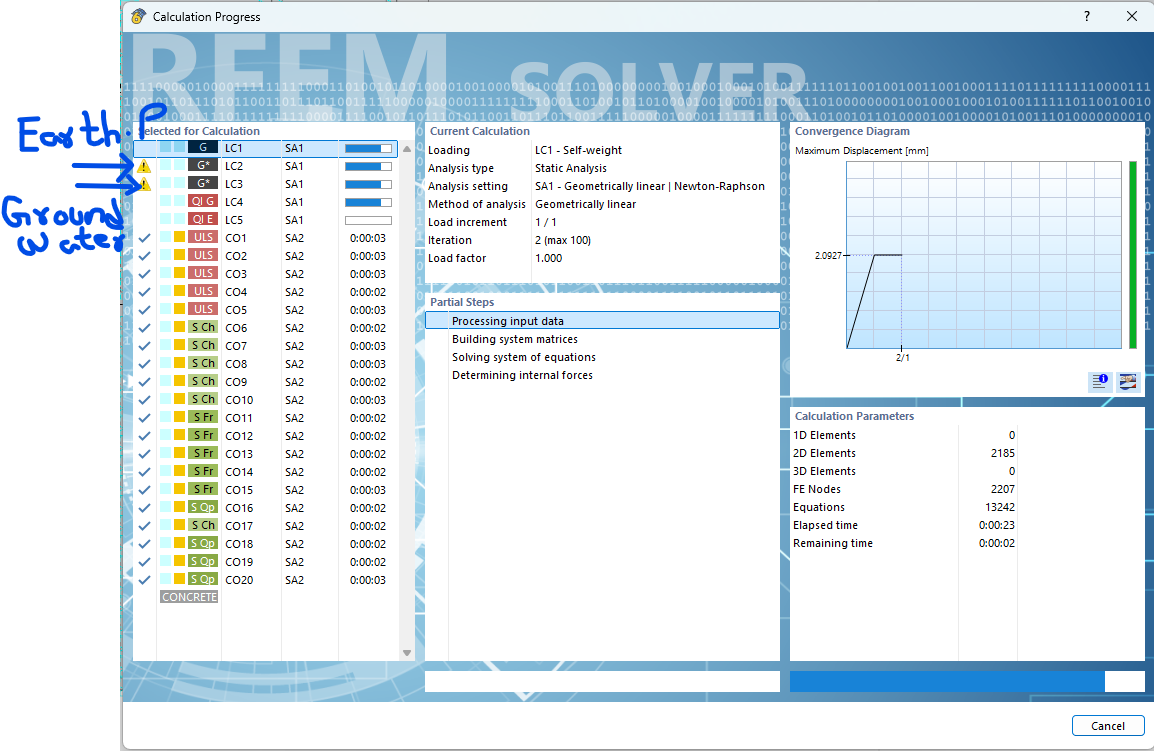
However, when I run the model, RFEM shows warning triangles in the load cases related to lateral earth pressure and groundwater uplift. Despite these warnings, the results appear to be approximately 80 to 90% consistent when compared with another FEM package.

Has anyone experienced a similar issue in RFEM? Could you please advise what these warning triangles might indicate and how to properly model or troubleshoot the groundwater uplift and lateral earth pressure cases?

Any suggestions or guidance would be appreciated.


RKB Rev.00.rf6 (1.1 MB)

Thank you.

Thanks for your question! :slightly_smiling_face:

In a nonlinear analysis, it doesn’t really make sense to evaluate the load cases on their own. They always act together with the self-weight (permanent load), so you should not consider them separately.

For your specific case:

  • Load Case 3 (groundwater uplift):
    In this load case, there is no opposing force included, so the uplift acts without counterbalance. After the analysis, it’s important to check the resulting deformations to properly assess the behavior.
  • Load Case 2:
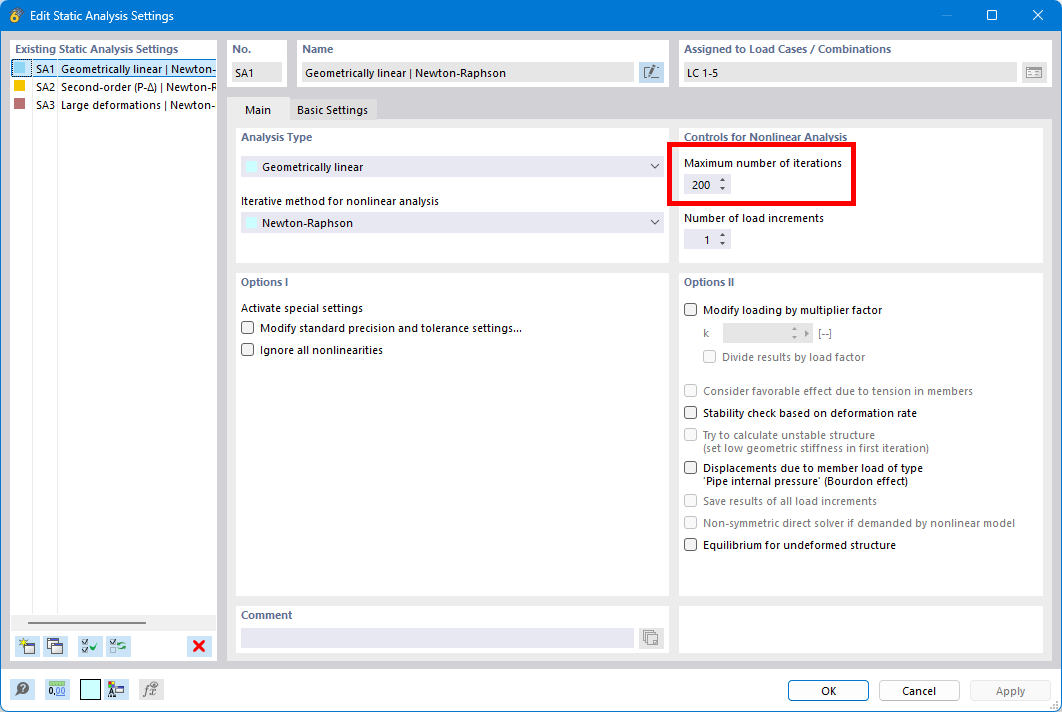
    This load case converges successfully when you increase the solver effort to 200 iterations:

1 Like

Hi Gerhard,

Thank you very much for the clarification and looking into the matter. :slightly_smiling_face:

In that case, I will activate the self-weight of the structure together with the groundwater uplift load case, so that the uplift is not acting without any counteracting permanent load.

However, I have one further question regarding the load combinations. If I include the self-weight directly in the groundwater uplift load case, then in every load combination where I use this groundwater uplift load case, I would need to subtract the self-weight so to avoid doubling the self weight of the structure.

Is there any option in RFEM to handle this automatically, so that the self-weight can be considered together with the uplift load case for the nonlinear analysis without being counted twice in the final combinations, as this would avoid editing a list of combinations which is otherwise quite time consuming?

Also, I believe the same issue would apply to uplifting wind load cases on foundations with multiple supports. In such cases, the self-weight would need to be activated together with the uplifting wind load case to obtain a realistic nonlinear behaviour.

However, in the load combinations, the self-weight is treated as a permanent action, while wind is treated as a variable action, with different partial safety factors. Therefore, when wind is the leading variable action, it seems that I would need to deduct the additionally included self-weight, for example self-weight × 1.5, from the combination to avoid double counting.

I just want to confirm whether this is the correct approach, or whether RFEM provides an automatic way to account for this.

Thank you again for your help and guidance.

Hello.

I think you are overcomplicating things.
@gerhard.rehm only meant with his statement that it doesn't make sense to look at the single load case because it will never converge.
You should simply ignore or suppress it, not add the dead weight to the buoyancy.

Regards

2 Likes

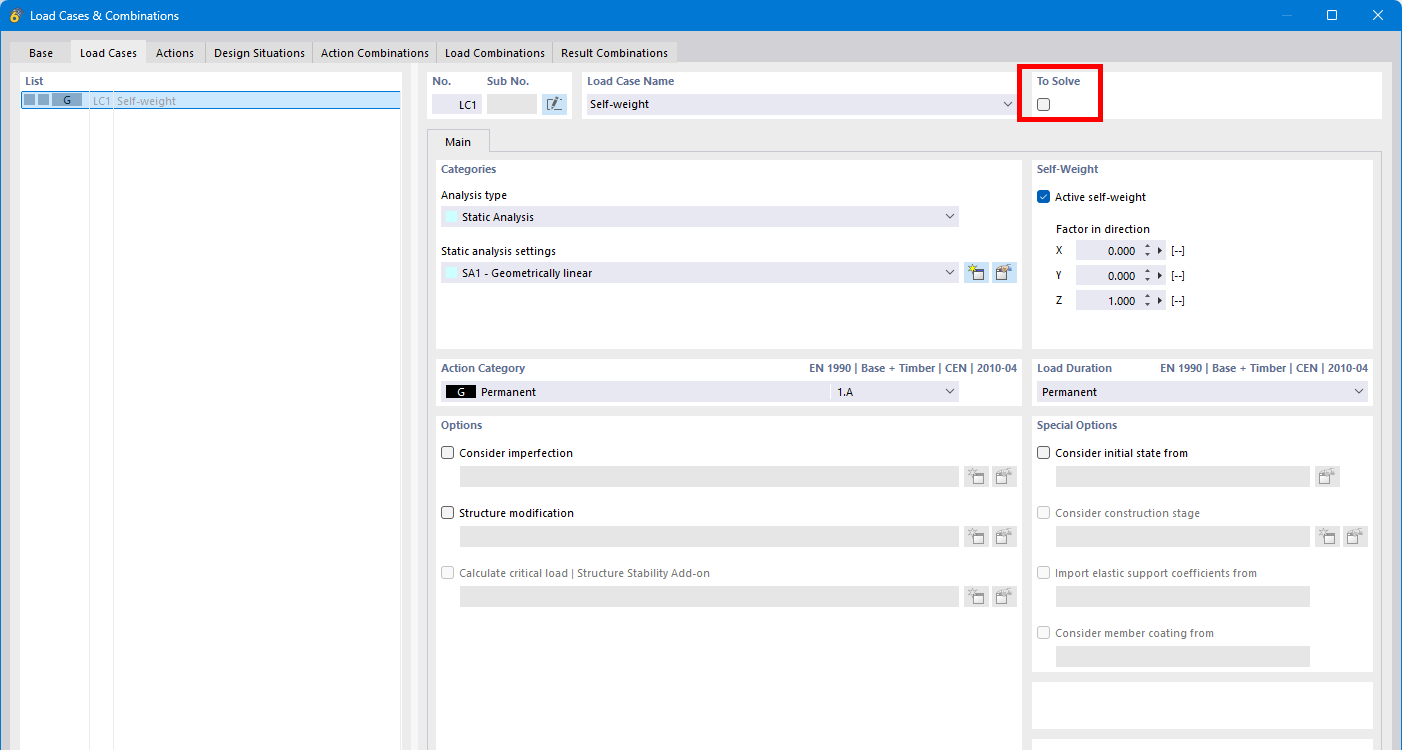
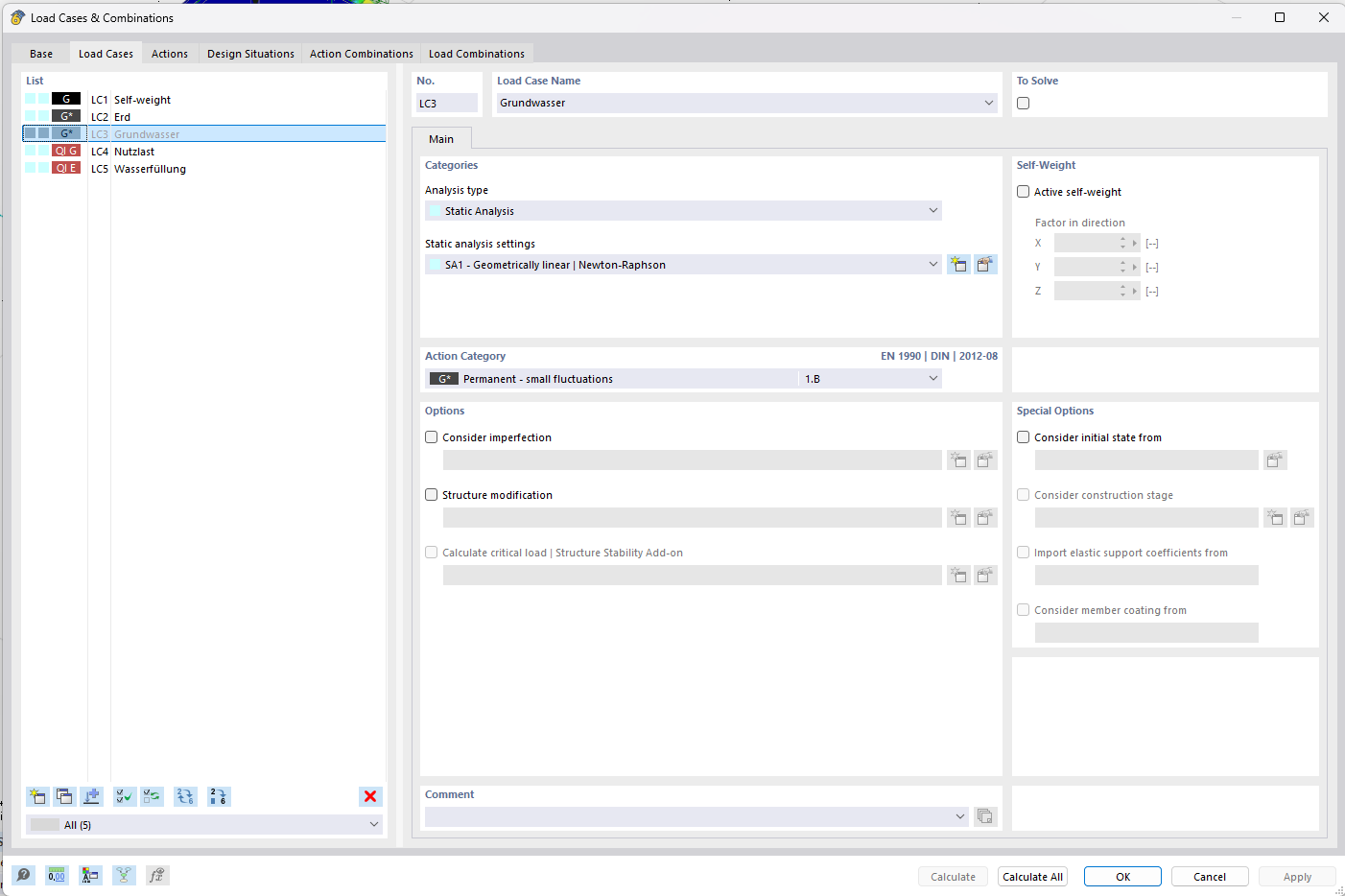
Yes exactly. Simple ignore the LC. If you want to get rid of these LC for the "Calculate all" Button image, simple deactivate the LC here:

1 Like

@Robert yes, indeed it is complicated, and that is exactly why I came here to the community, as I am still a beginner user of RFEM.

Logically, I understood the approach, and I had already been practicing and implementing the same concept for quite some time. However, I was not sure how to implement it correctly in RFEM. I have used CSI products before, so I was trying to keep a similar workflow, which I have now achieved.

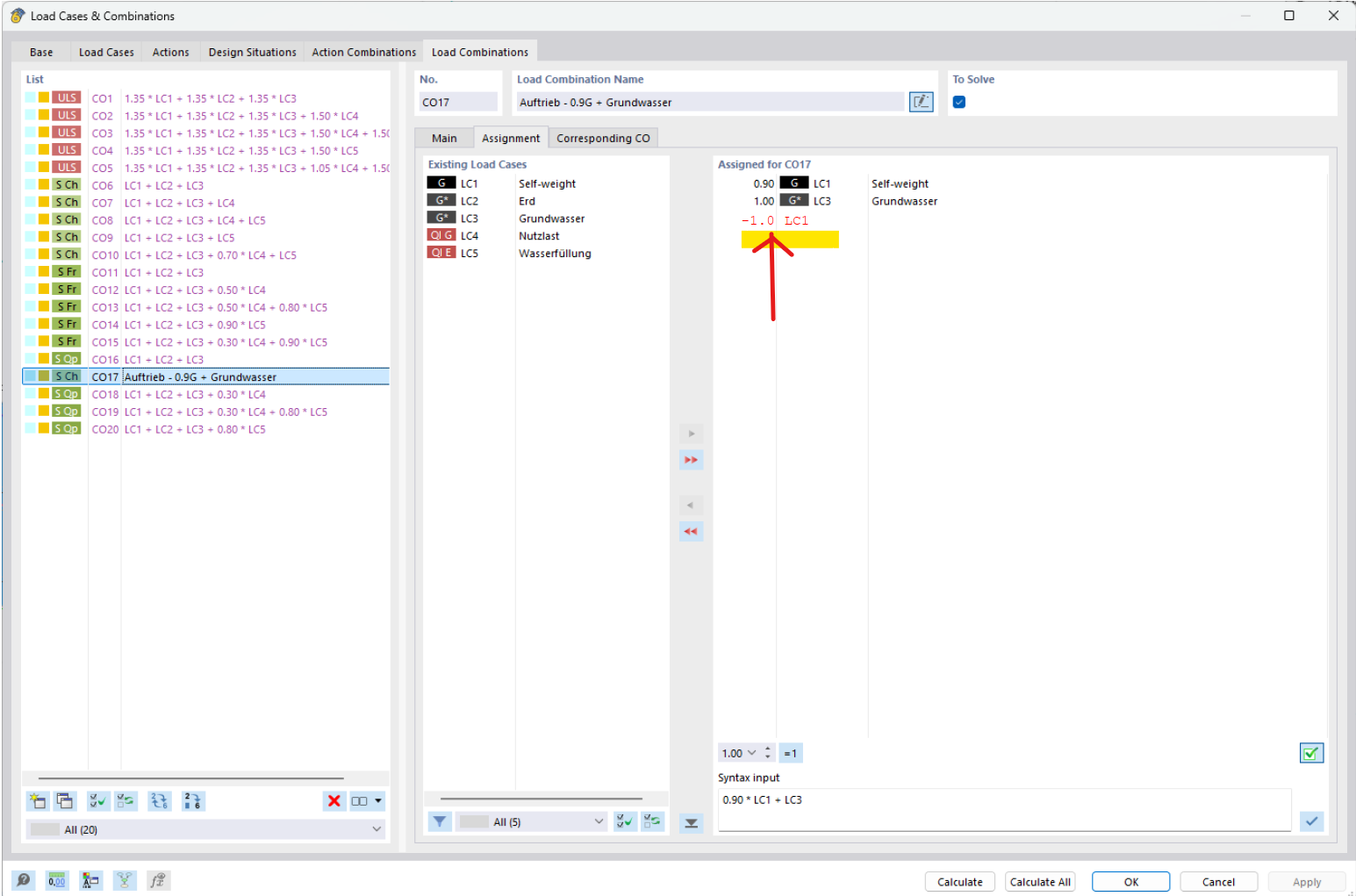
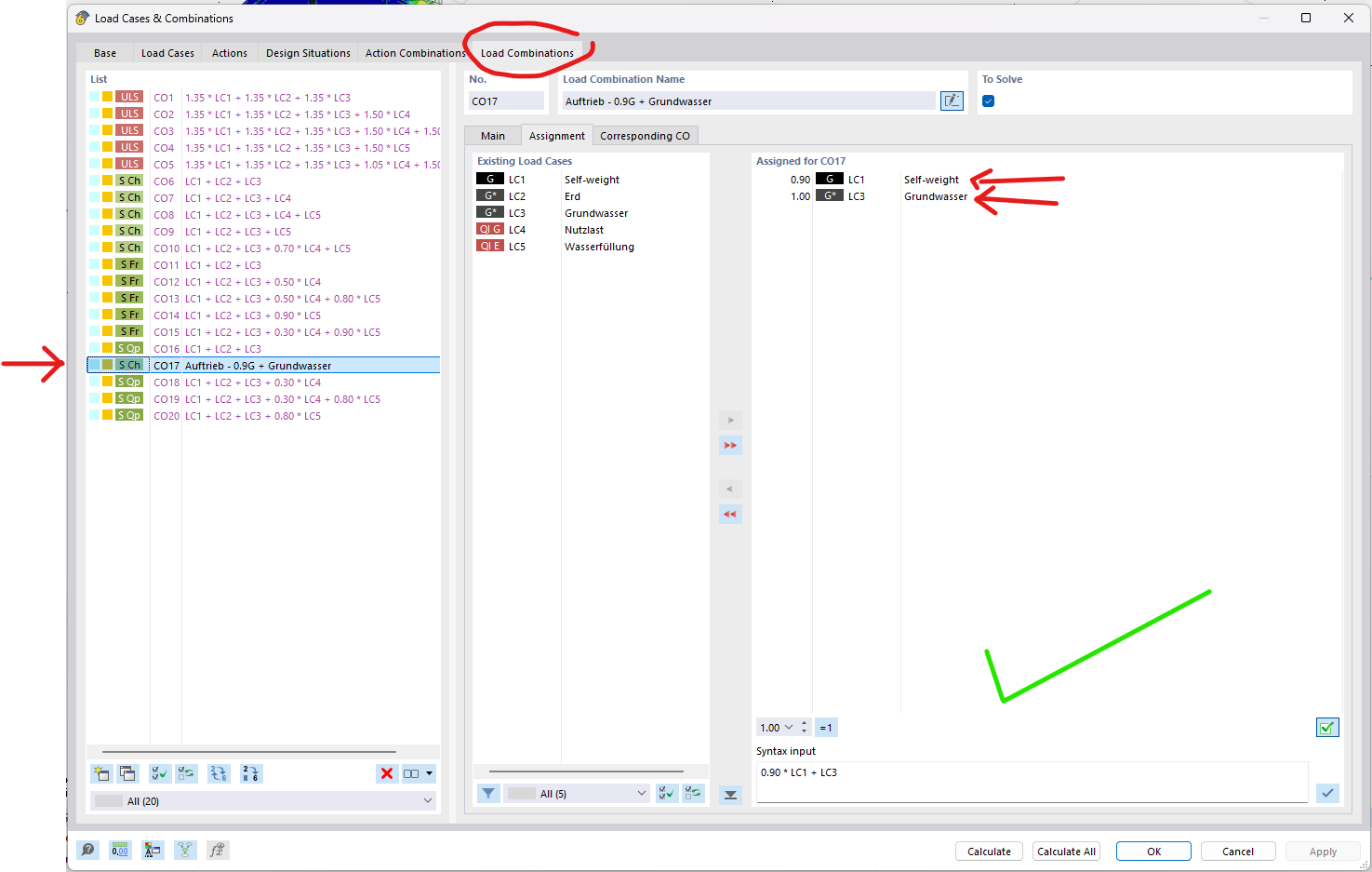
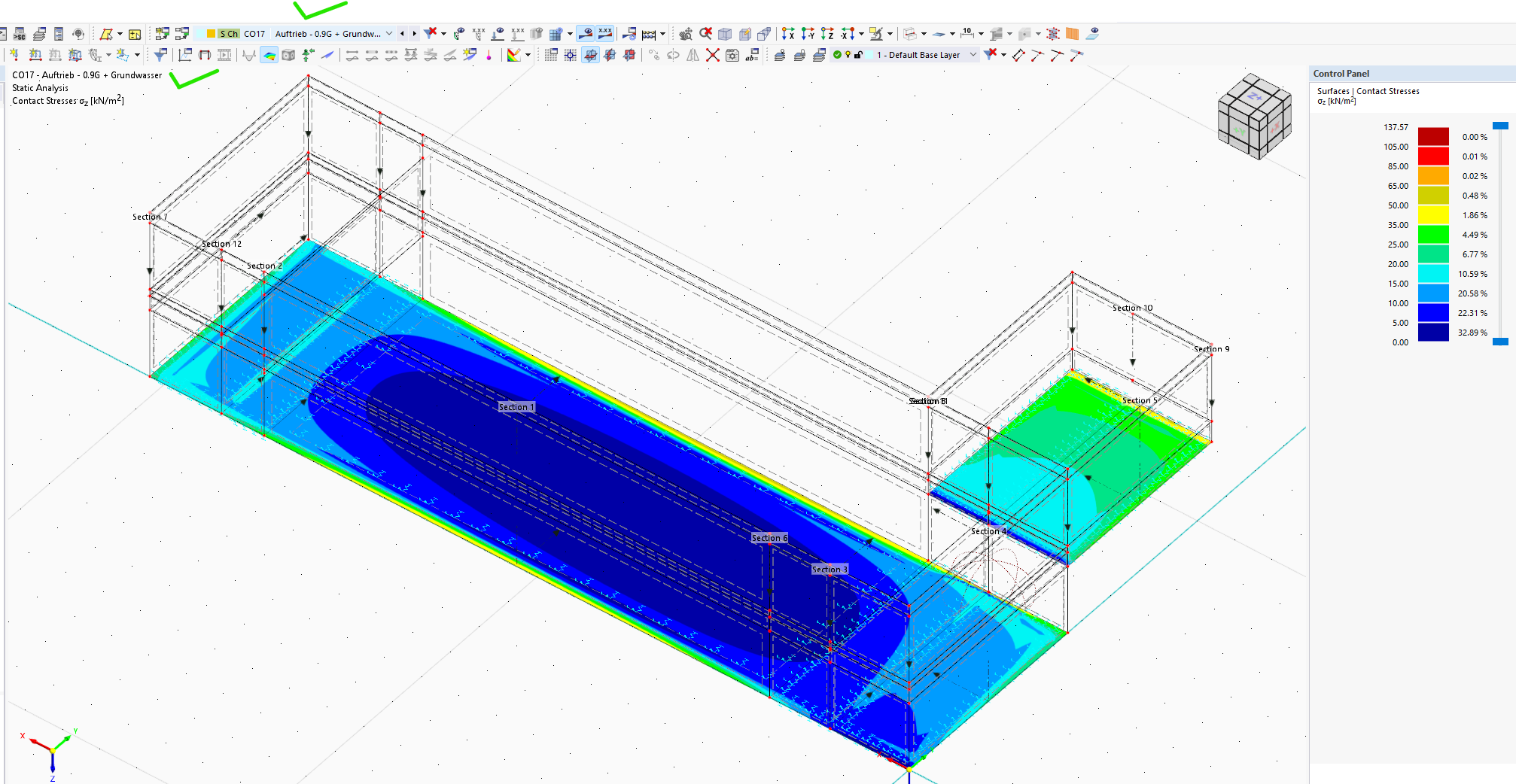
@gerhard.rehm I have now disabled the calculation of the individual uplift load case and am only solving the load combination in which I have combined self-weight, with a 0.9 factor, and the uplift load case together. This is similar to what I used to do in CSI products for nonlinear cases. Now I am getting the expected results.

Thank you both, Gerhard and Robert. The problem is now solved, and now I understand how to implement uplift case correctly in RFEM.

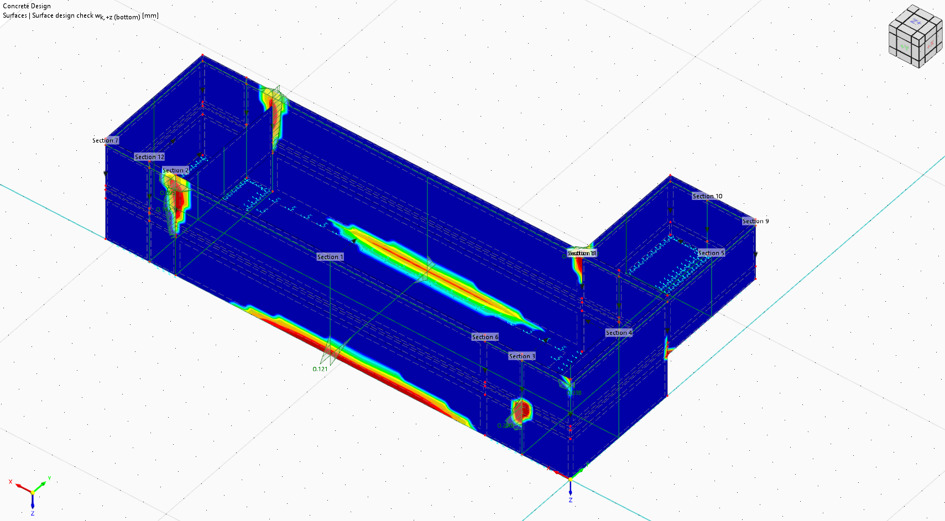
I also really like RFEM, as it has indeed saved me a lot of time and effort by allowing me to calculate crack widths and reinforcement directly in the same environment, instead of jumping back and forth between different tools to calculate reinforcement and crack widths. :slightly_smiling_face:


3 Likes