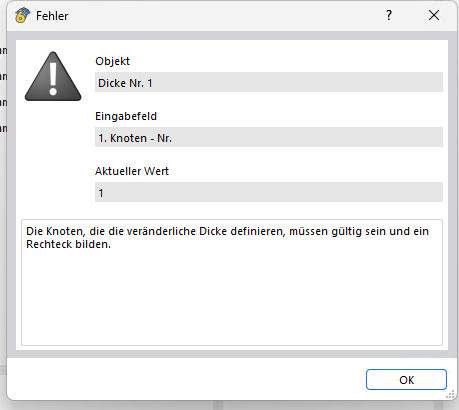
Unfortunately, it is still not possible to define variable shell thicknesses for surfaces for general Nurbs surfaces in RFEM. When attempting this, the following error message appears:
In our research project, we are working on concrete shells with variable cross-sections, which unfortunately we cannot calculate with RFEM. Would it be possible to implement this feature soon?
Best regards, Rudolf Neumerkel
1 Like
Of course, the implementation with Grasshopper would be interesting…
1 Like
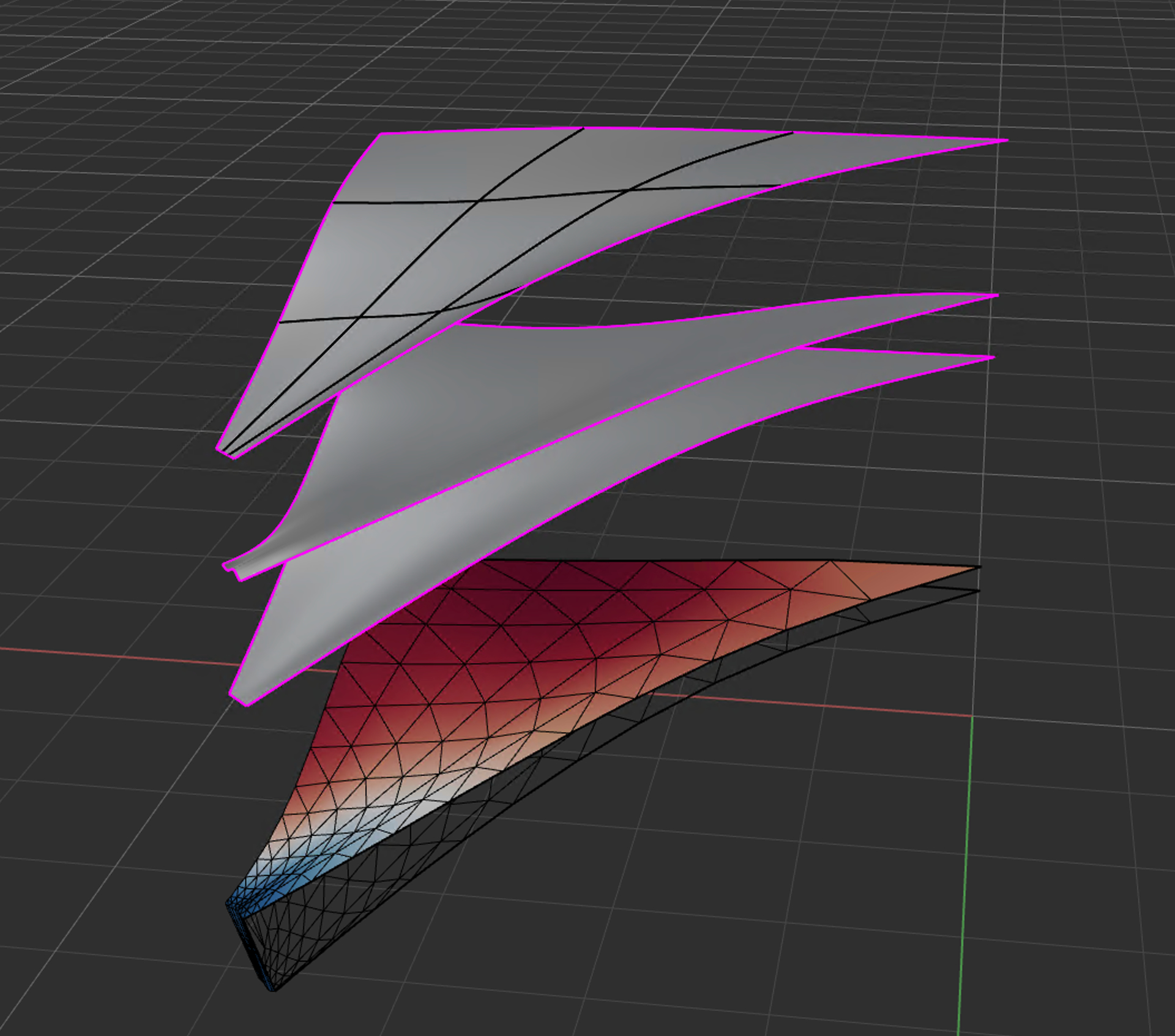
I would like to define concrete shells with variable thickness. Currently, I control the thickness distribution via inteRSECTION values with NURBS curves (logic in Grasshopper).
In principle, it would be sufficient if I could define variable shell thicknesses for the NURBS surfaces, see at the very top of the image
Hi vform_rudi,
Thank you for your request. We will try to consider this request in future development.
I would be very grateful if you could share your Rhino/GH file. You can also send it to me via direct message: click on my profile picture or user name → Message.
Best regards
Paul Sivolgin
1 Like
I still need to create a minimized version of the script… currently, the script is not cleaned up.
But simply put, the implementation of the already existing function variable shell thickness with 4 points for NURBS surfaces is urgently needed.
@paul.sivolgin, is there any progress regarding the definition of variable shell thicknesses?
We would like to model such shell structures with variable shell thicknesses.
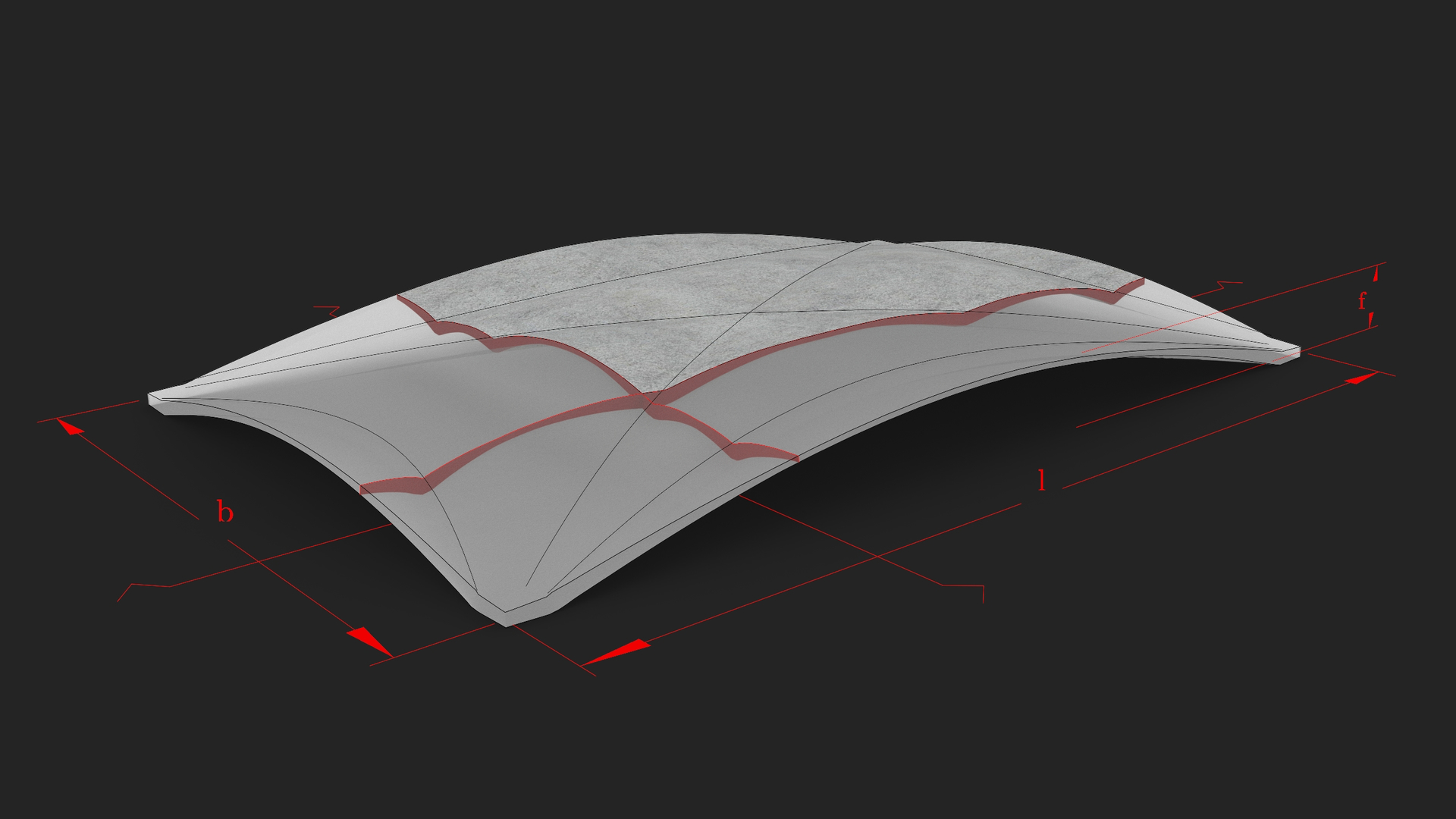
The shell would of course be defined, as shown in the previous answer, by several NURBS surfaces. At the corner points of the NURBS surfaces, I would like to specify the shell thicknesses, which should then be interpolated linearly along each NURBS surface. Just like it currently works with planar surfaces, only these are curved...
We currently have a research project and three theses running on this and cannot use RFEM at the moment.
Otherwise, would there be a workaround using the RFEM API as an interim solution?
Best regards,
Rudolf Neumerkel
Dear @paul.sivolgin, I have created a minimized example here.
The goal is simply the applicability of variable shell thickness to non-planar surfaces. I would like to be able to specify shell thicknesses at the respective 4 corner points on Breps made of NURBS surfaces ONLY. As with the variant for planar surfaces, the shell thicknesses should simply be interpolated locally linearly (along the curved surface).
variableSchalenstärkeBeispie.gh (30.1 KB)
Please give a brief feedback on whether the minimal example is sufficient. A timely implementation would of course be a dream...
Please let me know if further details are required
Best regards, Rudi
Hi vform_rudi,
Thank you very much for the example. Currently, variable thicknesses in RFEM 6 can generally only be defined for planar surfaces. A workaround via the API is therefore not effective. The request has been documented for programming. The implementation naturally depends on the established development priorities. As soon as there is new information on this, I will share it.
Best regards
Paul Sivolgin
Thank you very much for the response! Is there any way to track the progress of the feature somewhere?
Could you still recommend any workaround? Currently, we are exporting hundreds of surfaces, each with a different shell thickness. Unfortunately, this makes the export very slow and, of course, results in inconsistencies in the shell thickness…
Best regards, Rudi
Hi vform_rudi,
Direct tracking of progress is not possible.
If the implementation takes place, it will be visible in the Extranet:
 https://www.dlubal.com/de/support-und-schulungen/support/faq/005149
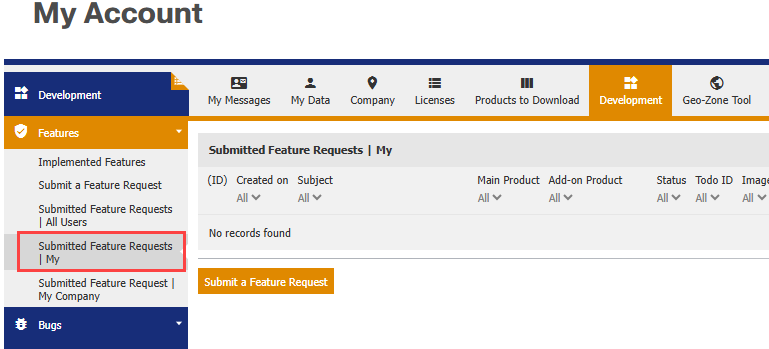
You can also submit the feature through the Extranet. This will make it visible directly in your account under "Submitted Feature Requests":
Unfortunately, I currently see no other way than to approximate this with many surfaces.
Best regards
Paul Sivolgin
1 Like