Hello,
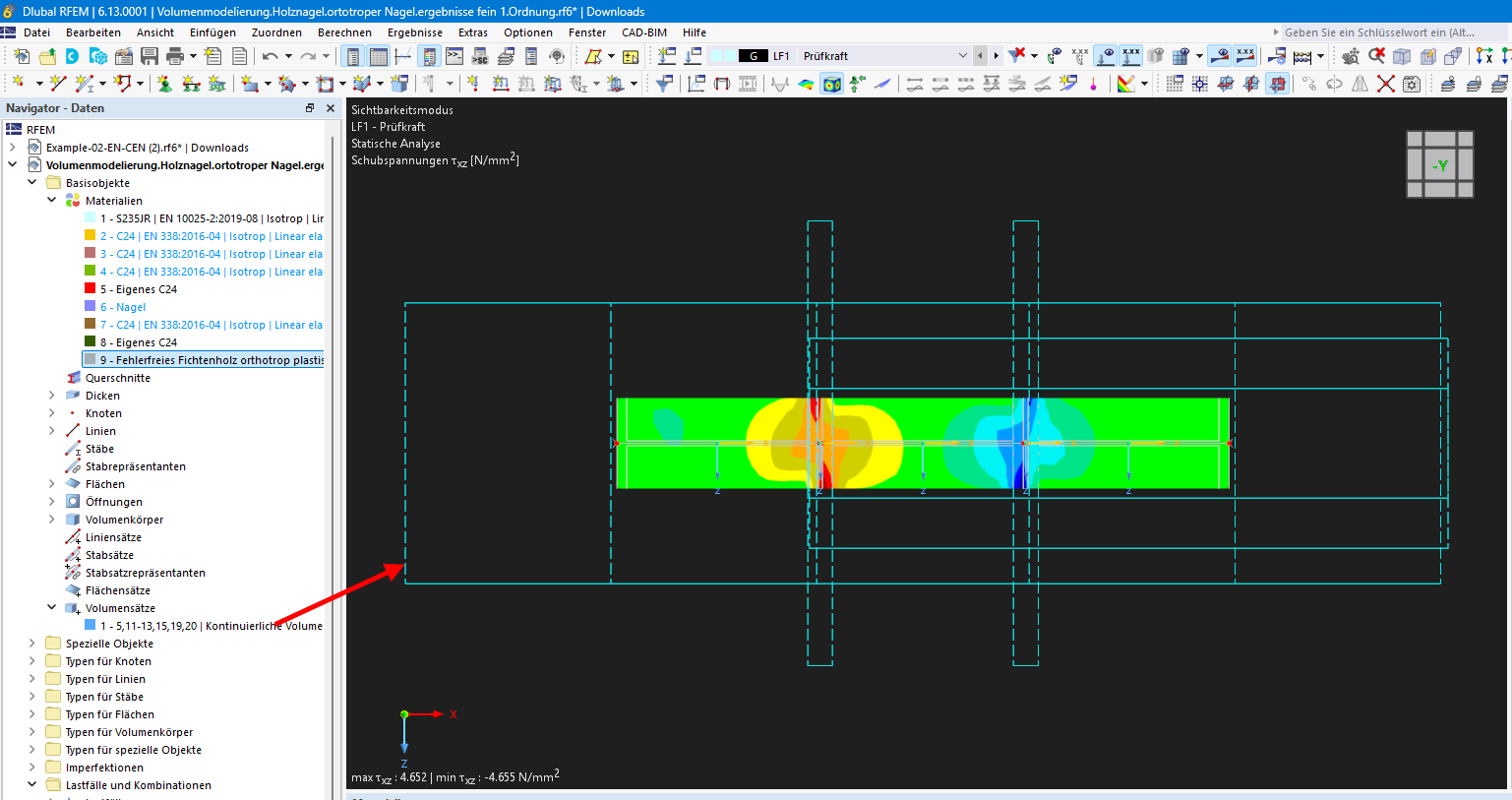
As part of my bachelor's thesis, I would like to simulate a two-sided wood joint with a spruce wood dowel. The goal of the work is a comparative simulation of real test specimens. I have already started a few modeling attempts and have encountered some obstacles.
Since the wood dowel is modeled as a contact volume, I can only work with surface contacts between the woods, as contacting contact volumes to each other do not work, is that correct?
Is there a way in RFEM 6 to calculate a maximum system load?
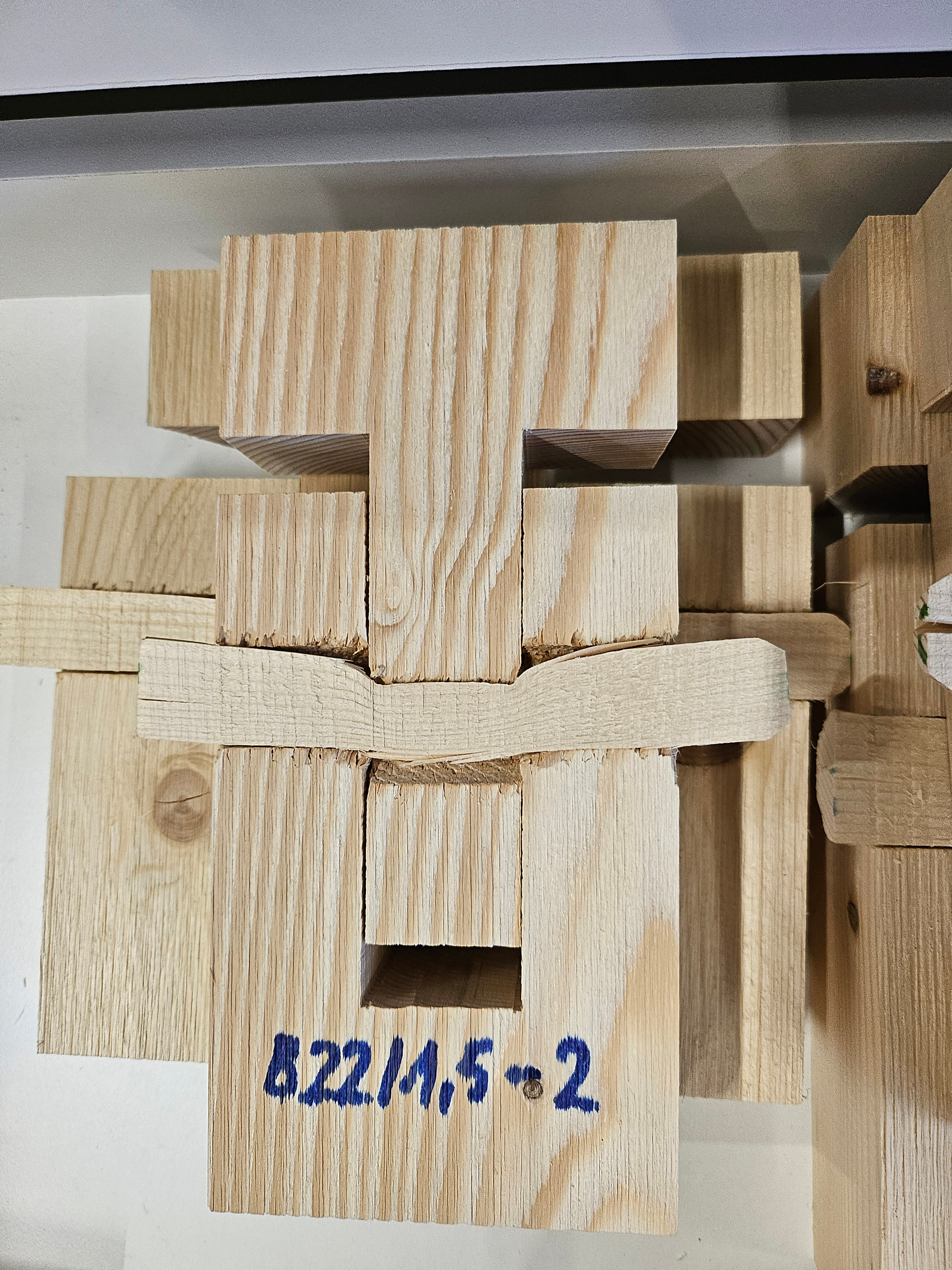
Thank you very much in advance for any feedback. I am uploading the file and a test specimen image. Best regards, Vinzent Halbig
Volumenmodelierung.Holznagel.rf6 (2.0 MB)
Hi Vinzent  ,
,
you correctly recognized that you cannot apply surface contacts to surfaces that lie exactly on top of each other. However, you have two options:
-
Define a very small gap to model the connection.
-
Use surface releases – this allows you to define coupled surfaces at the same origin.
You can calculate the branch loads using the Structural Stability add-on.
Further information can be found here:
 Manual: RFEM 6 | Strukturstabilität
 Webinar: Webinar | Traglastuntersuchung von Systemen auf maximale Beanspruchbarkeit
Best regards
Eike Hartmann
Hello,
when entering with a very small gap, using orthotropic material properties for the nail, the representation of the shear stress distribution does not seem plausible to me. The distribution is identical with changed material properties.
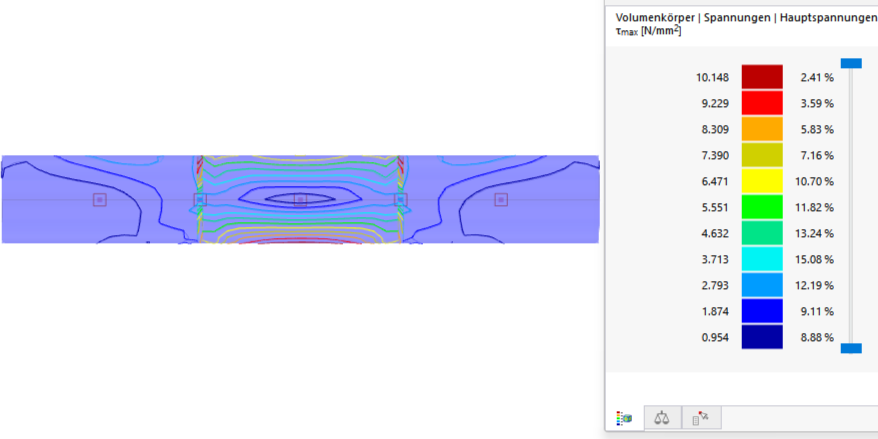
How can I improve the model in this regard? Or is modeling with surfaces and frame structures, similar to the steel connection details, perhaps more effective?
The volume file has been uploaded to the Dropbox folder.
Thank you very much for any information,
Vincent
https://www.dropbox.com/scl/fo/4b2ufb7j510h8vjkmgquw/AMmxqkkWkUdp9mFqLVbWiB4?rlkey=12aiq8jamyngzap79ox7vf3x6&st=8ft4t44f&dl=0
Hello Vinzent,
You are looking at the volumetric shear stress tau_max, which is determined according to Mohr's circle of stress:
https://www.dlubal.com/de/support-und-schulungen/support/formulas/001048
The shear stresses in Mohr's circle are the maximum shear stresses that arise from the combination of normal stress (due to the bending moment) and shear stress (due to the transverse force).
I assume you are interested in the "direction-based" transverse force. For this, look at the principal stress tau_xz. Due to the short volumetric bodies at the third points, it is advisable to form a volumetric body set so that smoothing through the volumes works: