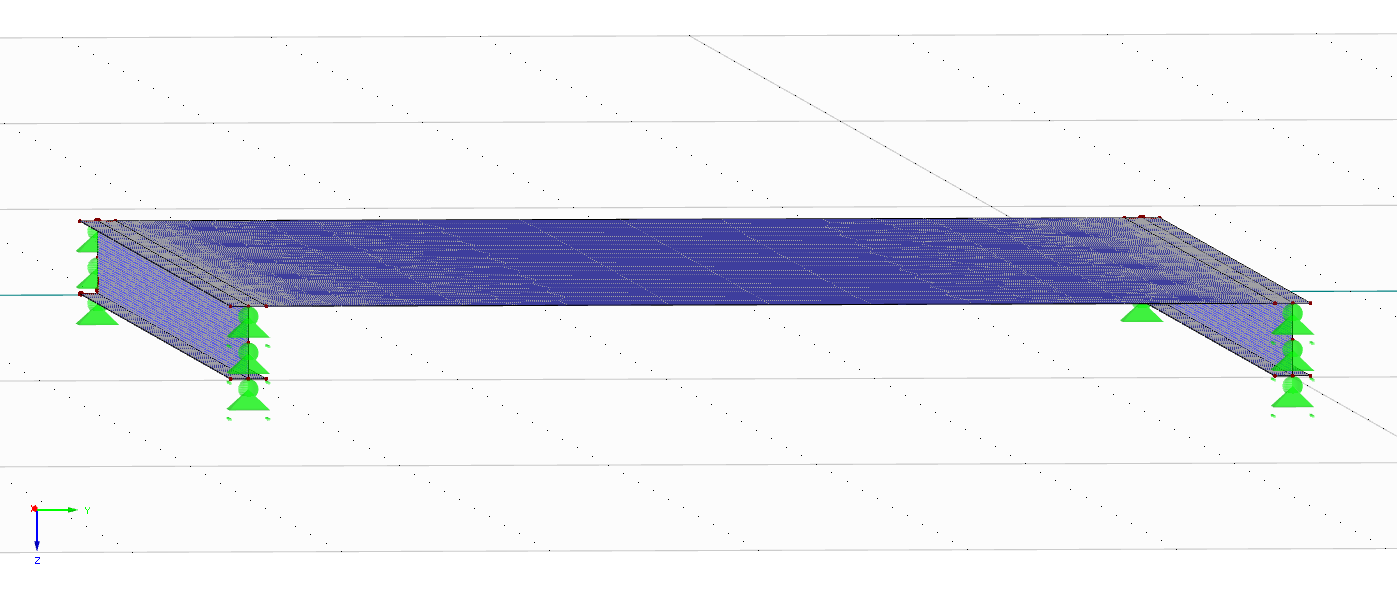
In addition, I am investigating the stabilization of a beam by means of a trapezoidal sheet acting as a shear panel between two beams.
My focus is solely on correctly capturing the stiffness of the trapezoidal sheet. According to the information on your Dlubal website, the trapezoidal sheet is to be modeled as an orthotropic plate, which I have implemented accordingly.
I have the following questions:
How can I consider the coupling between the beam and the trapezoidal sheet when the trapezoidal sheet is attached at every rib?
How can I best represent the support point of the beam as a fork support (beam decomposed into surface)?
How can I determine the eigenvalue or the branching factor of the beam to calculate the bending-torsional buckling moment and compare it with beam theory? (Here, usually in the investigation with RF-Stabil, the eigenvalue of the trapezoidal sheet is shown.)
How can I consider the coupling between the beam and the trapezoidal sheet if the trapezoidal sheet is fastened at every rib?
How can I best model the support point of the beam as a fork support (beam decomposed into surface)?
How can I determine the eigenvalue or the branching factor of the beam to find the bending-torsional buckling moment and compare it with the beam theory? (Here, mostly in the investigation with RF-STABIL, the eigenvalue of the trapezoidal sheet is shown)
Gladly – I will answer you chronologically
1) Modeling as an orthotropic plate
If you model the sheet as an orthotropic plate, the behavior can only be represented meaningfully to a very limited extent.
The ribs are not considered, and the connection is ultimately only represented in a "smeared" way again.
The line supports must be defined so that they represent a fork support in the degrees of freedom.
Currently, we do not have a direct example that we can provide you.
With RF-STABIL you can also determine the eigenvalues for the surface model.
What exactly you mean by the comparison with the beam model is not quite clear to me at this point
If you can explain that a bit more precisely, we will gladly look at it together